
[ad_1]
The frontier state of Assam – incidentally the land of my birth – is today seething with animosity, fear and resentment. It is tearing apart. Assam Chief Minister Himanta Biswa Sarma has done all he can to weaponise the legitimate anxieties of the Assamese people concerning indigeneity and land, to manufacture and stoke hatred against Assamese Muslims of Bengali origin. This is a community that is both a religious and linguistic minority in Assam. He constructs them as the foremost enemy of the indigenous Assamese people.
The parallels that he draws with Israel are particularly telling. Indigenous Assamese people, who he says are in a minority in 12 of the state’s 35 districts, should learn from Israel ways to survive and prosper despite being surrounded by “enemies”. He declared at a programme to commemorate the martyrs of the Assam agitation of the 1970s and ’80s, “I would urge Assamese to learn from Israel. In the Middle East that country is surrounded by Muslim fundamentalists. With Iran and Iraq as neighbours, Israel with a small population has become an impregnable society…”
What he unfailingly glosses over is that the Assam agitation was never a struggle against people of any religious identity. It opposed Bengali immigrants in Assam, agnostic if they were Hindu or Muslim. The Assam agitation and the Assam accord of 1985 made no distinction between Hindu and Muslim “foreigners” residing in Assam because, as Sangeeta Barooah underlines “the popular anxiety was about Axomiya identity, a regional sentiment, hinged on the fear of losing their home, hearth and language to ‘outsiders’ from Bangladesh, both Hindus or Muslims”.
Sarma instead portrays just Assamese Muslims of Bengali origin as the dangerous “other”, the “infiltrator”, the enemy that threatens the future of the people to whom Assam rightfully (and exclusively) belongs. This is a profound shift transforming an ethno-nationalist movement to a stridently communal one, targeting only people of Bengali origin of Muslim identity. He has gone so far as to direct the Foreigners’ Tribunals to drop all cases of Hindu Bangladeshis who entered Assam until 2014, and pursue cases only against Muslims.
Take his Independence Day speech while raising the national flag. He chose this occasion to passionately warn that the state’s indigenous identity is facing its greatest-ever threat from “illegal infiltration”. He urged every indigenous Assamese to stand together to protect their land, culture, and way of life.
“This is not just a political issue, it is a battle for our very existence,” he pronounced. “If we remain silent, within the next decade we will lose our identity, our land, and everything that makes us Assamese”. He added that the state was facing various forms of “jihad” – from love to land – which he claimed were aimed at weakening indigenous control. “This is the biggest challenge Assam has ever faced. Our fight today will inspire the next generation to keep our identity alive.”
His speech in many ways echoed that of the prime minister from the Red Fort. Prime Minister Narendra Modi warned the nation about a “well-thought-out conspiracy” to alter India’s population composition. “These infiltrators,” he alleged, “are snatching the livelihood of the youth of my country. They are targeting our sisters and daughters. They are misleading the Adivasis and grabbing their lands. This will not be tolerated.”
He added, “No country can surrender before infiltrators. Then how can we?”
For both Sarma and Modi, the highly emotionally loaded appellation “infiltrator” signals Muslims alone. For them, Bengali Hindus who might have crossed the border are never infiltrators. They are refugees escaping persecution, for whom the doors of Hindu India must always stay wide open.
The threats posed by this “enemy within”, and their alleged sinister conspiracies or jihads against the indigenous Assamese people has been the staple of Sarma’s politics. He goes so far as to describe Assam’s Muslim majority districts as “mini-Bangladesh”. “Today you see in the neighbouring Bangladesh, where 35% of the population was Hindu, today the number of Hindus there has become 8%, the temples have been demolished”. He speaks of these dangers looming in Barpeta, Morigaon and Dhubri districts. Dhubri just has 12% Hindu population, only a little higher than Bangladesh’s 8%.
He makes the fallacious but potentially incendiary claim that the Muslim population in Assam has skyrocketed from 12% in 1951 to 40%, threatening the state’s identity. However, his resort to scare-mongering is not based on fact. To begin with, in the 1951 census Muslims comprised 24.68% or nearly a quarter of the population. This rose to 34.22% in 2011. Since then, there has been no population census, therefore there are no scientific grounds to estimate a rise of Assamese Muslim populations to 40%.
This “changing demography” of Assam, he pronounces, is a “matter of life and death”. Because of the rise of Muslim population, he says that people from the community are visible in almost every sphere of life. “If you travel in app cabs in Guwahati, you will find that nine out of 10 are from one particular religion.”
He further suggests that it is only fear of the government machinery backed by police and military that keeps “some people” in check. It is because of this Hindus of the state are protected. He takes personal credit for this: “Our temples and women are safe because everyone knows whose government is in Assam.” He warns, “The day that fear is broken, we will see the scene in Bangladesh today everywhere in Assam except [the Hindu majority] upper districts of Assam. And that is the real truth of our lives.”
He presages forebodingly a “dangerous dark future”. He claims that by 2041, Assam would become a Muslim-majority state. “It’s a reality and nobody can stop it.” He warns that after two decades, the Independence Day flag would be hoisted by “an unfamiliar chief minister”. “Our holy country, our Hindu nation and our religion are under threat. They are planning to sell, convert and destroy our country.” Once again it is clear that for him, Muslims do not belong to “our” country.
He frequently charges Muslim minorities in Assam of engaging in so-called land jihad and love jihad, which the state must crush decisively. He alleges that lands belonging to indigenous people in Assam are being acquired by “a specific community” and announced plans for a new law to regulate land sales between religious communities.
The proposed legislation would restrict sale of land between people of different faiths without the prior permission of the state government. Communist Party of India (Marxist) leader Brinda Karat describes the proposed legislation as “absolutely outrageous”. But Sarma is adamant, saying “People from a particular community kept snatching land from our indigenous people there and today we are in the minority in our own land.” His use of the words “we” and “our” are telling because these excludes Bengali-origin Muslims.
Also, he had announced that the state government would soon introduce a new law mandating life imprisonment for those convicted of “love jihad”. This became necessary, Sarma claims, because Muslim men marry Hindu girls by impersonating Hindu men on social media. “In Assam, this is rampant,” he said. “People put their Hindu names on Facebook, lure a girl and after marriage the girl discovers that the boy is not the same boy whom she married”.
He also reveals plans for a new domicile policy that restricts state government employment only to Assamese-born persons.
In another swipe at Muslim residents of Assam, the Assam Legislative Assembly officially amended the rule going back for decades providing for two-hour break on Fridays to facilitate Muslim legislators to offer Fridays prayers.
These decisions all aim at “protecting the rights of indigenous people”.
He often resorts to communal hate terminology. Madrassas he said are “factories for manufacturing mullahs” which the government should shut down, and the Muslim population are “Babar, Akbar and the Aurangzeb”.
He does not even balk from openly inciting violence. Speaking to Hindu youth, he says, “The young [people] present here, I know these are the days that you should eat and play, but these are also the days that you should pick up swords.” Defying the Constitution, he exhorts, “Only vote for those who promise that they will declare India as a Hindu nation.” In an election rally in Jharkhand he declares, “I ignite fire against infiltrators. Lord Hanuman had also set fire in Lanka. We have to set fire against infiltrators and make Jharkhand a golden land.”
Not just land and love jihad. He never tires of charging Muslims with many other “jihads” as well. Some of these conspiracy claims are so fantastical that they sound like spoofs, except that Sarma is dead serious. When Guwahati was submerged in flood waters, for instance, he laid the blame on “flood jihad” waged by a private university of Meghalaya which, he claimed, demolished hills on its campus leading to large-scale water logging in Guwahati. (This incidentally was the only private university in the North East to find a place in the top 200 in the National Institutional Ranking Framework 2024 released by the Union Ministry of Education.)
In exasperation, Congress MP Gaurav Gogoi posted on social media, “Can someone stop the Chief Minister of Assam Himanta Biswa from his jihad of repeated nonsense?” Sarma however was unfazed. “What they are doing is the ‘baap’ of jihad. Jihad is too small a word for it,” he said. He also derided the university entrance’s domed structure which he said is reminiscent of Mecca, claiming this posed a threat to Assamese culture and heritage.
When prices of vegetables and fruits soared, again he claimed this to be the result of a jihad by Miya Muslims. Recently he appealed to Assamese people to avoid buying fish produced by “Miya Muslim” fish producers, claiming that they excessively use urea that causes kidney diseases. He tauntingly urged Assamese to rear pigs because “that’s something Miyas won’t steal.”
“I will take sides”, he declared defiantly in the state assembly. “What can you do about it …So that Miya Muslims can take over Assam? We won’t let it happen.”
Apart from Muslims of Bengali origin, the other “enemy of Assam” constructed by Sarma is people who stand for the rights of this beleaguered community. For this reason, this writer also often finds himself frequently in the crosshairs of the Assam chief minister. On many occasions he has claimed to reporters that I played a “big role in ruining the NRC” by defending “illegal infiltrators” with the aim of sabotaging the National Register of Citizens process. Also, that I was encouraging encroachers, mostly of Bangladesh-origin Muslims, to resist and challenge the legal eviction drives of the government on tribal and forest land in the state, and that this has fuelled tensions
In the Assam legislative assembly, he announced, “During NRC people like Harsh Mander came here, and launched such a big conspiracy against Assam that no newspaper, no television could track. Harsh Mander and some so-called local Supreme Court [lawyers]… created a chain to make people Indian…And if during my days Harsh Mander would have come here, I would have put him in jail. If NRC was done when I was the chief minister – I would have done khallas – through the process of law. I would not have allowed him to mount such big … conspiracy against Assam.”
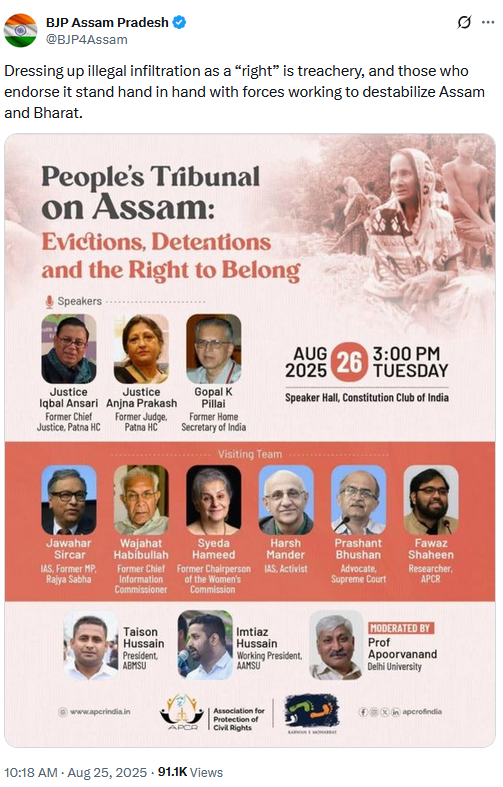
His attacks became even more shrill after a group of concerned citizens recently constituted a People’s Tribunal to travel to Assam to investigate charges of massive demolitions and evictions targeting Assamese Muslims of Bengali origin. I was one of the convenors of this tribunal. Sarma was not restrained by the fact that many members of the tribunal were people with impeccable credentials. There was a former chairperson of the National Minorities Commission Wajahat Habibullah, former member of the Planning Commission Syeda Hameed, former MP Jawhar Sarkar and leading public interest lawyer Prashant Bhushan.
Sarma alluded to “strange people” visiting Assam, alleging that their sole aim was to paint the lawful evictions as a “humanitarian crisis”: “This is nothing but a planned attempt to weaken our fight against illegal encroachers. We are alert and firm – no propaganda or pressure will stop us from protecting our land and culture.”
On our arrival in Guwahati on August 23, we were told that the state government had slapped prohibitory orders in the district that we had earlier announced we would visit. This was Goalpara, where massive evictions had taken place. Wajahat Habibullah, young lawyer Fawaz Shaheen and I decided to nonetheless travel to Goalpara. We were continuously trailed by the police and barred from visiting the sites of the demolitions. But we still met in the home of the local legislator some among the 1,600 people whose homes were demolished.
Sarma’s attacks peaked further after a heartfelt appeal for ordinary humanity by Syeda Hameed was deliberately distorted by the media and political class in Assam. When pressed by reporters for her views about Bangladeshi infiltrators, she said they too were human beings – Allah ke bande. The world should be large enough to accommodate them. Sarma took little time to claim that Syeda Hameed “legitimises illegal infiltrators”.
“They seek to realise Jinnah’s dream of making Assam a part of Pakistan,” he said in a tweet. “Today Assamese identity is on the brink of extinction because of the tacit support of people like her. But we are the sons and daughters of Lachit Barphukan, WE WILL FIGHT till the last drop of our blood to save our State and our identity. Let me make it very clear, Bangladeshis are not welcome in Assam, it is not their land. Anyone sympathising with them may accommodate them in their own backyards. Assam is not up for grabs by illegal infiltrators, NOT NOW, NOT EVER.”
At the time I write this, police complaints have been filed against Syeda Hameed in at least 15 Assam districts.
After we returned to Delhi, the members of the Tribunal assembled at the Constitution Club for a press conference to speak of their findings. Some 30 minutes into the event, a noisy mob of around 100 men stormed into the hall, shouting belligerent slogans, closely followed by reporters of many mainstream TV channels. Neatly typed placards were wrapped in bubble plastic. The management of the club – which was constituted for meetings of members of parliament – did nothing to restrain the mob. The police arrived more than an hour after the mob had dispersed.
The mob was led, by their own admission, by Vishnu Gupta of the Hindu Sena and Chaudhary Baliyan of Muzaffarnagar, Uttar Pradesh. The slogans they shouted included “Goli maro saalon ko, desh ke gaddaron ko”, “Joote maro saalon ko”, “Jai Shri Ram” and “Har Har Mahadev”. Their hectoring was directed at the dais where, apart from members of the tribunal, sat former Chief Justice Patna Iqbal Ansari, former union home secretary Gopal Pillai and public intellectual Apoorvanand. Alarmed by this, a group of young men from the audience and organisers formed a protective ring around the dais.
The tribunal continued its press conference after the group left. Syeda Hameed rose with fortitude and dignity to reveal that the threatening group brought back painful childhood memories of Partition, when mobs had swooped down on her family in Panipat.
We found later that Vishnu Gupta and his Hindu Sena have a long and colourful history of disruption and criminal conduct, with several FIRs against them for assault, vandalism, and spreading misinformation. Gupta was arrested in 2011 for assaulting lawyer Prashant Bhushan inside his chamber, detained in 2015 for making a false complaint about beef being served in Kerala House, and again arrested in 2016 for vandalising the Pakistan International Airlines office in Delhi. He also organised a massive public celebration of the birthday of Donald Trump. A scan of the social media also revealed that skull-capped Chaudhary Baliyan shares close ties with the chief minister of Assam, publicly posting photographs with him on social media.
Just hours before the mob disruption, the Bharatiya Janata Party’s Assam’s handle posted on X (formerly Twitter) the poster of the press conference of the People’s Tribunal with the words, “Dressing up illegal infiltration is treachery, and those who endorse it stand hand in hand with forces to destabilise Assam and Bharat.”
Sarma from his official X handle again with a poster of the press conference said, “Do whatever you can, but Assam’s soul is invincible – You will not kill our spirit this time.”
The story that emerged from our meetings with some of the evicted persons from the mass evictions in June and July in Hasila Beel, Paikan, Bethari and Ashudubu villages of Goalpara, was immensely troubling.
It was not recent forest or slum encroachments that the Assam state brought down. There was no ground to believe that the evicted families were “illegal immigrants”. Their settlements were decades old, and were served with a number of government schools, Anganwadi centres, electricity supply, hand pumps, pucca roads, police beat stations, mosques, madrassas, and markets. Among those whose houses were demolished were families who years earlier were displaced by river erosion and settled in these villages by the state itself.
Many had homes built under the Pradhan Mantri Awaas Yojana. They lived in brick and cement dwellings. The adult residents had voted in successive elections, they held job cards, ration cards, Aadhar cards, school certificates and most even had certificates of inclusion in the National Register of Citizens, confirming that they were Indian citizens. Several had land deeds, others had applied for these and these applications were pending for many years.
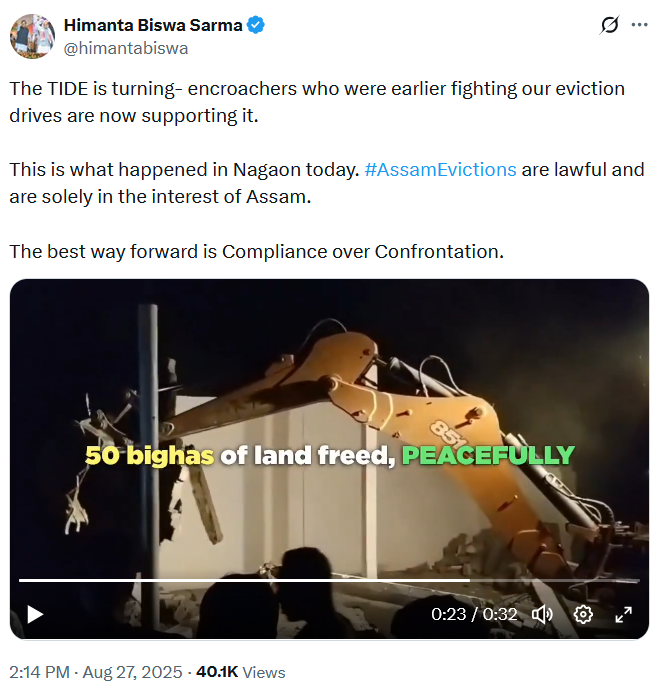
The state chose the monsoon season to evict more than 1,600 families in these three villages from their homes. No individual notices were served on them. A general notice was pasted maybe 48 hours before the eviction. Scores of armed policemen arrived with the bulldozers that razed the houses, often with people’s belongings still in the homes. People reported not even being given the time to salvage their clothes, documents and livestock. Standing crops were also destroyed. The administration also brought down government schools, Anganwadi centres, madrassas and places of worship.
The borders were sealed. The state did not allow the political opposition, media and rights groups from entering.
To add to their suffering, the state government made no arrangements for temporary relief camps or alternate housing for the thousands rendered homeless overnight. As a result, more than 1,600 families, including children, women, older and ailing people are forced to survive the monsoon fury under canvas sheets that the community erected.
One young man protesting the demolitions was shot and killed at point blank range.
It is this outrage that the chief minister tried to ensure – through his battery of intimidation and prohibitions – that we do not witness.
Just days later, during a programme to commemorate Golap Borbora, the first non-Congress chief minister of Assam, Union home minister Amit Shah lauded the drive led by chief minister Sarma against encroachments by “infiltrators”, the coded word in the BJP-Rashtriya Swayamsevak Sangh lexicon for Muslim persons of Bengali origin. “I appreciate the Assam government’s drive to clear land from infiltrators,” Shah said. “I believe no infiltrators should stay in the country”.
He said that not just forests but also large swathes of land belonging to the Satras (referring to Vaishnavite monasteries) have been “cleared from the infiltrators”. He announced that a staggering total of 1.29 lakh acres of land, mostly in five Muslim-majority districts, have been cleared.
Heartened by his praise, Sarma responded, “We will snatch the land from the infiltrators and will be given to indigenous Assamese and Indians”.
His drive would continue “until the last inch of land is snatched from the infiltrators”.
During our time in Guwahati, people often said to us that what we are seeing are simply strenuous efforts of the administration to clear the state of encroachments. These have happened in many states under many governments. You may fault the process that the state followed, but these are not attacks on a particular religious community, they argued.
However, we found that these arguments are disingenuous. Almost every one of the 1,600 families whose homes, schools and shrines have been razed are Assamese Muslims of Bengali origin. The large majority of the 1.29 acres of land that have been cleared of farmlands, homes, schools and shrines that Amit Shah so valorised belonged to Assamese people of Bengali origin. People of other identities have settlements and farmlands that fall within the same legal status, but they have been spared.
These are not ordinary “encroachment removal” drives. What is under way in Assam is a project of ethnic cleansing.
I am grateful for research support from Fawaz Shaheen.
Harsh Mander is a peace and justice worker, writer, teacher who leads the Karwan e Mohabbat, a people’s campaign to fight hate with radical love and solidarity. He teaches part-time at the South Asia Institute, Heidelberg University, and has authored many books, including Partitions of the Heart, Fatal Accidents of Birth and Looking Away.
[ad_2]
Source link