
[ad_1]
I learnt of Indranil Chakravarty’s The Tree Within: The Mexican Nobel Laureate Octavio Paz’s Years in India through a WhatsApp message sent by my friend, Abir. He added, “This book has been written for you”. Considering that author Indranil Chakravarty said during his book release that he wrote the book primarily for himself, as an act of personal homage, Abir’s comment sits well with the understanding that to write for yourself is the only legitimate excuse to write for others.
I have been reading and quoting Paz’s poetry and prose in my various writings since I was introduced to him in my college in Assam by a lecturer in English literature, the late Upal Deb, in the early 1990s. It was a proud moment when The Hindu recognised the quality of my grief and published my obituary of Paz in May 1998. The structural innovation and complexity in Paz’s poetry were initially difficult to grasp. The words appeared to be in flux, sometimes making a pause, then rushing through. Paz’s long poems read like a sea on fire, like trees not just moved by the wind, but breezing past your eyes like a moving landscape.
In the beginning lines of his first major poem, “Sunstone”, from 1957, Paz writes, “a tree deep-rooted yet dancing still, / a course of a river that turns, moves on, / doubles back, and comes full circle, / forever arriving.” Paz’s poems are forever arriving, sparked off by a sudden thought or a sensuous impulse.
Truth over ideology
Paz’s prose, both on literary and political matters, is a treat for readers who are not looking for rational and ideological fixities, closures and certainties, but are persuaded by insights that keep you thinking and wondering. That does not make his writing any less penetrating. From Paz, you discover the difference between clarity and certainty.
On a customary note, Chakravarty begins from the beginning, with Paz’s birth on March 31, 1914 in Mexico City, in the middle of the Mexican Revolution. His father was an anarchist who had joined the Zapatista movement led by the peasant leader Emiliano Zapata. Because of his father’s proximity to the peasants, Paz enjoyed the pre-Columbian delicacies they brought for him. In 1936, Paz briefly taught the children of peasants and workers in the capital of the state of Yucatán.
When Paz was 20, his drunken father was mowed down by an oncoming train. We learn the extraordinary cross-cultural detail from Chakravarty that the Mexican revolution was influenced by the Bhagavad Gita. We also learn that Paz’s father-in-law was an admirer of the Upanishads and attended talks by Jiddu Krishnamurti that moved him as much as they did Frida Kahlo, grappling with her health issues.
After a quick wedding with his girlfriend Elena Garro, Paz sailed with his new wife to Spain right in the middle of the civil war in 1937 at the invitation of Pablo Neruda and Rafael Alberti to take part in the Second International Congress of Anti-Fascist Writers at Valencia. One of the rallying points of the Conference was Federico Garcia Lorca’s assassination in August 1936 by Franco’s men.
Two things that happened during this event, highlighted by Chakravarty, serve to understand Paz’s abiding commitment to truth over ideology.
Firstly, many writers in the Congress resented Paz’s lack of political affiliation with a party. Leftwing politics is deeply suspicious of writers and artists who stay politically independent. Andre Gide’s critical revelations about the communist regime in the USSR in his travel narrative, Return from the USSR, resulted in public humiliation, leading to expulsion from the Congress by the largely leftwing group taking part in the Congress. Gide’s book is a brave, precise and damaging critique of the Stalinist state. Gide pleads for a public admission of the betrayal of the revolution: “We were promised a proletarian dictatorship. We are far from the mark. A dictatorship, yes, obviously; but the dictatorship of a man, not of the united workers, not of the Soviets. It is important not to deceive oneself, and it must be frankly acknowledged– this is not what was desired.” Gide simultaneously argued for an idea of democracy as the only way to suppress dictatorial tendencies: “To suppress the opposition in a State, or even merely to prevent it from declaring itself, from showing itself in the light of day, is a very serious thing; an invitation to terrorism.”
Paz discovered the conformism of leftwing politics from these episodes. After the Hitler–Nazi Pact of 1939, he abandoned his ties with communism. In his famous poem, “San Ildefonso nocturne” (1975), Paz wrote: “Good, we wanted good: / to set the world right. / We didn’t lack integrity: / we lacked humility. / What we wanted was not innocently wanted.” These lines are reminiscent of what Bertolt Brecht wrote in a self-critical moment in a post-World War I poem, “To Posterity”: “Alas, we / who wished to lay the foundations of kindness / could not ourselves be kind.”
Paz returned to Europe when he got the second secretary’s job at the embassy in Paris in 1945. He made good friends with Albert Camus and Andre Breton. Paz became part of the surrealist movement when it was dying. Despite that, Chakravarty affirms, Paz’s poetry “can be considered one of the last great expressions of the movement.”
Paz was sent to India in 1951 against his wishes after he had passionately campaigned for Luis Buñuel’s film Los Olvidados (The Young and the Damned) at the Cannes Film Festival, which had been earlier banned by the Mexican government. Before a heartbroken Paz reluctantly left for India, he was given books on Kabir (in Tagore’s translation), the Gita, the Ramayana and the Mahabharata. During his brief stay in Bombay, he visited the Elephanta Caves and wrote an angry poem on the vandalism of the sculptures by the Muslims and the Portuguese. In Delhi, Paz was impressed by the Mughal-style gardens. He travelled to Kashmir, Himachal Pradesh and Varanasi. He wrote: “Gothic architecture is music turned to stone… Hindu architecture is sculpted dance.” Paz was already beginning to write poems on India’s historical architecture and cultural life.
Eyes of a poet and intellectual
I once asked the eminent bilingual Indian poet, K Satchidanandan, who came to his mind when he thought of poems on India’s historical landscape? He replied immediately, “Octavio Paz”. No Indian poet in any language to date has explored the poetic potential of India’s historical and cultural sites as extensively and as passionately as Paz did. What made him do so? This book finds the answer in Latin American Orientalism. Unlike Europeans who saw India through modernist, Enlightenment binaries and colonial prejudice and power, Latin American thinkers and writers compared India to another version of themselves: an exotic place full of irreconcilable contradictions, where poverty and magic, myth and history, live side by side. European Orientalism has been critiqued by Indian scholars, but most often by using the master’s tools, privileging a scientific-rationalist approach towards Indian history and culture. Ideas of power, autonomy, and even the public value of art and culture in premodern India often slips into dominant western modes of critique that need counter-Orientalist counselling.
Paz’s critical sensibility did not make him divide the rational and fantastic, the material and the spiritual, of one thing being crudely understood as progressive and the other as regressive. He did not treat them ideologically as antithetical spheres to be either upheld or condemned. Paz was too sophisticated and nuanced a thinker to fall for the mediocre traps of late 19th-century European thought. In Paris, Paz gave his heart to early European Romanticism as much as to surrealism. Like Breton, Paz also sought to combine in his political ethic and aesthetic, Marx’s call for changing society and Rimbaud’s call to change life.
In his first, brief stay in India, Paz was disappointed by the lack of knowledge of world poetry. He wrote to a friend in Paris that no one he met in India knew of Baudelaire, and poetry meant Tagore. It is interesting to note here that Paz took Tagore’s sketches and paintings more seriously than his poetry. He found Tagore’s poetry “campy”, but found his artworks imbued “with a striking sense of violence, fantasy, and freedom.” Paz also read and admired The Discovery of India and liked its author, Jawaharlal Nehru, whom he met several times. Chakravarty suggests that Paz’s 96 masterpiece on modern Mexican history and identity that catapulted him to fame, The Labyrinth of Solitude, was probably inspired by his reading of Victoria Ocampo’s Spanish translation of Nehru’s The Discovery. Nehru’s idea of India as the civilizational “palimpsest” echoes in Paz’s use of the word “superimposed” in relation to religion and “indigenous myths”.
Paz arrived in Delhi for his second diplomatic stint in India in 1962, in the back of his divorce and bitter relations with his first wife and daughter. He was also tormented by the wounds of a torrid affair with the famous and mercurial Italian art student, Bona Tibertelli de Pisis, whose “melancholic beauty” was celebrated by Man Ray and Henri Cartier-Bresson.
Soon after he landed in India, Paz met his future wife, Marie-José Tramini (currently the French ambassador’s wife), at a party on the terrace of the Kumar Art Gallery. The painter Satish Gujral (whom Paz had helped get a prestigious scholarship to Mexico against the poor taste of the Indian establishment) shared with Chakravarty that his apartment served as the rendezvous for Tramini and Paz’s affaire d’amour. The twists of fate kept pursuing Paz’s life as Tramini suddenly disappeared without a word and Tibertelli briefly reentered his life. A chance meeting with Tramini in a Paris hotel sealed their future together. He wouldn’t have missed the role of what Breton called “objective chance” in determining the fate of his love.
After divorcing her husband, Tramini married Paz at his diplomatic home, 13 Prithviraj Road, under the neem tree in the garden. He later wrote in a poem, “We asked the neem to marry us. / A garden is not a place: / it is a passage, / a passion.” not a ritualist but an animist symbol. Paz goes into the poetic aspect of the event, imbuing the neem tree with a shared spirit of life. The task of poetry is to draw hidden meanings from things that are associated with our experience. Poetry awakens our metaphoric relationship with the world. A garden is not just a place, but a passion, because we activate it with our presence, we recreate the garden we see and breathe and walk through. The garden represents a dream where we cultivate our passion and bask in our little share on earth.
Paz’s open-air wedding was interrupted by the roar of Bengal tigers in the Sunder Nagar zoo that were not served lunch on time. A huge cobra emerged from a corner of the garden and a snake-charmer was summoned to take care of it. Chakravarty draws the civilisational connections of this naturalist script: “[If] the Bengal tigers represented India, the serpent – a prominent supernatural deity in Aztec and Mayan religions – represented Mexico. The wedding was such a Kiplingesque fantasy that one wonders if it was all real.”
There is definitely an element of what Alejo Carpentier called “lo real maravilloso”, or the marvellous real (popular as “magic realism”, a badly translated phrase to suit the Enlightenment binary between magic and realism, whereas Carpentier described Latin-American reality simply as marvellous). Paz’s passion for the garden activated forces and interruptions that revealed the unpredictable nature of our relationship with the world beyond the human.
It was in Tramini’s beloved company that Paz explored India and wrote his memorable poems of East Slope and other collections. Paz merged the style of the haiku he read in Japanese and Chinese poetry with the longer form of the lyric that he read in TS Eliot and other Western poets. His poems on the Lodhi Garden, Humayun Tomb, old Delhi, Amir Khusro’s tomb, Udaipur, Mysore, Cochin (where he wrote, “In the Christian cemetery graze / dogmatic / probably Shaivite / cows”), Madurai, Vrindaban, Himachal Pradesh, and others inaugurate a unique moment in modern poetry where the poet is not mere traveller but mediator of cultures, undergoing a dynamic experience where place, memory, language reverberate with unpredictable connections. Paz reinvents places through his poetry where the familiar is no longer familiar, and the alien is no longer alien.
A deep attraction for the most rebellious and controversial school of Hindu spiritual thought and praxis, Tantrism, led Paz to experiment, Chakravarty informs us, in “tantric sex”. He was fascinated by the paradox of emptiness and ecstasy in Buddhist tantrism. He explored its poetic potential in poems like “Maithuna”: “Your laughter burns your clothes / your laughter / soaks my forehead my eyes my reasons / Your body burns your shadow / You swing on a trapeze of fear / the terrors of your childhood / watch me / from your cliffhanging eyes / wide-open / making love / at the cliff”. Like many of his poems, this one barely has punctuation. The traffic of words stream across the page, the body transforms into an altar of touch, the crescendo of pleasure climbs through – accumulates, loses – the dark corners of memory, leaving nothing outside experience. Paz’s poems often reach dizzying heights where words are not just meant to be read, but touched. Sensuality for Paz is not vacuous indulgence, but a sacrificial act where the body baits death. Lovemaking is a provocation to experience afterlives.
Paz and art
Perhaps Paz’s greatest contribution while in India was in relation to Indian art. When he had just landed in Delhi in 1962, a host of young painters had come to see him at the Imperial Hotel, where he lived for a while. These painters included the famous Ghulam Mohammad Sheikh and his student Vivan Sundaram. The same year, he took Buñuel’s film Nazarín (1959) to various cities in India, including Calcutta, where Satyajit Ray, Ritwik Ghatak and Mrinal Sen attended the show. Paz had also distributed his essay, “Buñuel’s Philosophical Cinema”, considered the best on the filmmaker.
In that year itself, a group of painters led by J Swaminathan launched a new movement in art, whose manifesto was overseen by Paz (who was already a close friend of Swaminathan), and who also wrote the catalogue of the exhibition of the group in New Delhi’s Lalit Kala Akademi in 1963. In the note Paz wrote: “They don’t know where they are going but they know that someone, somewhere, something, awaits them… They go in search of the Encounter.”
Paz’s observation is striking that the painters were not following a doctrine they had come up with but rather following their instinct towards an unnamed future. Any artistic movement grants itself freedom by keeping the possibility of an unknown encounter alive, where you may learn something new and contradictory. It is opposite to the aims of socialist realism, where all meanings of life and society have been figured out in advance. Any art that follows a political theory is bound to be stifled by it. A creative movement must encourage a leap into the unknown, as much as it involves vision and critique. The painters of the new movement rejected “‘the vulgar realism’ of Raja Ravi Verma, the pastoral idealism of the Bengal School and the ‘hybrid mannerisms’… of the Bombay-based Progressive Artists’ Group”. The painters often met at Paz’s Delhi bungalow to discuss art, cinema and literature. They were impressed by Paz’s proximity to Picasso, Camus, Buñuel, Malraux and others. Paz often visited the painter in their studio and spent hours in silence watching them work. He even wrote a poem on Swaminathan’s paintings where he spoke of his art as an act “against the fixed idea… against the canvas against the void”: a philosophical geometry of hidden forms. MF Hussain’s “Hanuman Series” of 1982 was inspired by Paz’s book, The Monkey Grammarian (English edition, 1981), written by the poet on his visit to the temple city of Galta, near Jaipur. Paz initiated and inspired these collaborations that yielded some of the most creative artworks of its time. The most significant aspect of this phenomenon is the conversation between art and literature, which seems to have been so alive in that era.


Paz’s Indian friends also included writers: Mulk Raj Anand, Raja Rao, Sham Lal and Nirad C Chaudhuri (whom Paz occasionally met at his Oxford home). Raja Rao met Paz to Anandamoyee Ma, who threw an orange at him as a gesture wrapped in a riddle (about preparedness in life). Sham Lal dissuaded Paz from converting to Buddhism. Paz considered Lal “deeply read in modern Western thought as he was in the philosophical traditions of India, particularly Buddhism.” Erudite writer-journalists like Lal speak of a bygone era in Delhi. Paz called Nirad C Chaudhuri, “The only Hindu Zamyatin I know of” (referring to the Russian social critic, Yevgeny Zamyatin, who wrote the dystopic novel We) in his meditative book of political essays, Alternating Current (1967). In Paz’s last book, In The Light of India (1997), he endearingly referred to Chaudhuri as a “gnome, a little elf”, and praised the epilogue, titled “Credo ut Intelligam”, from Thy Hand, Great Anarch (1987), calling it “a philosophical and moral testament”.
I was lucky to find the original Hogarth Press publication of the book at the Guwahati Book Fair in the early 1990s. I have read with interest the epilogue Paz refers to, where Chaudhuri grapples with human and animal life and his assessment of religion, and Christianity in particular, as a Hindu. One of his hypotheses in the epilogue reads: “Intellectual knowledge is partial knowledge, and this knowledge can only tell us how and from where but never why or whereto. It cannot also perceive values, although it can analyse attributes and see differences between them. Therefore, this knowledge can never give us a full understanding of existence, for which we have to say: Credo ut Intelligam”. The phrase in Latin is from St Anselm of Canterbury that means, “I believe in order to understand”. It is a theological premise and contention that faith or belief is the prerequisite to secular knowledge.
As a diplomat, Paz understood India way more deeply than his Chilean counterpart, Neruda, who made terribly shallow assessments of Nehru, Gandhi and even Subhas Chandra Bose. For a poet who wrote the infamous poem, “Ode to Stalin”, Neruda’s communist in/sensibility failed to appreciate the complexities and predicaments of postcolonial nations.
For ideologues like Neruda, Paz had written in his reflections on contemporary history, One Earth Four or Five Worlds (1985): “Ideology converts ideas into masks: they hide the person who wears them, and at the same time they keep him from seeing reality.” Paz often rallied against the tragic opacity of ideological self-fashioning. He never wore that mask that came between him and others, preventing both sides from seeing each other. Michael Schmidt’s opening statement in the foreword of Paz’s masterly collection of literary essays, On Poets and Others (1986) – “When you meet Octavio Paz, you have the impression you’re meeting all of him” – connects to the disarming openness that one feels about his encounter with others.
Paz’s point is, however, deeper: he finds ideologues carrying fixed ideas that harden their appearance and lead to their willful distortion of reality. In an essay on Dostoevsky which appeared in his masterly collection of literary essays, On Poets and Others, Paz wrote: “The ideologue is a spiritual cripple: half of him is missing.” I have met such people at the university and also later in life, and I know exactly what Paz meant. There is a strange paradox in the most radical ideologues. They may appear erudite, but they mostly spend time with people who agree with their obsessions and denunciations. They are scared to inculcate intellectual friendships with those who don’t think like them. Ideologues prosper – amusingly – in echo chambers.
Indranil Chakravarty’s book is a treasure for Paz lovers. The book dives into a unique moment in India’s post-Independence cultural history when a Mexican poet and intellectual created an exceptional dialogue between art and literature across cultural sensibilities. The Tree Within is a work of love. Paz deserves to be loved in return for all the love he effortlessly showered on India.
The significant details from Paz’s life before, during, and after his two sojourns in India are densely packed. Though we also learn the lovely small details, like how Paz always wrote while listening to classical music or jazz. Chakravarty gives his readers a vibrant picture of the literary and artistic figures, lives and trends of the 1960s across continents. Paz emerges from that time and milieu as an exceptional man, intensely involved in forging ties between artists, filmmakers and writers. Chakravarty’s language of adulation does not slip into hagiographic mode. Genuine praise for even a great writer or artist must maintain a fine balance, and Chakravarty displays it in good measure. For instance, the author is circumspect about Paz’s understanding of Buddhist tantric practices as modes of epiphany. Chakravarty pointed out that Paz often suffered from a Eurocentric Orientalism in certain intellectual claims he made about India. Here, we can take solace from the phrase Chakravarty uses from Martin Puchner, “productive misunderstanding”. Even Gandhi’s reading of the Gita has been challenged. Some of Paz’s creative errors in understanding cultural and philosophical traditions in India do not make him any less or more insider or outsider than any Indian. We go to Paz for his poetic and philosophical insights (“India is an inverted cone, a tree whose roots are fixed in the heavens”, as he wrote in The Labyrinth of Solitude).
Octavio Paz is one of us, and is also our other. He is our “other voice”, the phrase he used to describe poetry. All nations are born of migrants. Historically, most people who claim nativity are also others. Belonging is not a matter of blood, but of time, love and labour. Paz lived and wrote and loved and dialogued endlessly during his eventful stay in India. As he wrote in his long poem, “Vrindaban”: “I am a history / a memory inventing itself / I am never alone / I speak with you always / you speak with me always”. Paz still speaks to us in his books, and he speaks to us through The Tree Within. I was speaking to him while writing this review essay. Chakravarty has returned Paz to India. Let us welcome him back.
Manash Firaq Bhattacharjee’s most recent book is Gandhi: The End of Non-Violence.
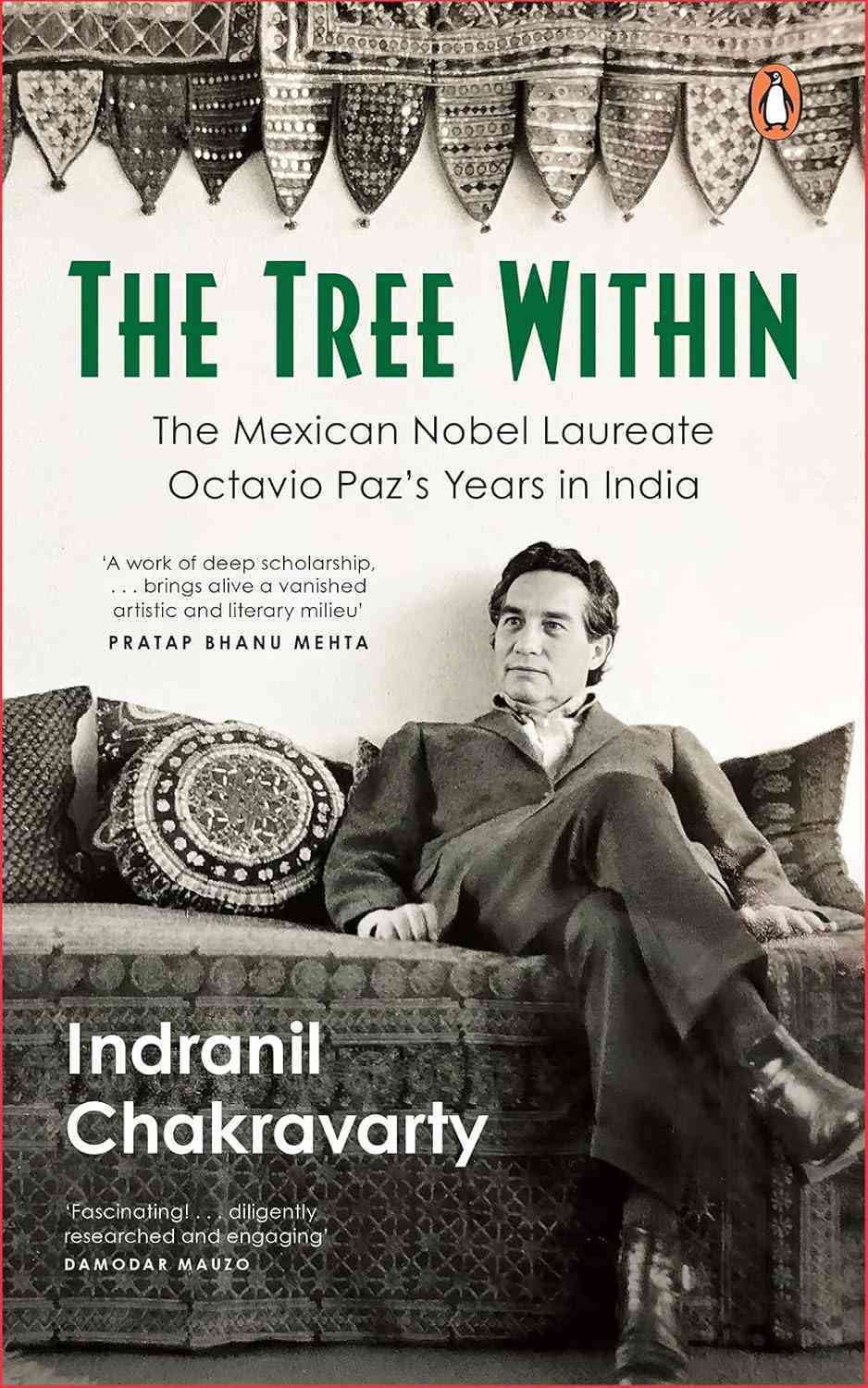
The Tree Within: The Mexican Nobel Laureate Writer Octavio Paz’s Years in India, Indranil Chakravarty, Penguin India.
[ad_2]
Source link