
[ad_1]
On a late July evening, Ashish Dimri wound up work at his hotel. He then retired to his home in the same building. As he and his family went into deep slumber, heavy rains started to batter their village, Kaleshwar, high up in the mountains in Uttarakhand.
Around midnight, Dimri woke up to desperate calls of help from outside. When he looked out of his window at the road outside, he saw that large boulders and a mass of mud had fallen and almost buried a car of tourists. Dimri rushed out to help them.
While the tourists were pulled out of the debris in time, in the next four hours, the road became unrecognisable – boulders blocked it and mud and trees continued to slide onto it.
At 4 am, realising that even his house was on shaky ground, Dimri moved his family and staff, and the tourists, whom he had sheltered, to a relative’s home 5 km away. That was the last night the family slept in their own home.
“The mountain had come down,” said Dimri, when we met him in late October.
This was no ordinary landslide.
The road on which Dimri’s hotel stood is part of the Chardham Pariyojana, a project to widen around 890 km of existing roads in the Garhwal Himalayas to 12-metre double-laned highways. The project, which Prime Minister Narendra Modi launched in 2018, was supposed to make it easier and quicker for pilgrims to commute to four Hindu shrines in Uttarakhand – Kedarnath, Badrinath, Yamunotri and Gangotri. A fifth road that falls under the project connects Tanakpur to Pithoragarh.
But early on, an expert committee had warned that widening roads in the region without adequately protecting slopes ran significant risks. Appointed by the Supreme Court in 2019 in response to a petition filed by an NGO challenging the project, the committee found that out of the 174 slopes that were cut along just one stretch of the project between Tanakpur and Pithoragarh, 102 had become prone to landslides. The committee made recommendations to limit the damage, but these were eventually not accepted.
Now, as the project gathers pace, the consequences are becoming clear. This year, the Chardham yatra was suspended several times during the monsoon because of heavy rains and repeated landslides. Three pilgrims were also killed in a landslide.
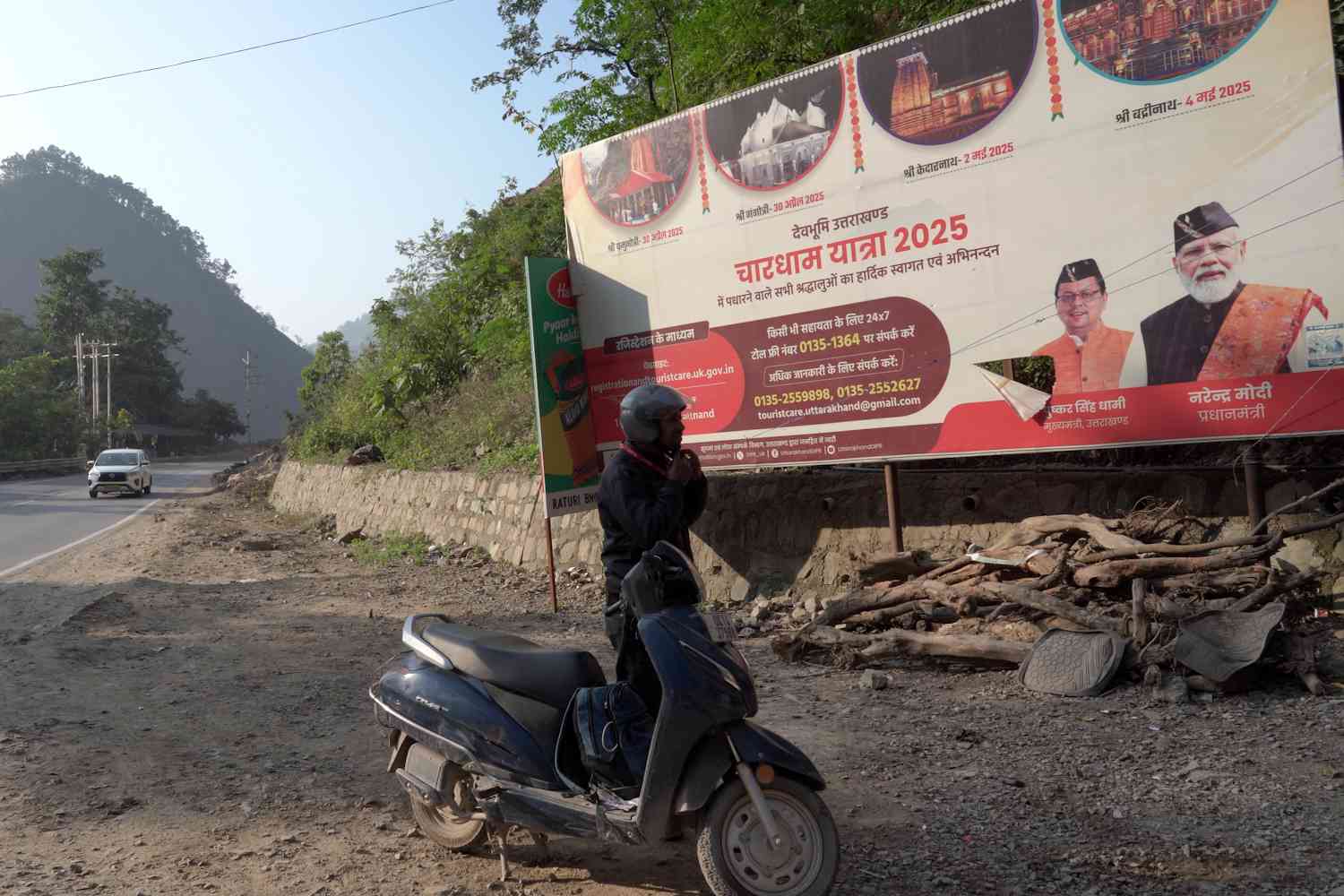
For many living along the route, the project is extracting a heavy cost.
In Silli, a town nestled on the banks of the Mandakini river, on the Rishikesh-Kedarnath route, residents recounted that they began noticing a worrying phenomena in the landscape after construction on the Chardham highway began in 2019.
Pradeep, an owner of a mechanic shop on the road, pointed towards a landslide a little ahead of his shed, and explained that while elsewhere around his village, rain had historically triggered minor rockfalls and landslides, this particular location had only seen a landslide after the road was cut, and that its intensity was much more severe than the others.
“If they keep cutting for the road here, then the mountain will come down completely,” said Pradeep. “This settlement will cease to exist.”
Dimri’s home was on the Rishikesh-Badrinath portion of the Chardham route. Four months after the landslide in Kaleshwar, boulders still lay in front of his home – at the same spot where they had fallen in July after, slamming into a wall, cracking it and leaving glass windows shattered. He said he had not received any compensation for the damage.
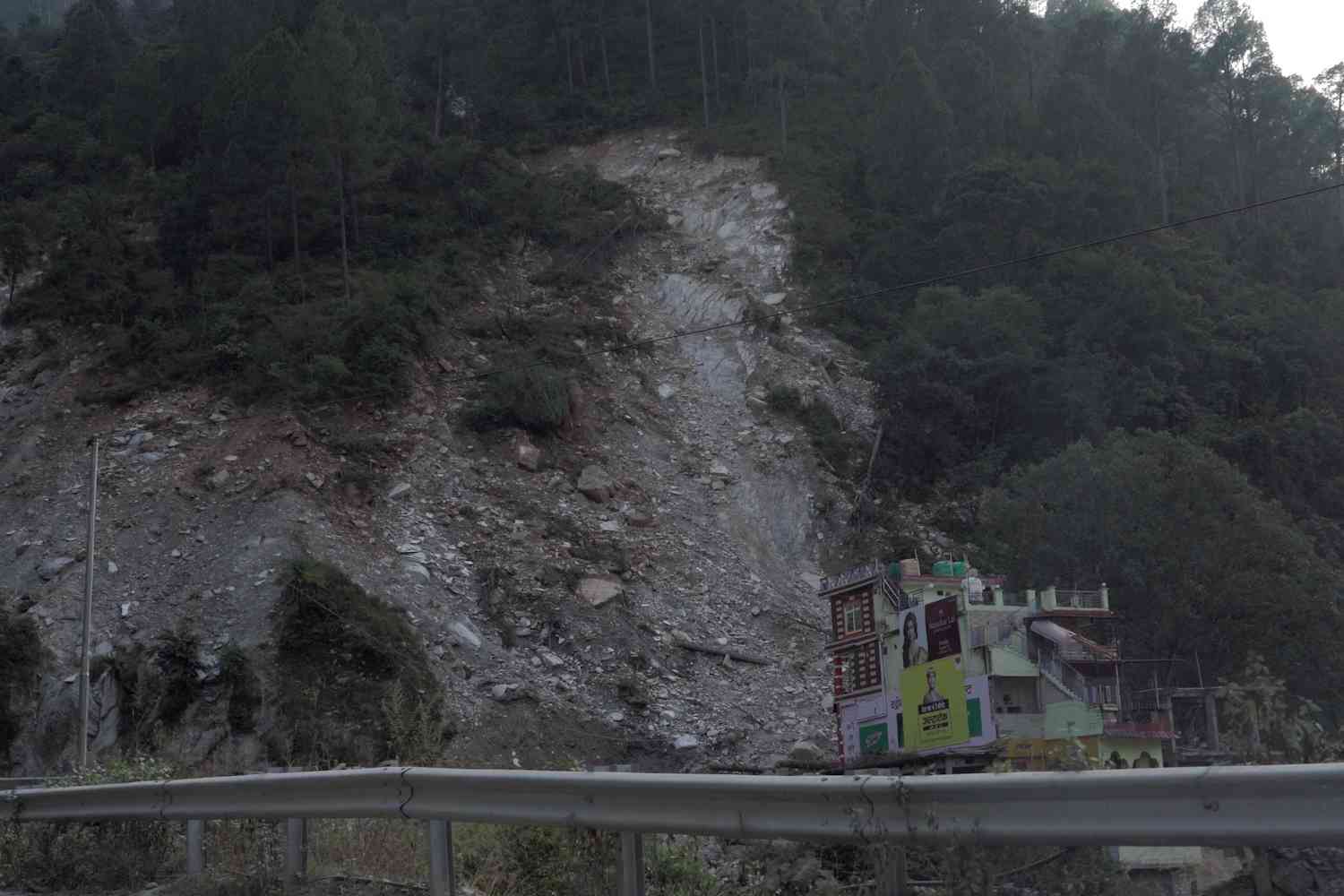
Two policemen were directing traffic alongside the debris, in one direction at a time. Around 15 minutes after we reached, a bulldozer arrived at the location, and began scooping up muck and levelling the potholes with it, as a temporary measure to make traffic movement easier.
“Ever since the widening work began here last year, we had told the authorities to at least make a concrete wall to prevent the mountain from sliding,” said Dimri. He pointed to some patches of a brick-and-mortar wall that were visible amid the rocks and mud of the landslide – such protection walls are sometimes built to provide support to slopes that are cut to widen the road. “They made a weak wall that did not hold the falling rocks at all,” Dimri added.
Indeed, authorities have failed to build sufficiently strong protective walls right from the initial years of the project’s construction – as the Supreme Court-appointed committee had observed in 2019. “The most important observation by all the members of the committee was that very steep slopes were being cut and the security walls were breaking,” said Ravi Chopra, the head of the committee, when we met him in Dehradun on our way to the hills.
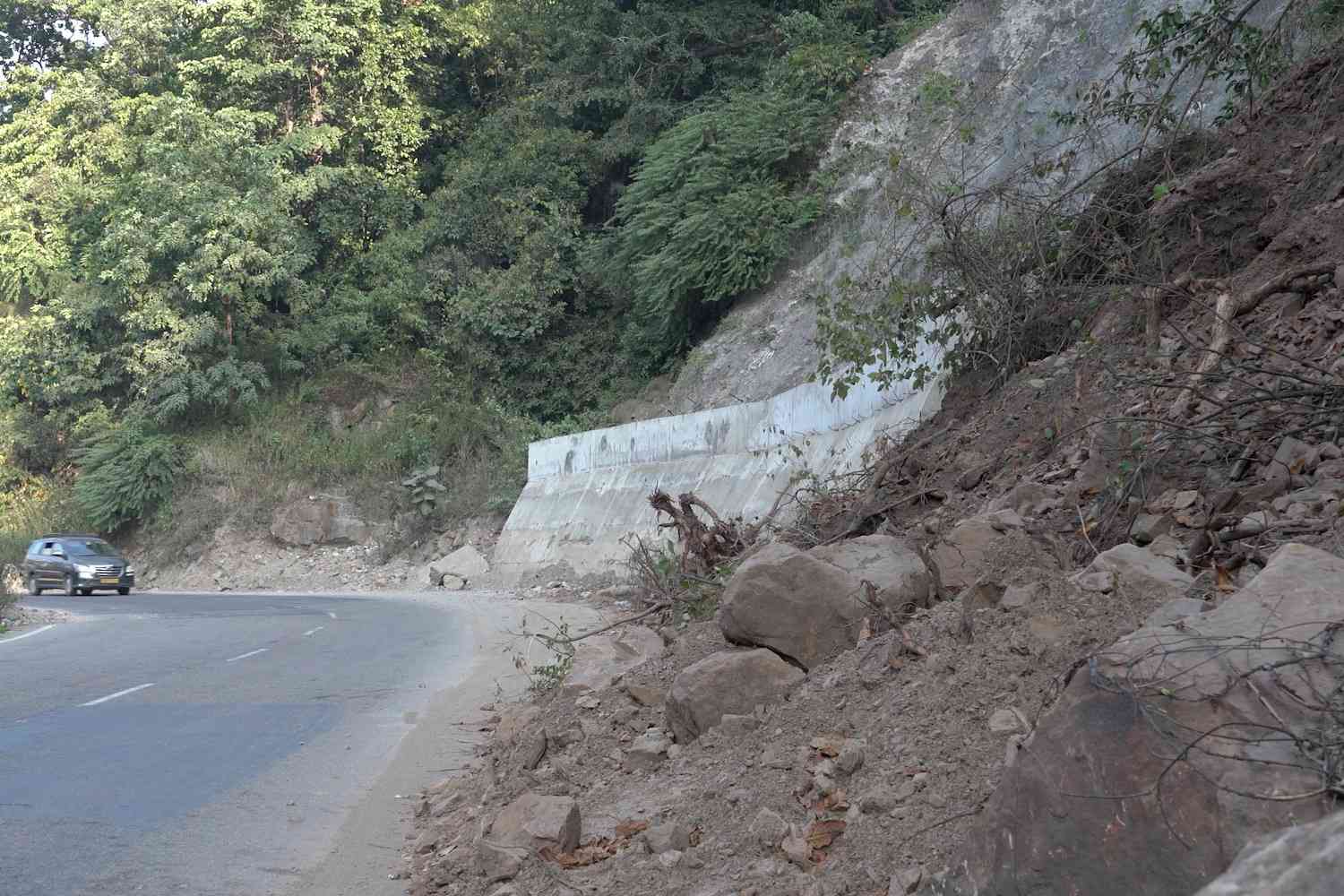
Over the next 300 km, driving between Rishikesh and Badrinath, we used a GPS app to tag the location of every landslide that we encountered. Dimri’s hotel was the location of the hundred-and-ninth landslide. By the time we reached Badrinath, 10,000 feet above the sea level, the count had climbed to 164.
“This is the national highway, this is the Chardham yatra,” Dimri said, shaking his head in disappointment as the bulldozer worked. “So many people come for darshan, is this what they have to see on the way to it?”
This story is part of Common Ground, our in-depth and investigative reporting project. Sign up here to get the stories in your inbox soon after they are published.
Geologists have pointed out that the risks of cutting the mountains to widen roads are exacerbated by the Himalayas’ inherent geological vulnerabilities.
A key reason for this is that large portions of the Chardham road go through the lesser Himalayas, which are mainly made up of relatively weak sedimentary rocks. In contrast, the higher Himalayas are made up of harder rocks, including igneous rocks like granite.
Further, three main thrusts or faults lie between the two regions, where tectonic plates push into each other – these faults make the region seismically active, and continue to raise the height of the mountains. “This is why Himalaya are young fragile mountains that are still evolving,” said Chopra.
He also noted that the rocks of the Himalayas tended to be disjointed – this, combined with the region’s tectonic instability, encouraged the formation of cracks and fissures. “So even if the rock itself is hard, the slope is weak because it has fissures,” Chopra said.
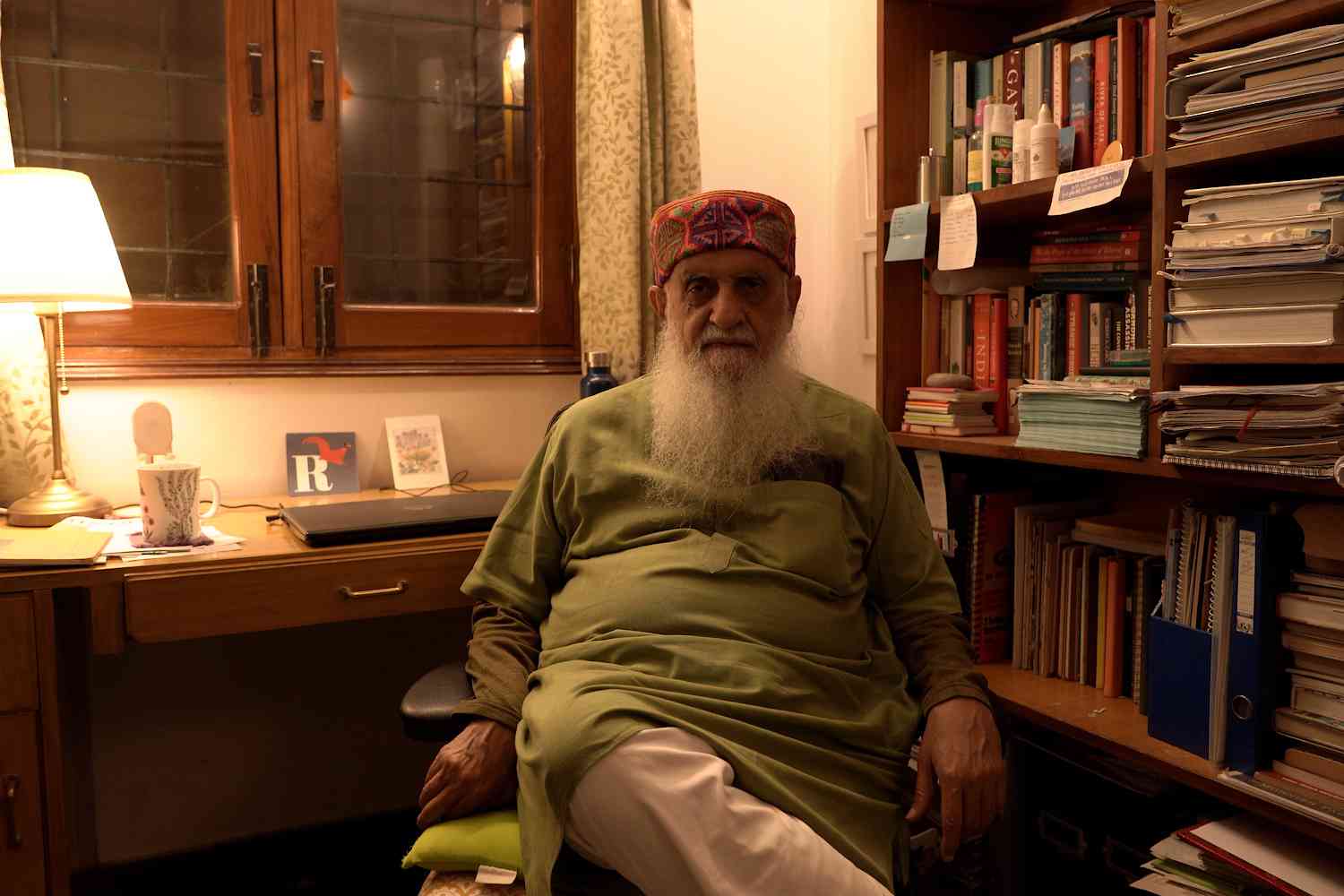
Indeed, a 2018 circular by the ministry of road transport and highways, had taken note of this fragility and overruled an older 2012 notification of the ministry that had recommended the construction of two-lane highways in hilly regions. The 2018 circular observed that building two-lane roads was not advisable in the mountains since it could result in “destabilisation of hill slopes” and damage to “higher contours on hills due to excavation works”, and would entail “large scale felling of precious trees”.
Chopra explained that when the committee was on the site inspection tour, all members had noticed the problems of vulnerable slopes and their cutting.
But the question of the committee’s recommendations became deeply contentious, and led to a split within it.
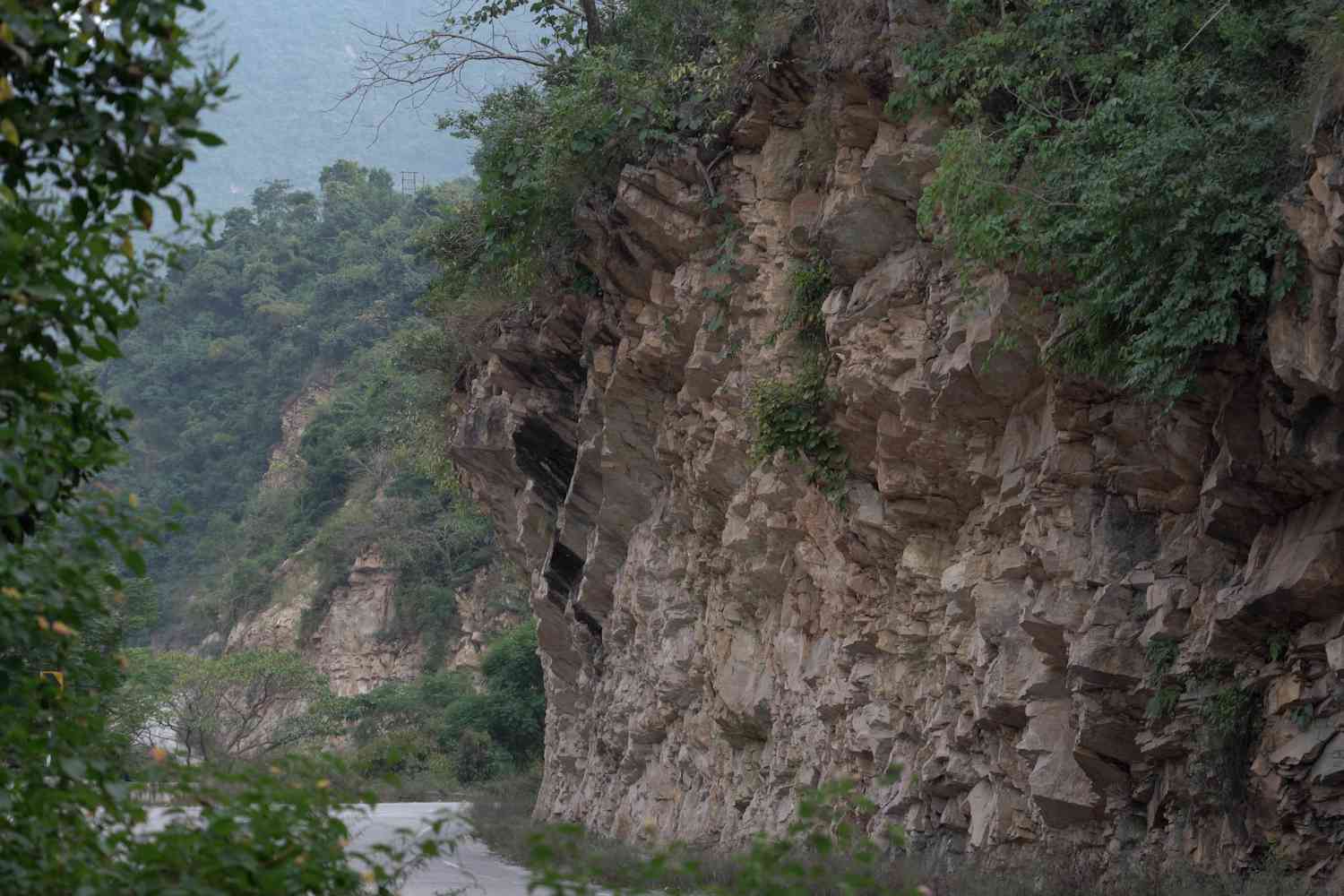
Five members suggested that the route should only be widened to 5.5 metres and cited the 2018 notification in support of their recommendation. They stated that the terrain would become “extremely unstable” if roads were widened to accommodate increased traffic “without due care and attention to engineering geology”. They recommended a “critical reevaluation considering inherent geological and geomorphological constraints”.
Fifteen other members, most of whom were government officials, however, rejected this recommendation and instead suggested a 12-metre road. Both these recommendations were compiled in the same report. After a hearing in September 2020, the Supreme Court ruled in favour of the recommendation to limit the width of the road to 5.5 metres.
But just three months later, the ministry of defence filed an application in the court, seeking a modification of this ruling, stating that the region needed a 10-metre-wide two-lane road in the “interest of the security of the nation and for defence of its borders”. This was a U-turn: while the high-powered committee was preparing its report, the then chief of army staff had told the members that the Indian army’s requirements were fulfilled by the existing roads.
The court accepted this request and modified its earlier order, saying that “armed forces’ infrastructure needs have to be met to safeguard borders, and highways that are of strategic importance cannot be treated the same way as those in other hilly terrains”. It allowed the widening of roads on the Chardham route to resume.
Many residents of the region that we spoke with agreed that it needed better roads, but expressed concern about the pace and design of the Char Dham project. Whether it was for the movement of people or troops, “We need disaster resilient roads,” said YP Sundriyal, a Himalayan geologist and adjunct faculty at Doon University. But, he added, “These roads are causing disaster after another.”
As we travelled through the region, we saw first-hand how the road-widening process destabilised slopes.
Ascending from Rishikesh, we came to a stretch of about 8 km called Tota Ghati. Here, to widen the road, the mountain had been cut to leave steep slopes above – in some cases, completely vertical slopes.
The high-powered committee report had noted that Tota Ghati had been a stable region before the Chardham project, and that “haphazard cutting” converted the region “into a disaster prone passage for local and defence movement”.
“The dominant rock in Tota Ghati is limestone,” said Sundriyal. “When the machines were not able to cut this rock, engineers used JCB and blasting.” He explained that engineers often used dynamite to blast this stretch, which led to the formation of “vertical cracks” in the mountains.
Further, Sundriyal said, “If natural slopes are cut and made vertical without giving it support at the bottom, then the loose material will come down” as landslides.
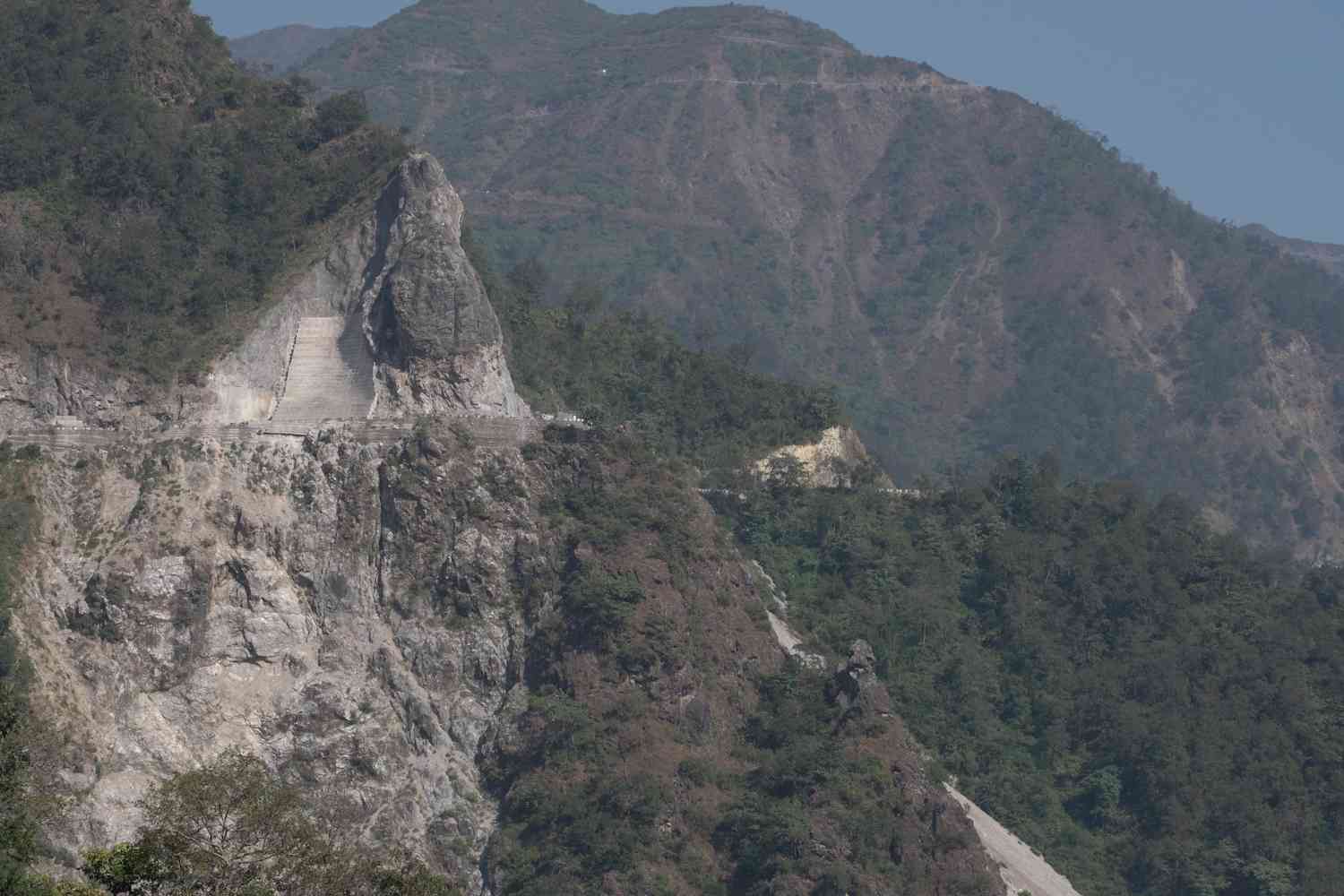
An official from the National Highways and Infrastructure Development Corporation, or NHIDCL, one of the implementing agencies of the Chardham project, agreed that cutting the mountain for the road had triggered landslides in the region. “If the slope is cut vertically, then sometimes they become stable over time, but many of them do not,” he said, requesting anonymity because he was not authorised to speak with the media.
He explained that scientifically cutting a mountain would entail creating a gentle slope rather than a vertical one. But, he added, such slope-cutting would require more land – in this region, that would include significant chunks of forest land, for the use of which approval from the forest department would be needed.
The official then showed us an exercise that he was carrying out similar to what we were attempting, to assess the roads after the monsoons – on a piece of paper, he had noted down latitudes and longitudes of landslides he had spotted on a 30-km stretch of the Chardham route for which he was responsible. He had marked at least 20 landslides.
Chopra explained that road widening also led to landslides when authorities did not create proper exit channels for water.
In an ideal scenario, he noted, after the road is cut, channels are also created that run along it, through which rainwater can flow, and which are directed down the slope through other channels at regular intervals – this helps prevent water from accumulating along roads, and weakening slopes. “The basic principle is that water is the enemy of the slope,” said Chopra.
In Gathra, a village in Chamoli on the Badrinath route, residents are suffering the consequences of this lack of drainage.
“If the road was made with a proper system, if they had provided us a drain, then any water, like rainfall, would go away on its own,” explained resident Anil Kumar. But after the road construction at the base of the mountain began around 2017, Kumar said, water collected along it without draining away. This eroded and weakened the mountain and led to it sinking.
Several homes in their village had developed severe cracks. “It’s not like this was some existing sinking zone,” said another resident who was on his morning walk. “People have been living here for ages without experiencing any sinking. This is a man-made issue.” He added, “Zyada vikas bhi vinash ho sakta hai” – too much development can be a disaster.
Along our 300-km journey, many locals articulated similar reasoning, which had led them to conclude that the widening work had caused landslides. “We see these landslides only on this national highway where the widening has happened,” said an electric appliance shop owner in Devprayag. “We don’t see them in the narrower state highways that connect our villages.”
In Karnprayag, Bhawan Singh Rawat’s home was one of 38 that had developed massive cracks in recent years.
Locals first noticed these cracks appear when the mountain on which their locality was built was carved out for a vegetable market. But after road-widening work began here in 2019, the appearance of cracks increased dramatically, especially in those homes on the portion of the mountain that was cut for widening.
Most of the impacted families moved out of the locality, either to relatives’ homes or, like Rawat, to rented accommodations. But every morning, Rawat walks to his home to spend the day there, before returning to the place he rented to sleep.
We spotted him on the morning we visited – he was sitting on a chair in the balcony of the third floor of his home, looking down at traffic. It seemed risky, given that the two floors below looked completely dilapidated.
“There is nothing to do there in the rented home, the rooms are so small,” said Rawat, who is almost 90.
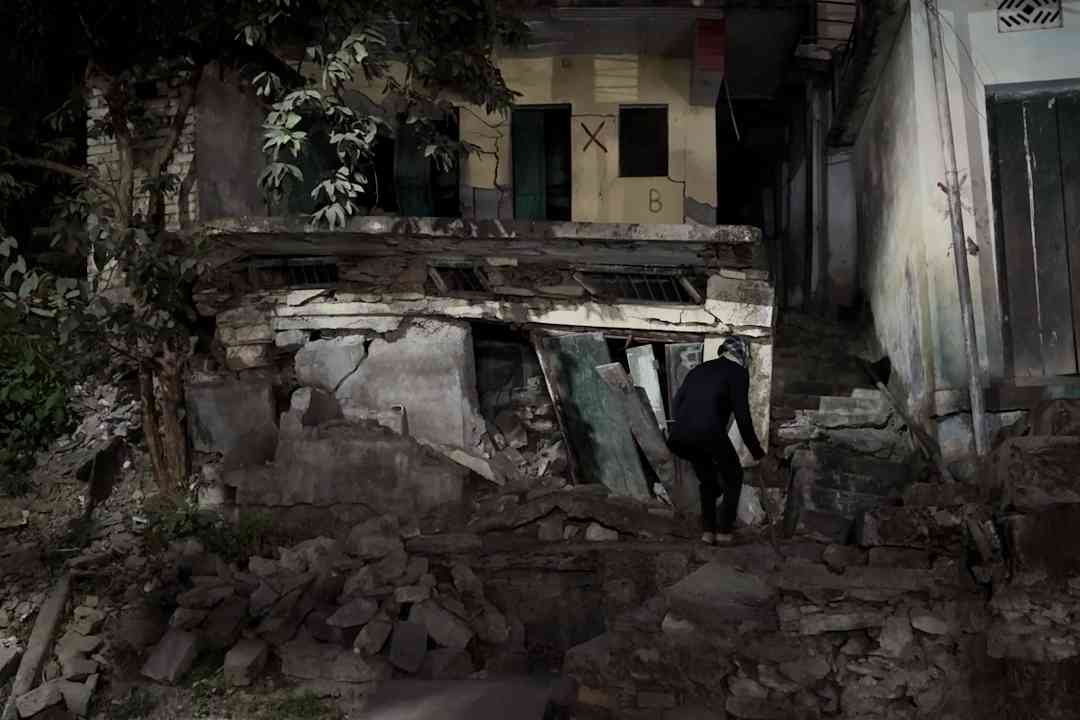
Of the owners of 38 houses that developed cracks, the NHDCL has compensated only four. Mukesh Khanduri was among them. “Initially, they were not accepting that the sinking and cracks were because of them,” he said. He explained that the corporation argued that the problem could not have been caused by road-widening work since the construction was not directly impacting their homes.
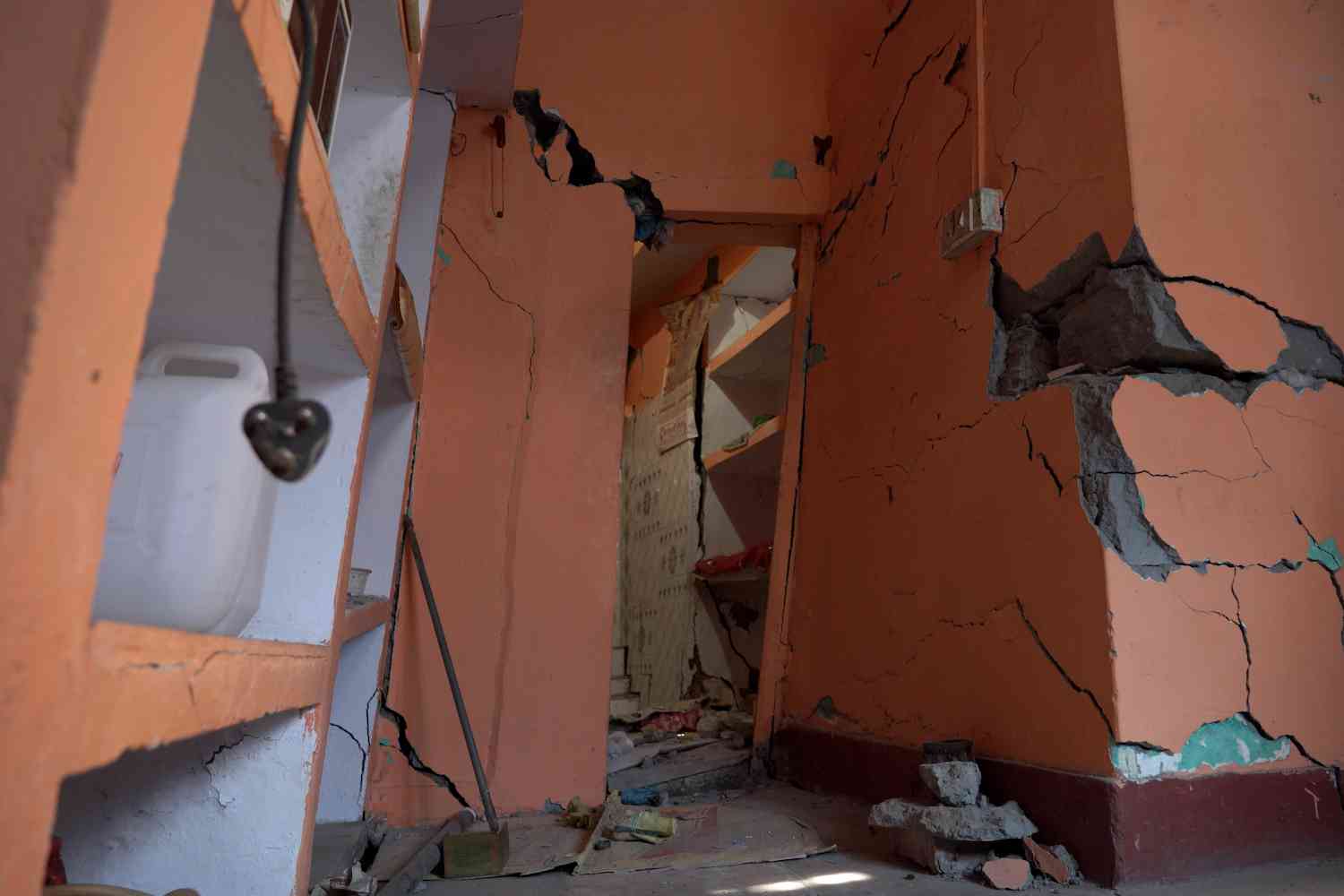
But Khanduri and others argued that the work had destroyed the “roots” of the land in the area, “which were the large rocks, trees, and protection walls”. Once that base was weakened, Khanduri explained, the land started to sink, causing cracks in homes. A half-foot wide crack ran through a wall in his home, which he had filled with rocks in an attempt to provide some vertical support to the structure.
“Many disasters like earthquakes and cloudbursts are natural, we cannot do anything about them,” said Khanduri. “But this is unscientific work happening here. This is not natural.”
Khanduri first raised his complaint with officials in 2021, but only received the compensation early this year. His neighbour Purshottam Kothiyal, with whom he shares a boundary wall, was not compensated. “The houses are next to each other here,” said Kothiyal. “If my neighbour got the compensation, then everyone here should have gotten.”
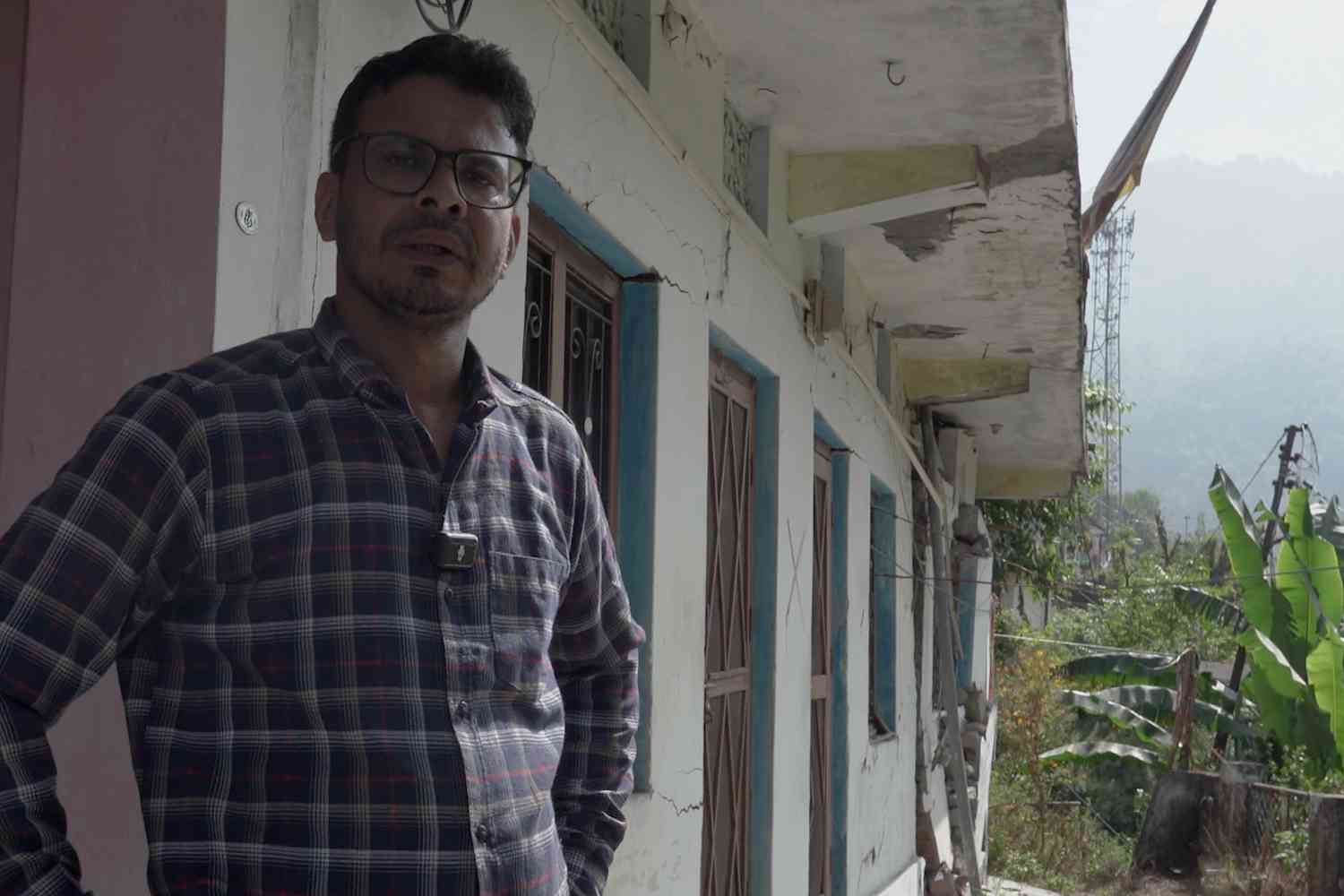
Cracks run over the walls of his home too. We spotted a “crackometer”, a small plastic device that the administration had installed over a crack, like a band-aid, which measures the expansion of cracks over time. The device indicated that the crack had extended to almost 20 mm, or a little more than half an inch. “When they first put the crackometer two years ago it was very small,” said Kothiyal. He continues to live there with his wife.
In Silli, residents had another problem. This October, many residents woke up to notices on their doors that instructed them to vacate their homes in the next two days because the land would be needed to widen the road.
This came as a shock to many, since this work had begun in 2019, and one round of demolitions had already been carried out. “When they first demarcated it, they told us that around 14-metre-wide roads will be made,” said Manoj Benjwal, a resident.
Benjwal earlier had shops that fell within the land that was acquired for the widening work and hence were demolished – he believed that would be the last of his troubles. “But now about a month ago they told us that they will be demolishing up to 24 metres,” he said. Indeed, when we visited, several homes and shops were being demolished in Silli.
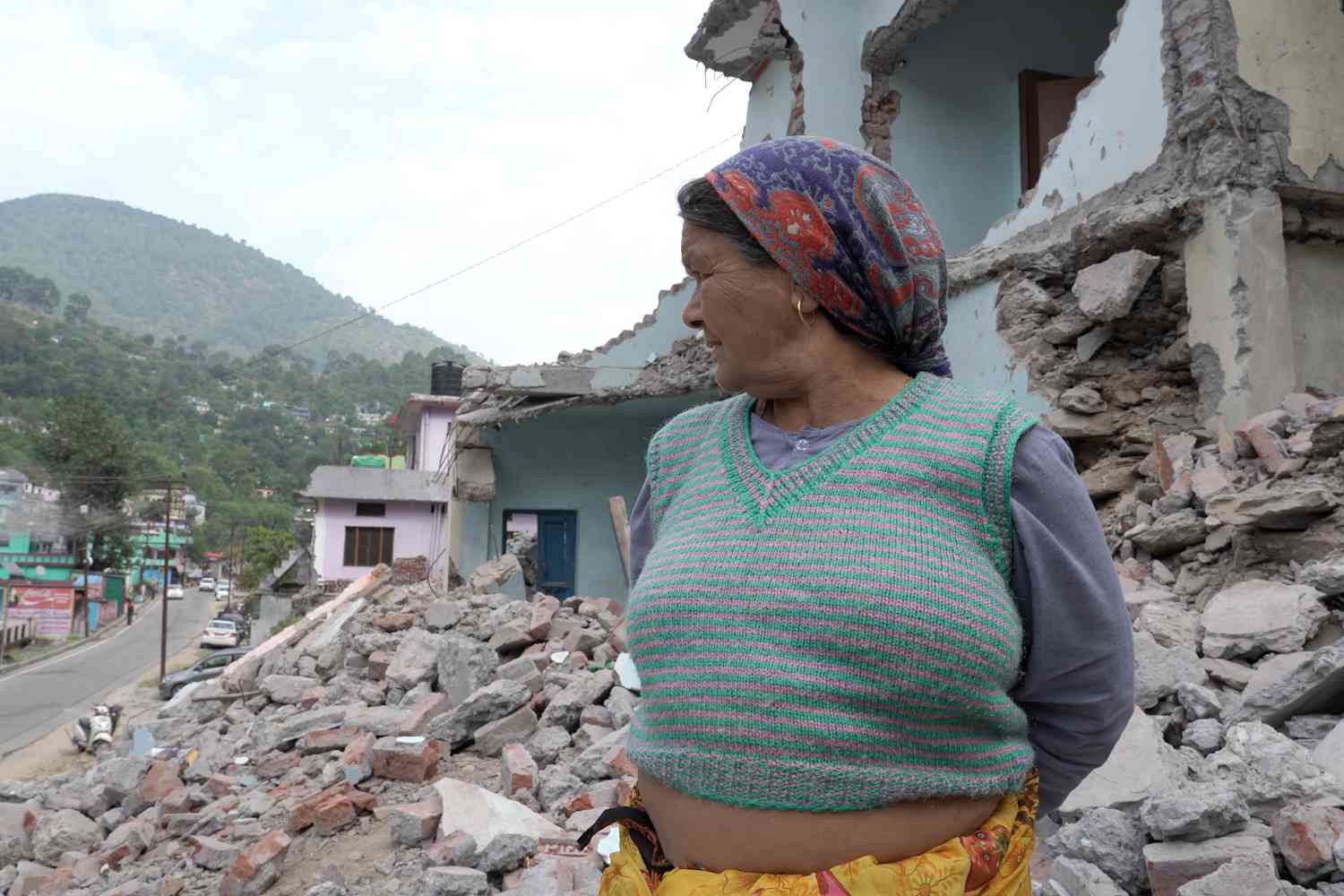
“Nowhere in the Rishikesh-Badrinath road has the widening been done up to 24 metres,” said Benjwal. “Everywhere else it is 12 metres, then why this much here?”
The NHIDCL official offered a clarification on this question. He said that although authorities only planned to widen the road to 12 metres currently, they typically sought to “acquire a right of way of 24 metres” – that is, to acquire rights to use this land for any associated work with the project. But, he added, at many places, this acquisition was stalled after residents protested.
Along our journey, we crossed several “landslide zones” – dusty stretches of road with boulders and debris on both sides, indicators that they had seen several landslides over the years. Many of these zones had existed even before road-widening under the Chardham project began.
Conversations with geologists and locals revealed that there was a contradiction inherent in authorities’ approach to some of these stretches, in contrast with their work on others.
For instance, one of the oldest such zones was Sirobagad, just short of Rudraprayag, which started seeing landslides around 1920. In 1969, the area saw such intense rockfall that the flow of the Alaknanda river, which runs parallel to the road, was blocked.
Incidents like this led the high-powered committee to term Sirobagad landslide the “most notorious” one “to affect Indian road network”. In 2020, the Supreme Court asked the committee to submit another detailed report examining the defence ministry’s application. In this submission, the committee noted that though the government had spent “crores of rupees” on trying to tackle the problem, it had not been successful – and that the landslide zone remained active today.
The committee found that authorities overseeing the road-widening work in the area took its history of landslides into account and, unlike on other portions of the Chardham route, carried out only minimal work on it.
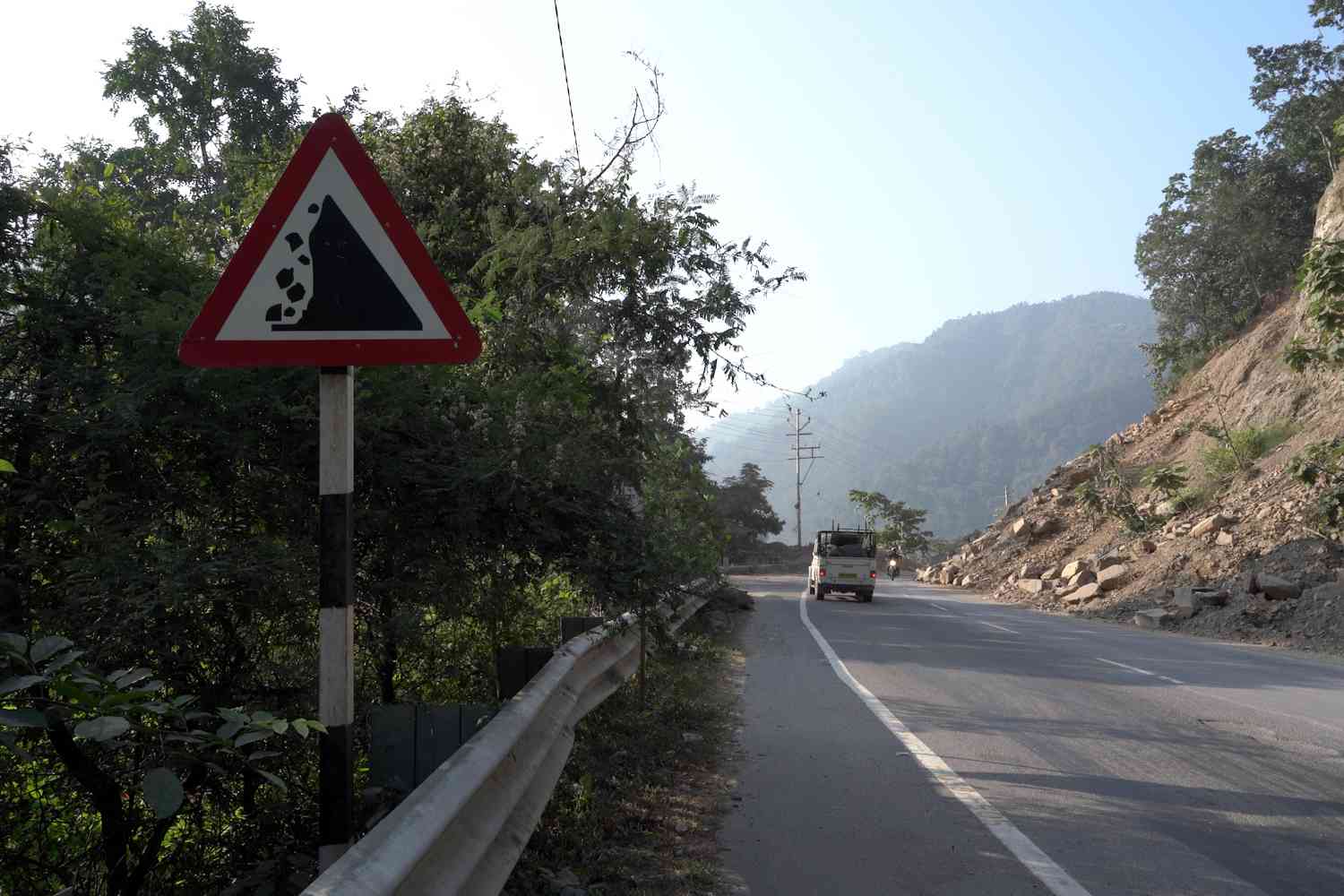
But this caution did not extend to several other such “chronic” landslide and subsidence zones, the committee stated in its report. These “would have required special care and engineering treatment during the road widening by CD Pariyojana, but were ignored”, the committee observed.
Now, in the last year, the NHIDCL and the Public Works Department of Uttarakhand have been attempting different mitigation measures in many areas on the route, after most of the road widening has been completed. The most common measure we saw at work was “anchoring” – a process in which hollow iron poles between 10 and 15 metres long are drilled into the mountain, and concrete poured through them to fill cracks in mountains. This, authorities claim, can help stabilise a slope.
Sundriyal expressed doubts over whether this method was advisable. “Putting cement inside is dangerous,” he said. “This process is not making the rock any stronger.”
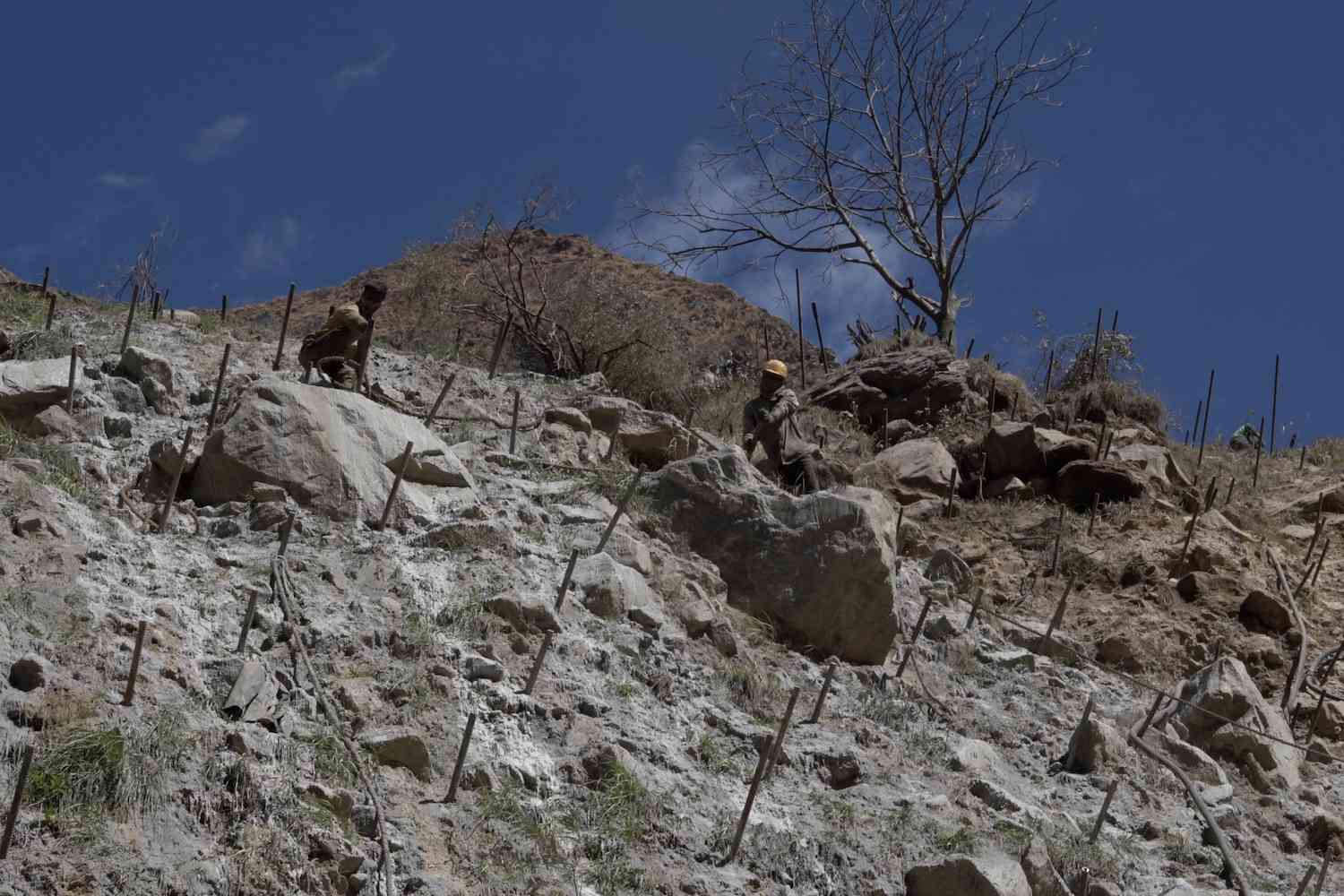
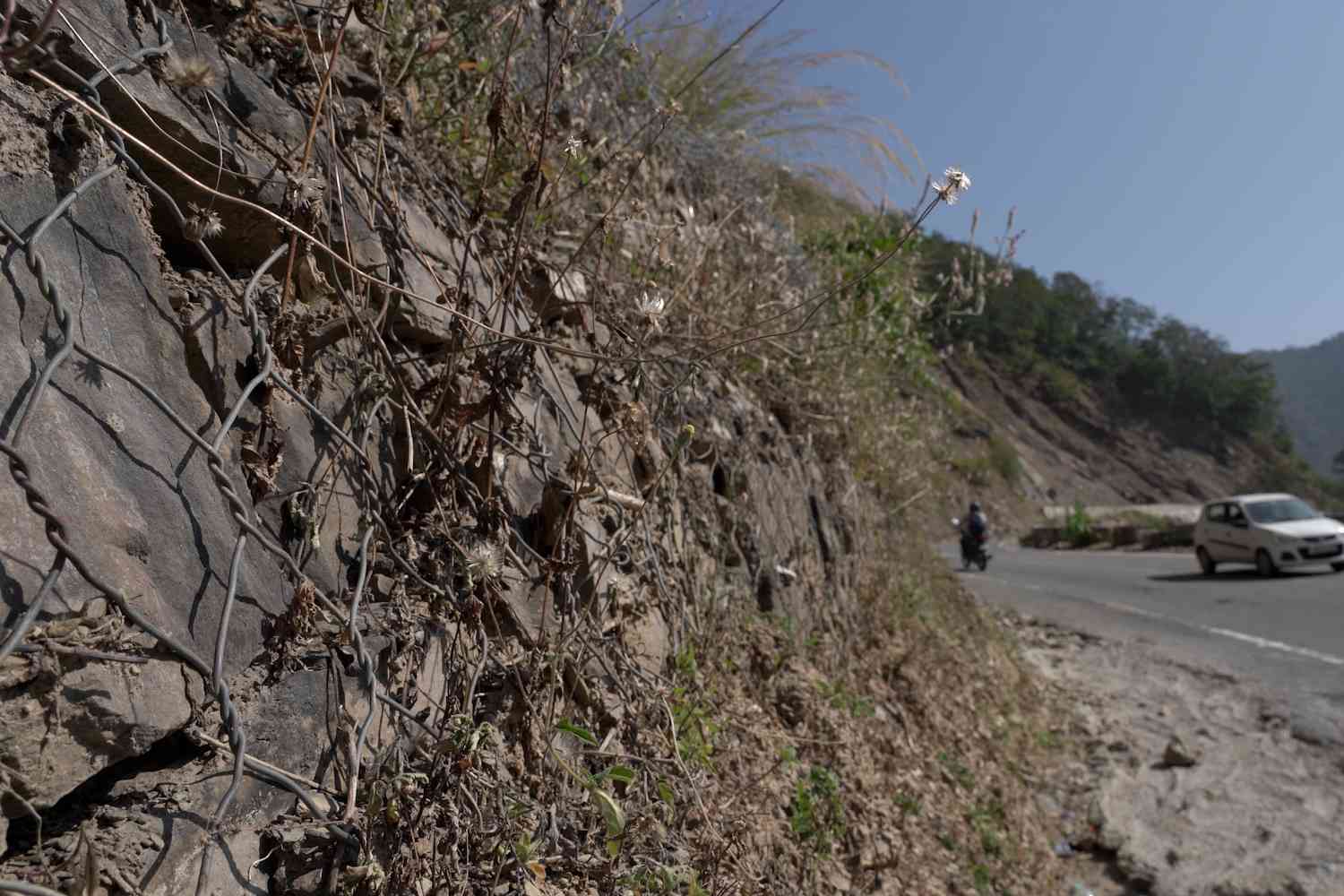
Another measure entailed covering mountain slopes with strong iron meshes intended to catch any large boulders falling onto the road. At a point between Totaghati and Devprayag, we had a short conversation with workers installing the iron mesh on the mountain face. “What is the advantage?” said one worker disinterestedly. “When large boulders fall into the mesh, the entire mesh will come down. We’ll have to put it up again.”
On mountain after mountain along our journey, we saw one of these two measures. “We have started to do these measures wherever we have noticed sliding happened because of the road cutting,” said the NHIDCL official. “Since we just started this year, we are yet to see how successful this measure would be.”
When we finally reached Badrinath, the Chardham season was coming to an end for the year, and only a thin stream of tourists were visiting the temple. The town’s few restaurants, hotels, and resthouses would soon wind up, and most locals would travel to Joshimath and Auli at lower altitudes to spend the winters.
A young prashad seller who was stationed on the path leading up to the Badrinath temple explained that this monsoon had seen roadblocks at several places in the area, especially in the last stretch from Joshimath to Badrinath, often leaving only a single lane operational. “We are looking forward to the next season,” he said. “This season was quite poor because of the rain.”
As we continued to drive downhill, we crossed the several landslides that we marked earlier, and passed through Joshimath, a town that has been in the news for its crisis of land subsidence, even as large hydropower projects come up near it, as well as a new railway line being built by blasting through the mountains from Rishikesh to Karnprayag.
As we drove through Karnprayag, dusk had fallen. We could not help but gaze up at 90-year-old Rawat’s dilapidated three storied home – there he was, sitting on his chair, peering down at the road.
[ad_2]
Source link