
[ad_1]
Contemporary art is often parodied for its use of bodily waste – urine on canvases, faeces in tin cans, menstrual blood as installation. But rewind two centuries and you’ll find that while excretory materials may not have made it to the content of images, they nevertheless did serve as ingredients for their production.
Two luminous substances in art and early photography embody this intersection of excreta and visual culture in 19th-century South Asia: the medieval pigment called Indian yellow, and Bengal light, one of the first ever artificial photographic lighting sources. Both technologies of illumination were derived in Bihar from bovine urine and involved processes of production and distribution that have been either historically documented or chemically recovered relatively recently. Furthermore, both reflected a colonial complex of political, economic and visual governance.
Among the two, Indian yellow is by far the more intriguing, partly due to what art historian BN Goswamy once called the “mystique” surrounding its preparation. A 2008 study contended that Indian yellow – also identified as peori, purree and gogoli in literature – was used to render the moon and stars in Vincent Van Gogh’s Starry Night (1889). There may have been a conceptual logic to its celestial deployment: chemist and painting technologist Alexander Eibner described it as “incomparably beautiful, deep and luminescent gold yellow in a shade…achieved with no other pigment”.
Possibly originating in Persia and used in Mughal, Rajasthani and Pahari paintings between the 16th and 19th century, it found its way to Britain in the late 18th century, according to Artists’ Pigments: A Handbook of Their History and Characteristics Volume 1 (1985). Its artistic legitimacy was sealed when it was listed in the catalogue of the major British fine art supplies manufacturer Winsor & Newton in 1840.
Almost since its appearance in the English archive in the 1780s, Indian yellow has attracted attention not only for its delicate fulgence but also, in its raw form, its odour, “the roughly shaped round lumps…accompanied by a smell of urine,” as noted by art historian RD Harley in Artists’ pigments c.1600-1835 : a study in English documentary sources (2001). For more than a century, this stench fuelled speculation. Chemist Rebecca Ploeger and conservator Aaron Shugar recount in their essay The Story of Indian Yellow – Excreting a Solution that repeated attempts were made to identify the malodorous pigment’s organic origin, with theories ranging from camel urine and beaver castoreum to tree sap.
Finally, in 1883, in response to an inquiry undertaken by the director of the Royal Botanic Gardens at Kew, TN Mukharji, an Indian civil servant and indigenous materials expert, travelled to Monghyr to witness the making of peori. In his article in the Journal of the Society of Arts, Mukharji documented how a caste of milkmen would collect the bilious, bright yellow urine of cows fed solely on mango leaves and water, precipitate it into pellets, and dry them for export to London.
Rival of the sun
The second visual technology indirectly derived from cattle urine was Bengal light, a saltpetre-based compound long known as a firework. Photography historian Niharika Dinkar, the only scholar to have written extensively about Bengal light, explains in her essay Pyrotechnics And Photography: Saltpeter And The Colonial History Of Photographic Lighting (2021) that its intense, actinic blue flame attracted experimenters for decades before it was patented in 1857 by John Moule for use as an artificial lighting material in portrait photography in the form of a hexagonal device called the Photogen.
Like Indian yellow, Bengal light was accompanied by “noxious fumes” when it was burned to generate the 15-second-long smoulder that allowed for the portrait to be taken. In 1883, the same year Mukharji undertook the field trip to Mongyr, saltpetre-based Bengal light was adapted for use in a portable apparatus called the Luxograph, which comprised “a concave reflector fitted with glass mosaic like bits” and reduced the flare duration to five seconds.
In his essay The Indian Saltpeter Trade, The Military Revolution, And The Rise Of Britain As A Global Superpower (2009), historian James Frey gives an account of the production of military-use saltpetre in India as well as its commodification by European empires. Since the early modern period, India’s superlative saltpetre was used for making gunpowder, with the region between Jaunpur and Bengal emerging as “the premiere saltpeter-producing region of India”. By the 18th century, Patna had become the hub of international commerce around saltpetre, with Dutch, French and British trading companies competing aggressively (the British monopolised 70% of the market share).

The compound was mined by licensed members of the nuniya caste, “whose occupation involved earth working and construction”. Believing saltpetre to be a by-product of cattle urine, nuniyas sought out “salt earth” in places where livestock congregated. During the monsoon, they would plough the urine into the soil, lixiviate the residue that surfaced after the rains, and then boil the brine to separate the potassium from the nitrates over multiple evaporation cycles. Finally, the precipitate was purified in a regional European refinery before being exported.
Unlike gunpowder, which exploited saltpetre’s explosive force, its use in pyrotechnics and photographic lighting required controlled combustion. Bengal light exemplified this calibrated release of energy. Dinkar points to advertisements for the Photogen that declared it to be a “rival of the sun”, even as critics dismissed the photographs it lit as “ghastly and gravelike”. A similar paradox attends Indian yellow. Chemist George Field observed in The Rudiments of Colours and Colouring (1870) that in watercolour the pigment “resists the sun’s rays with singular power” yet in oil it is “exceedingly fugitive”, that is, lightfast.
The metaphorical language of rivals and fugitives attempting to capture the blue dazzle of Bengal light and the rich gleam of Indian yellow takes on an intense hue in the context of the imperial aesthetic-industrial complex in which these materials circulated. At the end of the 19th century, Indian yellow was visible in canvases across Europe and Bengal light lit up stages, caves and monuments like the Eiffel Tower, the Colosseum and Niagara Falls as public lighting during night shoots. This glow, however, was not benign. It symbolised the extractive infrastructures of the empire that converted indigenous Indian resources and processes – cow urine, mango leaves and mineral-rich soil – into media for visual cultural production that profited the Raj.
Colonial racial politics coloured the use of Indian yellow both explicitly and implicitly. Art historian Jordana Bailkin notes in her essay Indian Yellow: Making and Breaking the Imperial Palette (2005) that “in Europe, Indian yellow…was praised for its fineness in conveying the subtleties of skin colors…When mixed with vermilion or hematite, Indian yellow was said to be especially useful in creating a dark brown flesh tone”. But despite its aesthetic suitability, it was politically fraught.
In 1908, Indian yellow was informally banned (there is no official record) by the British government, leading to the eventual ceasing of its production and use by the 1920s. Bailkin interprets this discouragement in the context of the proto-Hindu nationalist cow protection movement of the late 19th century, embodied by the Cow Protection Societies or Gaurakshini Sabhas. This movement reasserted caste-based social norms around purity and pollution against British attempts to desacralise the cow in the Indian Penal Code in the 1860s. Bailkin reads the ban as both appeasement and power play to counter swadeshi boycotts: “The fact that cow protection came primarily from an indigenous vigilante source of power led the British to reassert their dominance through their own forms of protection: that is, the disuse of Indian yellow.”
At the same time, the demand for Indian saltpetre was declining too. Dinkar notes that in the very year Photogen was devised in Britain, a company in the United States started manufacturing saltpetre from Peruvian sodium nitrate “to break free from British monopoly”. No longer was making Bengal light dependent on nuniya labour or the cow urine-enriched soil of eastern India. After that, the Indian saltpetre industry survived for only a few more decades. Its final collapse came in 1909, around the same time as the Indian yellow ban, with the development of the Haber-Bosch process that produced synthetic saltpetre from atmospheric nitrogen.
Scientific experiments eventually demystified Indian yellow as well. While its distinguishing component – euxanthic acid, comprising euxanthone and glucuronic acid – had been identified way back in 1845, questions around its production process had endured. Confident in his findings, TN Mukharji felt he had settled the matter conclusively once he had dispatched samples of Monghyr peori and associated cow urine to Kew. Instead, his testimony was doubted for over a century.
In Colour: Travels Through the Paintbox (2003), journalist Victoria Finlay followed Mukharji’s trail in the district of Monghyr, now Munger, only to be disappointed that nobody in the village had heard of peori, much less how it was once made. “What if,” she wondered, “[Mukharji] was a nationalist, wanting to make a point, or at least a joke, at the expense of the British?” It wasn’t until 2019, when Ploeger and Shugar in their investigation of Mukharji’s samples at Kew discovered a chemical marker of mammalian urine called hippuric acid, that the Indian officer’s integrity was upheld.
That it took a century and a chemical – left behind in a British archive – to confirm an Indian civil servant’s eyewitness account is a metaphor for the colonial regime of logistics and knowledge that converted cow urine into radiance, on canvas and in photographs. The stories of Indian yellow and Bengal light elucidate not just a quirky intersection of visual history with the metabolisms of animals, but of empire.
Epilogue
While Munger may not have had answers, another location just might. Artists’ Pigments states that peori could be obtained from Jaipur, where it was known as gogoli meaning “cow earth”. In a 2014 article on Indian yellow, BN Goswamy quotes a contemporary miniaturist, who cites an eminent master-painter of Jaipur, Bannu, “perhaps the last Master to use it”. The miniaturist differentiated between gogoli and the chrome-cadmium mixture “now designated as peori, once another name for the real gao-goli, but now to be distinguished from it”.
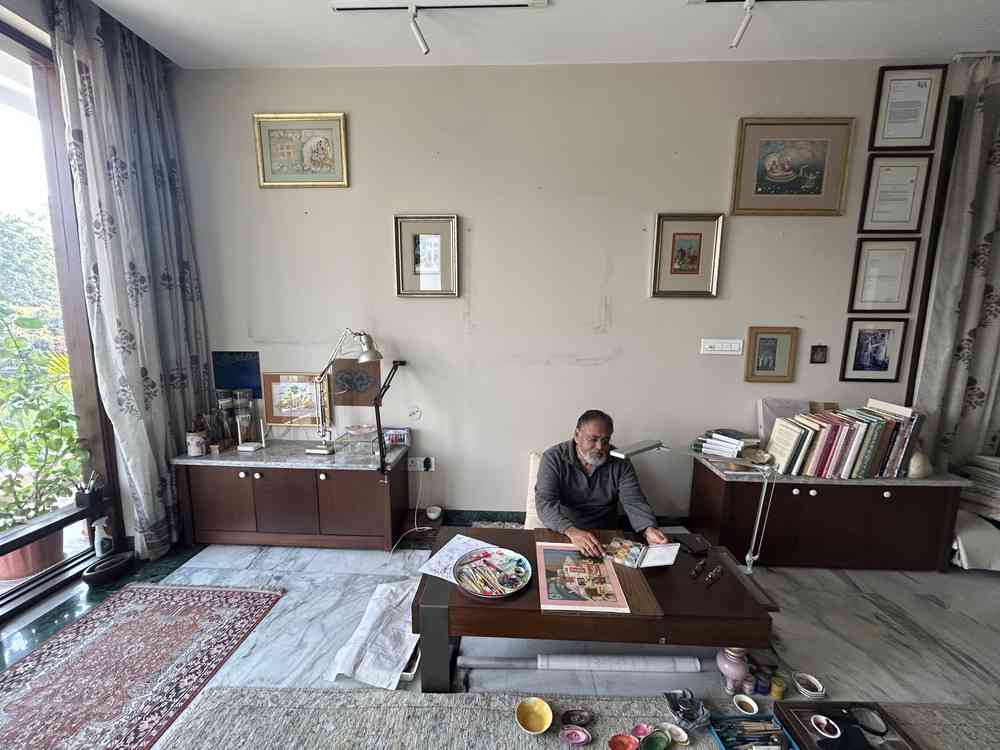
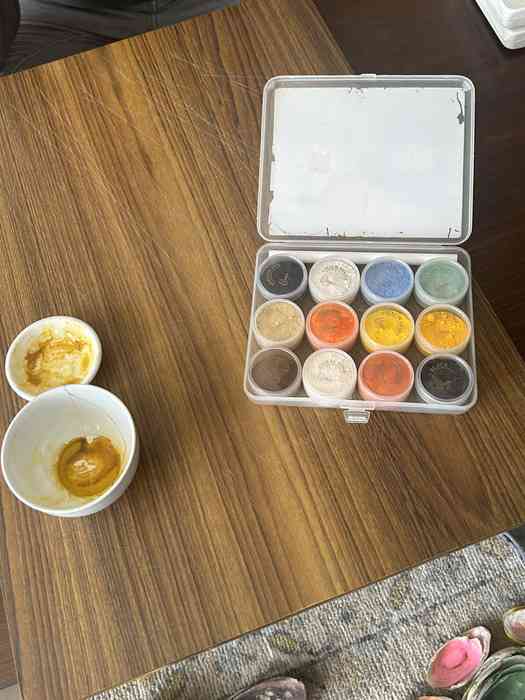
To find out more, I visited the Jaipur studio of the late ustad Bannu’s son, Shammi Bannu Sharma, a seventh-generation painter whose ancestors had moved from Aligarh to Rajasthan’s courts in the 18th century. The midday sun streaming into Sharma’s first floor atelier falls on the kharal in which he grinds stones into powder pigments, the palettes in which he keeps them and the chowki at which he works. Atop the table are a small white bowl and saucer with dried blotches of yellow.
The splotches are special: Sharma possesses perhaps the only known sample of the authentic gogoli Indian yellow pigment preserved within India, the remainder held in industrial and academic archives in the United Kingdom and the United States. He remembers his grandfather and father storing the material in little cylindrical boxes at a time when many traditional artist families left the profession. “Leftover Indian yellow pigment was still found in their homes,” he said. “When the older artists died, the younger generations didn’t know what the pigment was for. Some people even mixed it with lime to whitewash their houses.”
He inherited the pigment from his renowned father in 2000, when friends persuaded the ailing maestro Bannu – who kept a distance from his son’s practice – to view Sharma’s work: “He sat for 10–15 minutes on a chair, then stood up, walked toward a pichwai painting I had just finished and looked closely. He praised the work and asked why I hadn’t used gogoli to paint Krishna’s lalat [forehead] and srngar [adornment]. I didn’t deem my work worthy of such a precious colour. He said, ‘Whose is it, if not yours? How much do you think I’m going to use now?’ From that day onward, I’ve always given a touch of goguli to my paintings.”
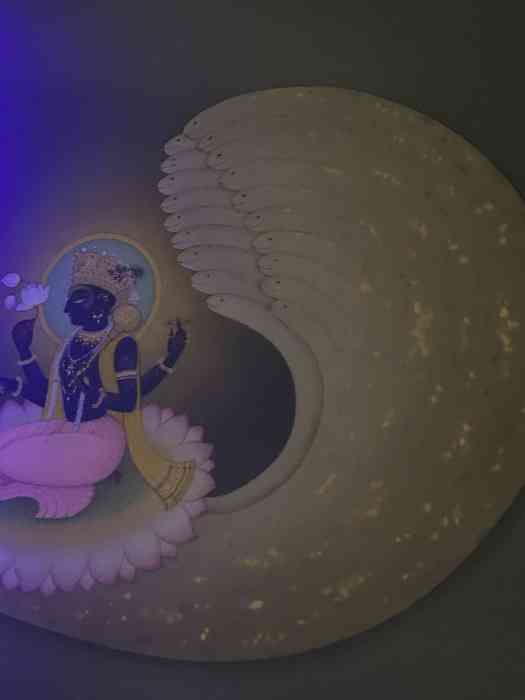
The main indicator of true gogoli – as opposed to what is termed peori these days – is its lustre, sharply visible in ultraviolet light. Sharma moves a UV torch across one of his paintings featuring Krishna and the serpent Kaliya to properly appreciate the sheen of gold on the deity’s robes, jewellery, nimbus, as well as the flecks on the naga’s body. As this sparing application suggests, Sharma is economical and careful with the heirloom gogoli, using it only for Krishna’s lalat, srngar and dhoti. “I have a few grams left,” he said. “For my lifetime, that will be enough.”
Kamayani Sharma is an independent writer, researcher and podcaster based in New Delhi. This project was made possible under the Scroll x MMF Arts Writer Grant.
[ad_2]
Source link