
[ad_1]
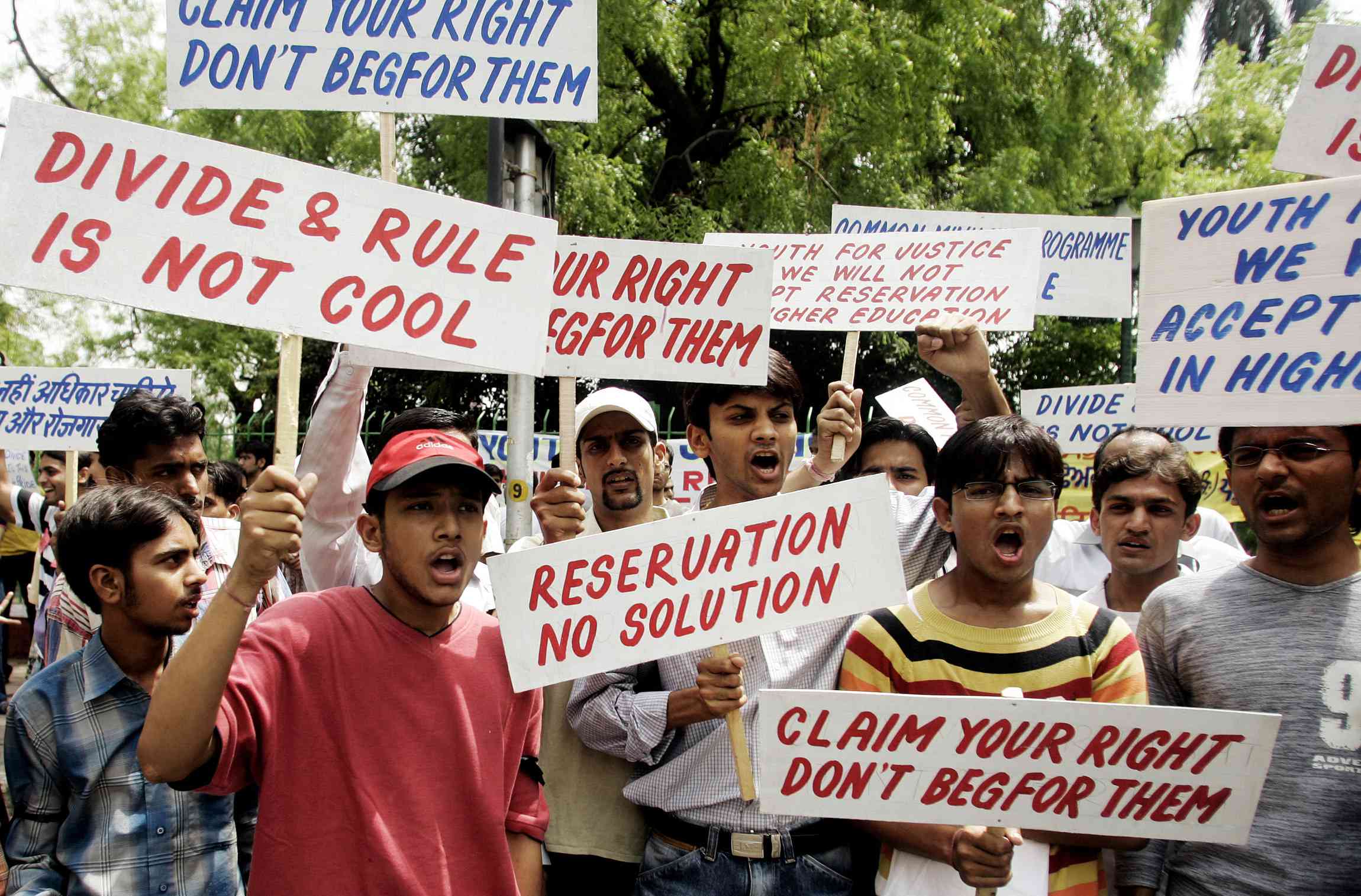
Many upper-caste protestors opposing the University Grants Commission’s new guidelines against discrimination have demanded that the rules be made caste-neutral.
But lawyer Disha Wadekar said there is no point to the regulations if they are made caste-neutral. “Then they will have to be gender neutral, they will have to be disabilities neutral, so everyone can file complaints against everyone,” Wadekar told Scroll in an interview on Friday.
Wadekar is representing petitioners seeking institutional safeguards against caste-based discrimination in higher education institutions in India. The petition is being argued by Indira Jaisingh, and the advocate-on-record in the case is Prasanna S.
Wadekar pointed out that the UGC’s Redressal of Grievances of Students Regulations, 2023, which has also been mentioned in the 2026 guidelines, allow any student to file a complaint of victimisation. “So what is this uproar that ‘we don’t have a redressal’?”
Regarding claims that the new rules could be misused, Wadekar said that misuse is a symptom of systemic failures in our criminal justice system.
“This whole ‘misuse’ narrative about the atrocities act was also based on the fact that there are so many acquittals,” she said, pointing that similarly, in rape cases, only 25% cases reach conviction. “Does that mean that 75% of rape cases are false and are a misuse of the rape law?”
Excerpts from the interview:
How do you respond to what happened in the Supreme Court on January 29? The petition opposing the UGC regulations and the court’s order to stay the petition.
The staying of the UGC regulations is an interim order, so in the interim, the older regulations will be in force. And the final matter on the merits of the case will be heard on March 13. The petitioners are challenging the definition of caste-based discrimination, which says that caste-based discrimination is discrimination only against SCs, STs and OBCs. Their claim is that that is not a caste-neutral provision, and so that provision needs to be made caste-neutral.
We, of course, do not agree with that. We believe that SC, STs and OBCs are the only people who need to be protected against discrimination based on caste. However, we will make our detailed submissions on March 13, and I would not like to comment directly on what the court said.
But I would like to point out that the 2012 regulations that are now going to be in operation, at least until the next hearing date, also protect Scheduled Castes and Schedule Tribes exclusively against caste-based discrimination. That to me is interesting because the whole rationale for staying the regulations was that the definition of caste discrimination is not caste neutral, and both the older regulations and the newer regulations are not caste neutral when it comes to defining discrimination based on caste.
In the realm of the law and regulations, have you even seen anything like caste neutrality when it comes to the question of caste discrimination?
Not at all. Caste is a group identity, and it is based on this group identity that an individual is discriminated against.
Are they denying any form of group identity in this country, which is an ascribed status shaped by historical disadvantages, untouchability and patriarchy? There are these identities that are inflexible, therefore we call these associations as group associations or group identity.
So is this an attempt to say that in this country we will not recognise any of us? And is that non-recognition therefore only caste specific? Or is it also going to apply to gender, because gender is also an ascriptive identity. To some extent it could be fluid but it is still an ascriptive identity.
The stay on the new regulations has led the Supreme Court to revert back to the 2012 UGC regulations which were in operation when Rohith Vemula and Payal Tadvi died by suicide, allegedly after being subjected to caste discrimination on campus. They have also been operational in the last five years, during which UGC data says that caste-based discrimination has risen by 118%. Why do you think the 2012 regulations failed to address caste-based discrimination in higher education institutions?
There is enough evidence to show that the 2012 regulations were completely ineffective. I remember Payal’s mother Abeda Tadvi, who is a petitioner in the Supreme Court, kept saying that they did not have any recourse, that they kept approaching college authorities who would send them back with all the representations and letters that they would take to them. And finally, because they didn’t have any recourse, Payal took this step.
That got us thinking whether there was an equal opportunity cell and whether these equity regulations were being implemented by Payal’s college or her university. And of course, they were not. And that was not specific to Payal’s college, 90% of the colleges and universities in the country did not have something like an operational equal opportunity cell or an equity committee.
When institutional heads and VCs were asked are you even aware of something like this, they were not aware.
Then we started looking for answers as to how we can make these regulations enforceable. We didn’t have to look too far, we just had to look at other UGC regulations. There was a regulation on ragging and sexual harassment of UGC that operates within the university sphere. We realised that the enforcement mechanism of the UGC regulations on ragging were extremely stringent, which is why ragging and prevention of ragging in this country has been a success story, to a great extent. Today, you will not find a single college or university without an anti-ragging cell. But that same college or university, if you ask them do you have an equity cell? They will say: what is that?
So we looked at the enforcement mechanisms of other UGC regulations, whether it’s sexual harassment, disabilities or anti-ragging regulations. We saw that there was a non-compliance action clause, which meant that the UGC as a statutory body has powers under the UGC Act to take action against universities that do not comply with its regulations. UGC can withdraw grants if a university doesn’t comply. They can withdraw affiliations, because they are responsible for giving affiliations to universities. They can derecognise courses. We noticed that this was completely absent in the equity regulations.
Then we also realised one more thing. Both these regulations had an independent monitoring committee, which is like an oversight mechanism, which means that you don’t leave it to the college that they will set up this committee or this equal opportunity cell.
So, what is this oversight mechanism? It should be an independent committee that asks the college for reports. It should ask them how many complaints have you received, how have you dealt with those complaints, what have the consequences been? To effectively ensure the implementation of these equity committees, it has to be an external body.
When we filed RTIs, we realised that most colleges didn’t even care to have an equal opportunity cell or an equity committee. The colleges that did say that we have these equal opportunity cells or committees, for year after year the same college has been saying that we have zero complaints. There were a few colleges that said that we have just one complaint.
When we asked them what was the resolution of that complaint, they said that we sent the complainant to mental health counselling. So even if the non-compliance clause is there and they end up having a committee on paper, the question remains, are they really going to function?
Why is it that only in 2026 people are outraged about the regulations, when the regulations have been there since 2012?
This is because both these enforcement mechanisms, the monitoring committee and the non-compliance clause, have now been added to the equity regulations, which means that colleges and universities will have to implement it. That is the reason for the outrage.
All this while you knew that nobody is implementing those regulations. The state doesn’t care, and nothing was going to happen. They were mere on paper regulations.
When the mother of Rohith Vemula, Radhika Vemula, and Abeda Tadvi approached you all as lawyers, seeking reform in anti-discrimination policy in higher education institutions, what was their main vision and how was that translated into the petition?
It actually started with me being Abeda Tadvi’s lawyer in Payal Tadvi’s case. In the conversations that we had, the mother kept showing me all these representations that she was writing to the authorities, for almost an entire year. It’s not that Payal decided to take her life suddenly. It was because of harassment that had been happening for over a year.
The response of the authorities would be to send the Tadvis back and not take any action. She thought, what is my recourse? I will approach the authorities. But then they shut their door. And then they didn’t have an equal opportunity cell or an equity committee. So you have doors shut from everywhere. There is a reason why Payal committed suicide.
So we thought, what if there was an equal opportunity cell? Maybe there could have been some action taken, even if it was a whitewashed committee. There could have been something, at least those girls who were harassing her everyday would have been called and given a warning.
When we looked at all the available legal safeguards, we found these equity regulations. There was something that already existed on paper but not in practice. So, our work was about translating that from a formal paper law to something that can actually be implemented and can actually work in institutions. I am not going to say that they are going to be perfect. But at least we have something to work with.
That’s also the problem with Internal Complaint Committees (for sexual harassment complaints). But at least there is that fear that there is going to be an ICC for a man who is a sexual harasser and perpetrator. That mechanism doesn’t exist for SCs, STs, religious minority students and those with disabilities at the moment in Indian universities.
Critics are saying the regulations are vague and there is widespread room for misuse. How likely do you think that actually might happen?
The critics on both sides have certain issues with the definition. There is one section that is saying that the older regulations had a better definition of the forms of discrimination.
Firstly, the forms of discrimination in the older regulations were restricted to caste-based discrimination. They were not manifestations or illustrations of discrimination on the basis of gender, or disabilities or any other form of discrimination – or even religion for that matter. They were restricted to caste, but they were there. Those forms and illustrations have been deleted from the new legislation.
The other section is also criticising the regulation for being vague because it does not include upper-caste or general category. That non-inclusion, according to them, is the vagueness.
We were very clear that the definition of discrimination is different from manifestation of forms of discrimination. They are illustrative, not all inclusive. So some things will always be left out. For instance, in the atrocities Act, all the definitions of atrocities are basically illustrations.
The way we understand the drafting of a law, definition is the most important part. There are two aspects of it.
One, is a definition, which describes or which includes or gives meaning to what you are trying to curb. We were clear that definition, the larger definition, should be based on the UN conventions, whether it is race or UN Convention on the Elimination of All Forms of Discrimination against Women.
The language used in these two conventions is very important because of how it defines gender-based discrimination and race-based discrimination. It says that any kind of distinction, any kind of exclusion, any kind of preferential treatment that degrades human dignity, that violates fundamental rights and freedoms. It is all-encompassing. And a definition should be like that.
But we also felt that there was a need for illustration. Are we saying that the illustrations are the only forms of discrimination? No. The illustrations might be able to cover some forms of discrimination, some others it might not.
But the larger definition should be enough to guide the committee to say that though it is not an illustration or a form of discrimination that is there in the regulation, it still amounts to a form of discrimination under the larger definition.
We were insistent on illustrations, especially with respect to caste-based discrimination. Because discrimination in institutional cases is never overt, it’s always covert.
All of us stop at “there was this slur and this was a casteist slur and therefore this is different”.
But that is really not how discrimination operates institutional spaces. It is systemic. It is endemic to a point where it is so normalised that it is difficult for someone facing the discrimination and harassment to even pinpoint and say that this is what I am facing and this is discrimination.
The purpose of illustration is that it will guide both the person who is at the receiving end of the discrimination to even be able to articulate that this is what is happening.
Secondly, it is also for the equity committees and cells who are going to decide on these cases and these complaints. Otherwise, in most cases, whatever complaints they would get they would just say “but this doesn’t look like discrimination to us”. That’s always subjective. There needs to be that guiding principle.
So this would be a civil regulation, not criminal, right? Social media posts are making claims that upper-caste faculty and students will land up in jail. There are some posts claiming that if a Dalit man proposes to an upper-caste woman and she says no, he can just lodge a false case against her and she will end up in jail.
Under the same regulation, she can file a complaint against the same Dalit man for gender-based discrimination – of stalking, of harassment. What are they even talking about?
An upper-caste, disabled person will not be able to file a complaint against a Dalit man for caste discrimination. And that is how it should be. But that upper-caste, disabled person can file a complaint against an able-bodied Dalit man for disabilities-based discrimination under the same regulation.
Why is there this whole narrative accusing only Dalits of misuse when even upper-castes are going to be able to misuse the regulation? If misuse is a narrative, why are Dalits being centered? This is just some narrative, discourse and propaganda-building. That’s not the reality.
Another much-cited example on social media was that if an upper-caste professor marks a Dalit, Adivasi or OBC student poorly in an exam, that student can file a revenge complaint of harassment.
If the student files a revenge complaint, is that going to put the professor behind bars or would that even land him in trouble? That’s not the case. You will have to prove that it is caste-based.
Look at the definition of caste discrimination. It says discrimination on the basis of caste and tribe. So the basis of discrimination will have to be proved. If the Dalit student was deserving of getting more marks and he still got low marks compared to, say, an upper-caste student who wrote the same thing and still got higher marks. Then that shows it is caste-based. The burden is much higher.
Even in this upper-caste women and Dalit man case, the Dalit man will have to prove the upper-caste woman has discriminated against him based on caste.
It’s not like everything will be decided based on one complaint. A complaint is filed. Notice is issued to the respondent. The respondent has to file their say, put their submissions on record. They can bring their own evidence and witnesses before the committee to support their claim that they did not do this.
The burden of proving a complaint is so much higher. And the burden is higher on the other side, on the complainant. The basis of caste will have to still be proved in both these examples. That is how the Atrocities Act is as well.
Hasn’t it been argued that there has been a systemic failure in the implementation of the Atrocities Act too?
Because the courts, over the years, have diluted its provisions in so many ways. Even if an atrocities complaint is filed, it doesn’t always lead to a good investigation by the police. It’s the state that represents victims in atrocities cases. And if the police investigation is horrible, it doesn’t stand the test in court during trial. In so many atrocities cases, there are acquittals only because the investigation was lopsided, there weren’t enough witnesses. Or if the witnesses were brought, they turned hostile.
This whole “misuse” narrative about the atrocities act was also based on the fact that there are so many acquittals. The proportion is equivalent to rape cases: in rape cases only 25% of the cases actually reach conviction.
Does that mean that 75% of rape cases are false and are a misuse of the rape law? It can be due to so many reasons: lack of evidence, lack of good investigation by the police, not having good representation by the public prosecutor representing you, the court being biased. It is not always that there is some mala fide intention and therefore that is a misuse of the provision.
Acquittal is a symptom of all of these systemic failures in our criminal justice system. And this is going to happen with equity regulations also. There is a line of thinking that if you file a complaint, there will be 100% success. That’s not how it is going to be.
Do you think these regulations could work if they were made caste-neutral?
Then there is no point to these regulations. They will have to be gender neutral, they will have to be disabilities neutral, so everyone can file complaints against everyone.
And there is already a UGC regulation for that: the student grievance redressal regulation of 2023. That regulation has also been mentioned in the 2026 regulation. For all sorts of individual complaints that are not based on group identity, or group-based discrimination, there is already a redressal mechanism. So what is this uproar that “we don’t have a redressal”?
The 2023 student grievance regulations are caste-neutral, gender-neutral, disabilities-neutral. Any student can file a grievance of victimisation. The definition in the grievance redressal regulation says it includes harassment and victimisation.
We are not suggesting that upper-caste students do not experience harassment or victimisation in educational institutions. They certainly can. However, such experiences are typically individual-specific and not rooted in ascriptive group identity.
By contrast, discrimination faced by Scheduled Caste, Scheduled Tribe students, women, or persons with disabilities, religious minorities arises from their group-based, ascriptive status. This form of discrimination is systemic and structural in nature, operating across institutions and contexts, and is qualitatively different from the individualised harassment or victimisation that an upper-caste student may encounter.
[ad_2]
Source link