
[ad_1]
In the last section of the last chapter of his book on Nirmal Verma, the author Vineet Gill writes, “We have been reading someone for years, and then one day we suddenly come face to face with that writer. What do we experience then? Undue familiarity? Or surprise at how different the ‘writer’ is from the ‘person’ we have before us?”
I have been reading Arvind Krishna Mehrotra for some years now. Like all students of Indian English literature, I first encountered his name on the cover of A Concise History of Indian Literature in English (not The Illustrated History of Indian Literature in English since it was more expensive and was usually avoided by students and, it seems, even the libraries.)
That is when I had first seen his photograph on the back cover of the book – a flowing white beard and a face exuding an air of vitality and wisdom. Over the years, I kept seeing that name and sometimes that face on other covers – The Oxford India Anthology of Twelve Modern Indian Poets, Partial Recall, The Songs of Kabir, Translating the Indian Past.
A reluctant writer
Standing outside Mehrotra’s house in Dehradun, Gill’s words were ringing in the back of my mind. I expected something to happen during that moment, when the name would suddenly give way to the man. I pressed the doorbell. The man who soon appeared out of the wooden door was thinner than the weight of his name but looked remarkably similar to the photograph I had seen almost a decade ago.
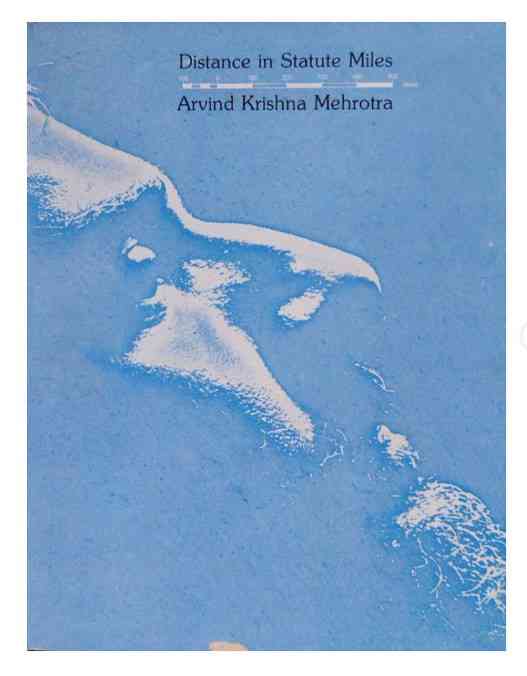
I had arrived to talk to him regarding my PhD work on Gujarati little magazines but also to interview him about his new book of poems. The garden of this house is the subject of that book of poems, a book he has sincerely titled Of Least Concern.
I met him over the course of two days to discuss both these subjects. It was on the second day that we spoke about his book. I had arrived on time and unlike the day before, two chairs were now spread in the back garden. “The introduction says quite a lot…it has whatever one wants to say.” These were his first words while I settled on the chair with his book and my notepad full of questions. He had admitted elsewhere that he was a “reluctant writer”. I didn’t know he was a reluctant speaker of his work too.
“Why does it matter for you to name things in your poetry?” was my first question. The epigraph to “Lockdown Garden”, the first section of the book, is taken from the Analects. It goes: “The Master said: ‘Little Ones, why don’t you study the Poems?… Also, you will learn there the names of many birds, animals, plants, and trees.”
He answers almost instinctively, as he did very often during our conversation, as if the responses are always ready and he was waiting for the question to arrive – “Unless you name it, the thing does not exist for you. How does it exist? It is only when you name it that it takes on a life. Otherwise, it is only something floating in the sky. All you know is it is a butterfly but once you look at it and look it up in a book of butterflies, you take a photograph, and through Google Lens, you realise it is called the common glider. You can’t look at the world in the sense of a butterfly, a tree, or a bird. I mean, you can’t think without naming something. I wouldn’t be able to construct the world.”
This also meant that all the poems in Mehrotra’s book had emerged from the reality around him, like much of his oeuvre over the decades. In the introduction to the book he had compared this act of looking and naming to the practice of drawing: “Perhaps the nearest description of what I was doing is a passage in Coleridge’s Biographia Literaria: ‘With my pencil and memorandum book in my hand, I was making studies, as the artists call them, and often moulding my thoughts into verse, with the objects and imagery immediately before my senses.’”
But naming once does not guarantee that the “thing” has permanently entered one’s perceptual world; it is not a mathematical exercise of addition or one of solving a complex puzzle, where one secures a piece and goes looking for the rest, as he immediately added: “I can forget the name the next minute but how do you construct the world by just saying it is a tree. That’s not enough; you are not seeing anything. You only see it once you see that it is a jamun tree or a litchi tree or a mango tree.”
He quickly points to something behind me: “There is that tree at the back, which I am still waiting to know the name of… For me, it doesn’t exist because I do not know what it is.” He paused for a moment, and we became aware of the chirping of various birds blending with the calls of passing vehicles outside.
“You see the tree in the fifth poem, the long one,” he said.
“You mean the fourth one? The one which begins, ‘It was planted all wrong’?” I asked.
“Yes, come. I will show you that tree. I will show you exactly why it was planted all wrong.”
And we got up. I am taller and much younger than him but he was too quick for his age. As we briskly walked to the front garden, he continued, “It flowered for the first time last year. It took me all these years and I kept waiting and I thought I would die without knowing what this wretched tree is. It meant nothing to me.”
Soon we were under the shade of a large mango tree and in front of us, close to the garden wall, was a tall yet lean tree. Mehrotra tore a leaf and told me “It is the Ashoka tree. The Saraca asoca. The sorrowless tree. Next to a wall under these huge mango trees, it refused to grow… I must have planted it eight years ago. And then suddenly after four or five years it had its first flower and then I was able to identify it.” He laughed with an intoxicating childish smile and says, “You see, nothing is imagined. If I say it is there then it is there.” Here is the poem he was referring to:
“It was planted
all wrong, too
close to a wall,
under the mango
trees. There was nowhere for it
to go except up
like a mast and
that’s where it went, taking
its leaves with it –
long, tapering.
I never saw them
fall. It never
flowered, which
would’ve helped
me look it up in a
book of flowering
Indian trees. Now
I’ll never know
its name nor of
the bird singing
at evening
in the shrubbery.”
And when we came back to our chairs, he returned to the nameless tree behind me, saying that he had tried asking woodcutters about its name but to no effect. He appeared impatient after he said that, looking expectantly at the tree. “Let’s go and take a leaf and see if Google Lens can help us,” he said. I was sure he must have done that already but regardless, he plunged ahead in the direction of that nameless tree.
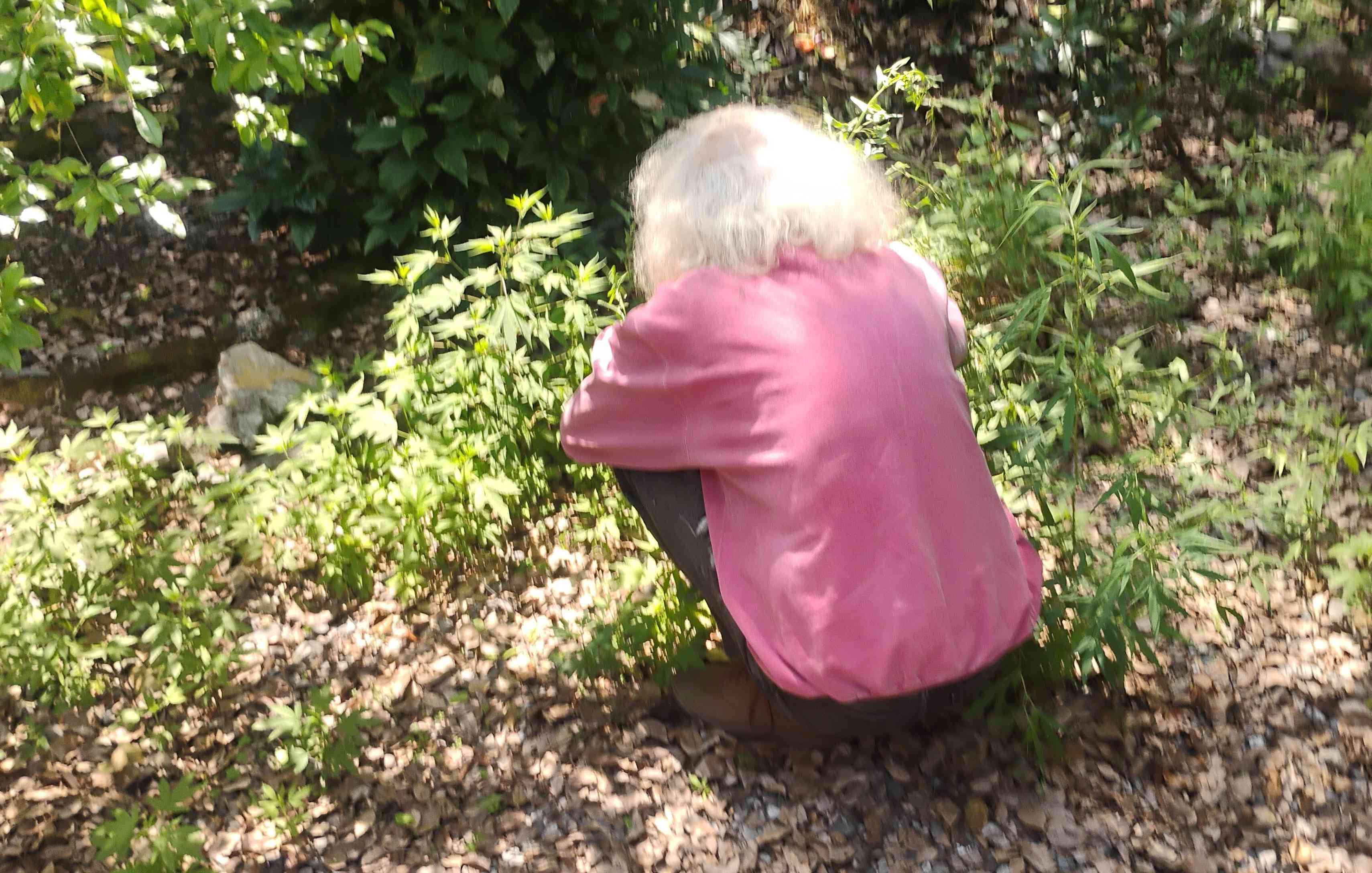
I followed him but before I knew, he was sitting on his haunches in front of what looked like some kind of grass or weed. When he turned towards me, I saw he was chewing some leaves, saying that someone had told him that one can make very good chutney out of them. “These are delicious!” he said, offering me a few. It was the French sorrel; I learnt later from him.
Writing about places
We checked the leaf but the nameless tree still didn’t come to life. He seemed annoyed but then noticed some garbage at the corner of the garden. Plastic plates with bird food that neighbours had kept on his garden wall had fallen inside. The ground was mushy and covered with a thick layer of dry leaves. I needed to be careful. But he had again plunged ahead without a thought. It was his territory, not mine.
Over the two days, I noticed this frequently; I mean, his distractions. What might draw his fancy the next moment, one never knew. On the first day, while speaking about Gujarati little magazines, our conversation had swiftly drifted to the saffronisation of academic institutions. We were sitting in the front garden and he was talking about colleges in Dehradun. “It is completely ruled by the BJP, the institution, the faculty, the students and research is what you do in your spare time. What you do is help run the college, you do invigilation, you do this, you do that,” and after a short pause, he added, “And I am trying to identify this bird… Let me check.”
And that is when I heard a distinct bird sound that had been going on for some time in our background. Mehrotra was engrossed in his phone. “Ah, I think it is the white-throated fantail.” He was elated upon identifying it. “Recently I have had this toy,” he said with a broad smile. He was talking about the “Merlin Bird ID”, an app that helps him identify birds. I was reminded of a poem from the book:
“What might
the bird
be saying
so loudly
so early
in the morning?”
In the introduction to their translations of Vinod Kumar Shukla’s short stories, Arvind Krishna Mehrotra and Sara Rai write: “There is nothing of me except what is here,’ Vinod Kumar Shukla writes in a poem. His ‘here’ is a specific place: Raipur and, before that, Rajnandgaon.” The same lines could be used for Mehrotra, only the specific places would be replaced with Dehradun, and before that, Allahabad (not what is now called Prayagraj). “Place was not a part of Indian poetry in English for a long time. We did not mention any cities,” Mehrotra said in a recent conversation with the poet Arundhati Subramaniam.
He goes on, “In the [19]60s…the whole country was waiting to be named in Indian poetry in English.” Mehrotra and his generation of writers, not only in English but also other Indian languages, took on the charge of bringing streets and places back to the page, to give a location to their poetry – Dehradun, Allahabad, Bombay, Ahmedabad, Baroda. “We were like cartographers, mapping the city,” he had acknowledged elsewhere.
But unlike his compatriots, the best example being Arun Kolatkar, who has immortalised his idiom of writing about places in iconic works like Jejuri and Kala Ghoda Poems, Mehrotra’s quest for naming and mapping his territory often begins from his own house.
The garden poems are only an extension of that project of relentless discovery of his own location. While the Author’s note to the book credits the Covid lockdown for providing him a “new watchfulness: towards his garden – “During Covid, I began to see, in the shingled paths around it, what had always lain unnoticed under my feet.” Yet when answering the question regarding the beginning of the garden poems, he was drawn to other genealogies of his poems as he said, “There were garden poems even before the lockdown… But then it was the house…The house has been there since the 70s-80s… if you look at earlier poems from the Collected Poems or Transfiguring Places, the house has been there. Sometimes it is the house, sometimes it is a room, sometimes it is my father, sometimes it is my mother.”
It is for this reason that he says that the garden poems are “only a later extension, an addition rather than a beginning” of his writings about his house. He was talking about his house on Old Survey Road in Dehradun. Here is a section of a poem from his collection Transfiguring Places (1998); the poem is titled “Old Survey Road”:
“At the compound’s edge,
Is a single tree,
Which is three trees
Grown from one sapling,
Or three saplings
Grown into one tree,
Mango, litchi, and peach
Ripening on its branches.”
Yet naming does not guarantee a straightjacketed sense of belonging. For a poet who has, on different occasions, called himself a “Lower East Side poet” when he started out in Allahabad, America was an equally important place in his early decades of writing. His literary imagination had been fuelled by reading American poets like Ezra Pound, William Carlos Williams, Allen Ginsberg, and Lawrence Ferlinghetti. And perhaps that is why, while speaking about Dehradun and Old Survey Road, he soon came to America.
Recounting the experience of his stay in America for the Iowa Writers Program in the 1970s, he said, “This, I think, was my problem with America. I could never write about places there. It was never real for me.”
“Even if you name them?”
“The name did not mean anything…I could never respond to the climate, the ice, to the seasons…I could never have stayed there and become an American poet. I didn’t even try.”
Responding to the same issue in his interview with Laetitia Zecchini, he had said, “In Iowa City I found myself often writing about Allahabad. In the poem ‘Continuitie’ I mentioned the musical names of its roads – Thornhill, Hastings, Lytton – feeling nostalgic for home. Somewhere along the line I realised that if I was going to write about Allahabad in Iowa City, then I may as well do so in Allahabad. Since I draw my poetic sustenance from the things around me, the bountiful goods of America, paradoxically, left me feeling starved.”
But in recent years, another location has started to inform Mehrotra’s work, the place where he was born – Lahore; 11 Temple Road, to be precise. While talking about how it was this house in Dehradun to which his mother had brought him from Lahore in 1947 when he was only a few weeks old, he said, looking in the direction of the nameless tree, “I had always wondered how did she travel. I often wanted to ask my mother, did you come via Delhi…how did you come in 1947, May, in the height of Summer from Lahore to Dehradun? And I was reading just ten days ago a memoir of Dehradun written by BK Joshi, and there he mentions a train that ran from Lahore to Dehradun and the train was called Lahori. So, then I realised that that was the train my mother must have taken when she brought me.”
Mehrotra’s family soon moved to Dehradun during partition and later that house on Temple Road was allotted to the family of Begum Badar Hasan. To this day her family has retained the name plate with Mehrotra’s grandfather’s name – Amolak Ram Mehta. He later showed me a video where Fatma Shah, the current owner of the house, talks about the “Mehta Mansion” as it is called now. Mehrotra was quick to point to the room on her right where he was born on April 16, 1947.
Mehrotra has been suspicious of national identities from the very beginning of his writing career, his poem “Bharatmata: A Prayer” from 1966 is an often-quoted example in this regard. Yet the resurfacing of his connection to Lahore, a place that might have continued to be his home had circumstances been different, has made him even more alert to the contingencies of national belonging. While reflecting on Allahabad, Dehradun, and Lahore, he spoke about his strange disassociation with this country:
“You see you are associated less with a country and more with places. Country is too abstract a thing. It does not mean very much. You associate not even with a place but with a mohalla…you have nothing to with the rest of the world. So basically, the two or three streets in which you live, that becomes your universe. The whole idea of a nation is so abstract. There is utter vagueness about these terms – nation, religion. So one stays away from these large designs. You don’t see yourself as part of these designs. You know if the country were a large design or religion were a design, you don’t see yourself to be fitting in that design anywhere. You can get into a smaller design and relate to that.”
And in this way, the name of one more place and one more street found its way into his poetry. Here is a section from a poem titled “Lahore” from Book of Rahim and Other Poems (2023):
“Behind razor wire, the home town
next door, the Temple Road address
to which I cannot ask my way back;
the city of a thousand names and one:
it can only be Lahore.”
The discussion about Lahore surprisingly brought us to Vinod Kumar Shukla. On my notepad, one of the questions had been about the passing of Shukla and how Mehrotra, as a long-time translator and admirer of his work, responded to it. I was never able to ask the question but Shukla’s departure entered our conversation through Anjum Altaf, an author, translator, and professor from Lahore, who also runs The Peshawar Review.
Altaf often writes poems inspired by the work of other poets; for instance, his 2019 collection Transgressions is written after the work of Faiz Ahmed Faiz. When he was introduced to Shukla’s poems through Mehrotra’s translations in Treasurer of Piggy Banks, he was taken by Shukla’s idiom and decided to write a few poems in his style which he sent to Mehrotra after Shukla passed away in December last year.
Here are two stanzas from his poem “We Live Where We Live”, fashioned after Shukla’s iconic poem “After Chhattisgarh became a state”:
“When I come to Lahore
I come to Lahore
not to Pakistan;
certainly not to West Punjab.
When I go to Amritsar
I will go to Amritsar
not to India;
certainly not to East Punjab.When I come to Lahore
I come to Lahore
I come home.
When I go to Amritsar
I will go to Amritsar
I will go home.
I have keys to both.”
I was worried about the passing time, about the fact that I had only been able to ask two questions so far out of the 25 I had prepared. I now wanted to turn to the question of ageing. In the collection, Mehrotra writes a poem titled “Approaching 80”:
“At 20, meeting an 80-year-old,
I’d wonder what it’s like
to be 80. Now I know.
It’s like being 20 again,
except that along the way
fathers have breakdowns,
mothers dementia,
family houses are sold,
and young men arm wrestle
in the park, as their friends
look on cheeringly.”
I prod him to read the poem. He put on his glasses and after reading the first line, he stopped to say: “When I was 20 and these old retired teachers came to the staffroom, one felt, these people are buffoons…what could someone be thinking at the age of 80? I was pretty confused looking at these bastards… What could be going on in their fucking minds?” He finished reading the poem and laughed like a 20-year-old at his own lines.
The pleasant sunlight of the morning had now turned harsh. He suggested that we could move in. But before we continue with the interview, he wanted to stretch his back and lie down for a bit. He went inside and I shifted to the back porch. Vandana, Mehrotra’s partner, joined me with her artworks and books written by her son, which once belonged to her brother, Pavankumar Jain. While we went through them talking about Jain and her own life, I kept wondering what that 80-year-old might be thinking lying on his bed.
Jain was a Gujarati writer who wrote poems and short stories. Much of his writing had been published within the Gujarati and English language little magazine circuit in the 1960s-70s, with which he had himself been involved for some time. Jain had been responsible for publishing English poems of writers like Mehrotra, Dilip Chitre, Ashok Chopra and Amit Rai in Gujarati magazines like Kruti (1966–72). In fact, it was the issues of Kruti from the late 1960s that had brought me to Old Survey Road.
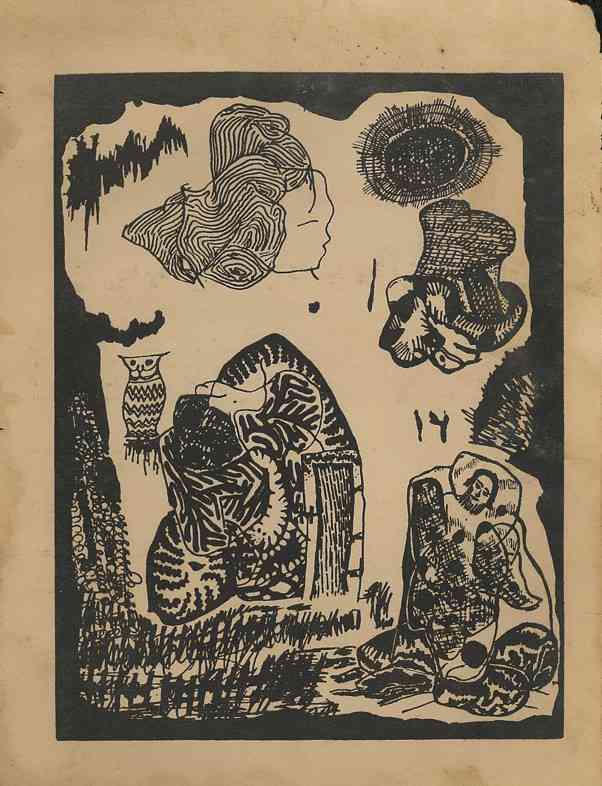
The day before that we had gone through Jain’s daily journals. Made from children’s school notebooks, these journals recounted not the intimacies and predicaments of his life but offered instead an inventory of banal facts – activities he did (“Got Mangilal’s passbook updated”), meticulous account of the money he spent, bus timings, the people he voted (“BMC elections 2012. Went and voted at Manilal Sunder ji School for Miss Falina Shroff.”). A recurring entry was – “Slept in the afternoon” and “Went for a walk in the evening.”
“This is the high point of banality raised to a fine art.” Arvind had said holding the journal from 2009 in his hand. But soon his enthusiastic face gave way to a lament, “How do we make the world read, recognise, and understand someone like Pavan? This is the problem with this country. Everybody is so busy talking about themselves. How will any literature live? It lives on its past. But we are forgetting our past so quickly. The people who are writing now, don’t they realise that the same fate is going to befall them very soon? With the coming of social media. It is so much present driven. The great sufferer is a thing like literature. Unless you are looking at the past, you don’t know where you are coming from and where you are going.”
While the world around him wallows in a celebration and forgetfulness of the momentary, Mehrotra’s steadfast recording of his humdrum present as well as excavation of past continues quietly on Old Survey Road. These days he is translating the Hindi poet Shamsher Bahadur Singh and working, in fits and starts, on translations of Pavankumar Jain’s writings from Gujarati.
In an email he sent a few days ago he had written, quite poignantly, “Had I another life I’d spend more time translating people like him than writing my own poems.” Some of his new garden poems appeared in the latest issue of the Australian literary journal HEAT. Here are a few lines from a poem titled “The Spell”:
“The travelling sun returns to its summer schedule.
A branch of the peach tree scrapes the ground;
a fat green chilli hangs by a thread. Separately,
bulbuls arrive at the birdbath and leave together.”
Digvijay Nikam is a PhD student at the Centre for English Studies, Jawaharlal Nehru University. His work deals with modernist print cultures from western India.
[ad_2]
Source link