
[ad_1]
America has been our happy home for nearly 60 years. My wife and I remain deeply grateful to this welcoming society, which has allowed us to be part of the American Dream in every way. But we have never been as concerned as we are now – for our family and for our democracy.
Our children and grandchildren are quintessentially American, yet their appearance will always set them apart. It would break our hearts if someday a stranger were to yell at them, “Go back to India!”
Our concern is not unfounded, given the dramatic increase in hostility toward Indians. It began with the H-1B visa controversy and has grown more vocal and more hostile since. Texas, with its large Hindu and Muslim populations, has become a focal point for segments of the MAGA Right who openly display bigotry and xenophobia.
Hindus for Human Rights, of which I am a co-founder, has denounced these disturbing developments in the strongest terms. “Hindus and Muslims are not ‘taking over’ Texas,” said Ria Chakrabarty, Senior Policy Director. “We are building homes, raising families, serving our communities, praying in our own traditions, and contributing to the shared civic life of this country…As a Hindu Texan, I know how Hindu and Muslim Texans have made Texas stronger.”
As an immigrant who arrived in the 1960s, I have long been aware of the undercurrent of racial supremacy among segments of white conservatives – especially after being physically assaulted by a racist white man in 1969. Ugly though the incident was, it never shook my belief in the decency of most Americans.
So it is shocking to hear otherwise decent people openly expressing hatred for Hindus. Unfortunately, all it takes today is news of an Indian involved in a scam or a viral video of troubling behaviour abroad to trigger a fresh round of online hostility. Increasingly, anti‑Indian hate from the MAGA Right resembles the anti‑Muslim hate expressed by Hindu supremacists.
India-hate did not develop overnight. It began with the H-1B controversy during US President Donald Trump’s second term, followed by numerous reported cases of alleged visa fraud involving Indians. The hostility has snowballed ever since.
In Frisco, Texas – where 20% of residents are Indian – the City Council has become a battleground between older conservative residents worried about “cultural invasion” and newer Indian residents. Criticisms of Indians have included alleged reluctance to assimilate, concerns about civic engagement, and accusations of insular business practices, often framed through nativist and xenophobic rhetoric.
It is not my place to pass judgement on either the criticisms or the community’s responses. Perhaps heightened public scrutiny is exacerbating mistrust. Perhaps increased exposure to India’s seamier side, through proliferating video content, is generating more scorn.
How did the H-1B controversy escalate so rapidly into disdain for Indians? Why do Hindutva organisations continue to advance claims of “Hinduphobia” instead of joining others to confront the common threat of MAGA/White/Evangelical supremacy? And are Hindus guilty of double standards when they decry Hindu‑hate in America while supporting anti‑minority policies institutionalised by the Modi government?
These are questions worth pondering as we brace for more attacks on immigrant communities before the mid‑term elections in November. But first, a quick update on Federal Bureau of Investigation hate‑crime statistics, which I have reported on annually.
Anti-Hindu hate crimes still low
Year after year, anti‑Hindu hate crimes have remained at the lowest end of the 34 categories tracked – alongside Buddhists, Hawaiians, and Jehovah’s Witnesses – while Sikhs, Muslims, and Jews are many times more likely to face hate crimes.
Data from the FBI shows that hate crimes against most communities either trended downward or held steady during 2024-2026, contrary to claims of a surge in “anti‑Hindu” or “anti‑Jewish” hate crimes.
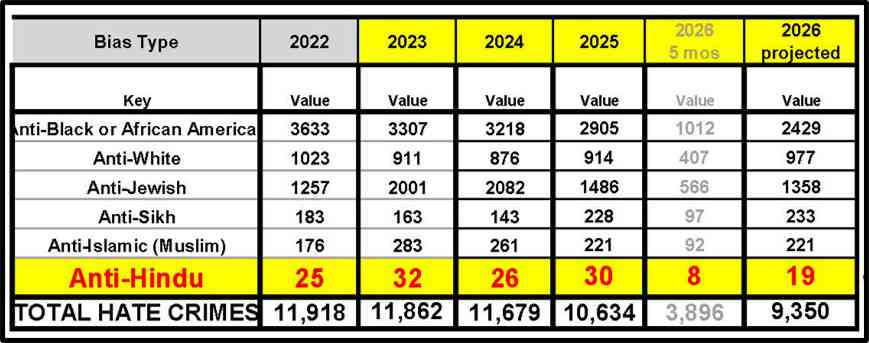
Since Georgia has legislatively condemned “Hinduphobia and anti‑Hindu bigotry,” I examined FBI data for the state. To my surprise, there was only one anti‑Hindu crime over the last five years, classified as vandalism. In the same period, there were 18 anti‑Sikh, six anti‑Muslim, 42 anti‑Jewish, and 99 anti‑White hate crimes. (Unreported bias incidents may exist, but that is true for all communities.)
This raises the question: Why are Georgia lawmakers so eager to champion only one faith community – Hindus – who appear to face little or no hate crimes in the state?
New epicenter of Hindutva influence
One answer may be that Hindutva organisations in Georgia have been highly effective in influencing lawmakers. A notable example is House Resolution 701, “Condemning Hinduphobia and anti‑Hindu bigotry,” championed by the Coalition of Hindus of North America.
It was strongly supported by Congressman Sanford Bishop, a civil‑rights stalwart who has become a close ally of Hindutva groups. Unsurprisingly, the resolution was introduced and passed on the same day – March 27, 2023 – with little scrutiny or debate.
Republican sponsors of the resolution had also received over $80,000 in donations from a political action committee calling itself “Hindus of Georgia”.
“We must stand against Hinduphobia. My state of Georgia became the first U.S. state to pass a resolution condemning anti-Hindu hate,” says U.S. U.S. Congressman Sanford Bishop to applause from Indian-Americans pic.twitter.com/BbTtUWtDXw
— Shashank Mattoo (@MattooShashank) June 24, 2026
The resolution is symbolic, yet it legitimises the “working definition of Hinduphobia” created by an alliance of Hindutva organisations in 2022: “A set of antagonistic, destructive, and derogatory attitudes and behaviors towards Sanatana Dharma (Hinduism) and Hindus that may manifest as prejudice, fear, or hatred.”
An extensive search for data supporting claims of widespread “Hinduphobia” yielded no evidence.
Why choose Georgia – a state with virtually no anti‑Hindu hate crimes – to push such resolutions? Likely because it offered an easy legislative pathway to legitimise the “working definition” and weaponise it against critics.
Journalist Pieter Friedrich has publicly testified about how such definitions could be used to silence dissent:
“Is documenting RSS history an ‘antagonistic attitude towards Hinduism’?
Is citing human rights reports about the 2002 Gujarat pogrom ‘derogatory’ towards Hinduism?
Is quoting RSS founders ‘destructive behavior’?
Perhaps prosecutors can define what an ‘attitude’ is. Perhaps they can distinguish between criticizing RSS and being ‘derogatory towards Hinduism.’ Perhaps. Perhaps. Or perhaps the vagueness is the weapon.”
Pushed by this Hindu nationalist network, Georgia writes ‘Hinduphobia’ into its civil rights law.”
Also, in an obvious attempt to frustrate scholars of Hinduism, the Hindu American Foundation maintains a growing list of terms that it considers “anti-Hindu or Hinduphobic”: for example, Brahmanism, Savarna, Hindutvadi, Bakht, and so on, which are frequently uses in academia. The Hindu American Foundation also makes a transparent attempt to parrot the Zionists: “There are also those who deny the existence of Hinduphobia and anti-Hindu hatred, which in itself can be a manifestation of Hinduphobia and anti-Hindu hatred.”
In my view, the “working definition” attempts to emulate efforts by certain pro‑Israel advocacy groups to broaden the definition of antisemitism. Many American Jews reject that expanded definition, yet it was officially adopted by the Trump administration. I am certain that, over time, many Indians and Hindus will also reject Hindutva’s expansive definition of “Hinduphobia”.
The “working definition” explicitly targets academia: “…Hinduphobia is exacerbated and institutionalized by some in academia who support the dismantling of Hinduism and accuse its sacred texts and cultural practices of violence and oppression.”
By this logic, scholars who critique caste oppression – including those citing BR Ambedkar – are guilty of “institutionalizing Hinduphobia.” This is deeply troubling.
As I have stated repeatedly, I condemn all forms of bigotry and hate. But the commonly understood definition of phobia – “extreme or irrational fear or aversion” – simply does not apply to anti‑Hindu incidents in America. Perhaps recognising this, Hindutva organisations now promote resolutions like HR 69 without defining “Hinduphobia,” confident they can insert their preferred definition later.
The Georgian Dissent
Mario Nawfal, a popular host on X, posted on June 24, 2026 that Georgia had outlawed “Hinduphobia and anti‑Hindu bigotry” and made them crimes. He was referring to HR 701, which passed, and SB 375, which would have criminalised “Hinduphobia” but did not pass. His misstatement inadvertently triggered widespread outrage among Georgians who suddenly grasped the implications of these seemingly innocuous legislative actions.
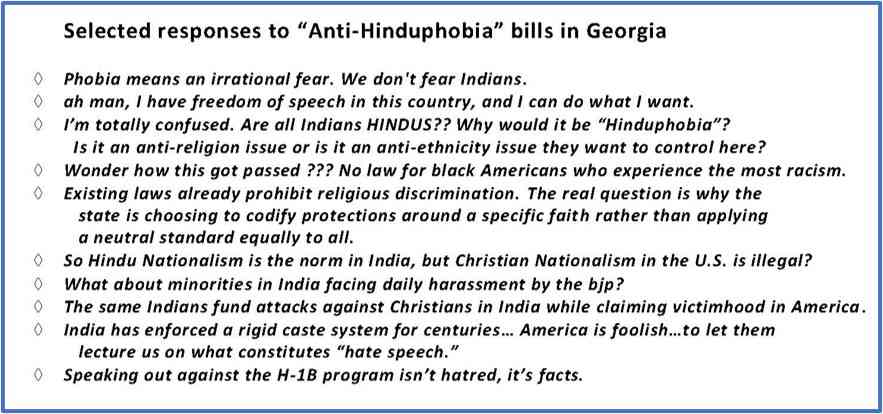
Reviewing more than 1,000 comments opposing HR 701 and SB 375 – see NDTV and RT.com – it became clear that Hindutva organisations had scored a “self‑goal” by drawing attention to their efforts to secure special protections for Hindus – protections no other community has sought.
That, and other objections raised by Georgians, are highlighted below:
Diaspora’s ‘Hindu khatre mein hai’
House Resolution 69, introduced in early 2025 by Representative Shri Thanedar of Michigan, claims that “according to the FBI… anti‑Hindu hate crimes targeting mandirs and persons are annually on the rise”. This is false; as noted earlier, anti‑Hindu hate crimes have remained level for five years.
Despite strong objections raised in Georgia, Hindutva organisations continue to push HR 69. Distressingly, four out of five Indian/Hindu Members of Congress have cosponsored it, despite the likelihood that it could be weaponised to intimidate Indian Americans who oppose Hindutva ideology. Endorsing HR 69 would undermine the trust of non‑Hindu Indian Americans.
Why are Hindutva organisations so fixated on portraying “Hinduphobia” as a major threat?
At one level, the answer mirrors the foundational dogma in India that Hinduism is perpetually endangered by Islam and Christianity – Hindu khatre mein hai. The slogan, which means “Hindus are in danger”, has long served as a rallying cry and justification for hostility toward minorities.
At another level, “Hindu victimhood” is central to Hindutva organisations’ messaging and fundraising in America. In this narrative, school textbooks describing caste, scholars critiquing Hindutva, Dalits advocating for caste‑discrimination protections, and Sikhs supporting laws against transnational repression are all labeled “Hinduphobic.”
The good news is that younger Indian Americans, with access to abundant images and commentary from India, can now independently assess the realities. Exaggerated claims by Hindutva groups are being increasingly challenged – sometimes aided by AI tools.
The pretense that Hindutva organisations alone define Hinduism or “Hinduphobia” has been exposed. Recent student protests in Delhi and other cities, led by the satirical Cockroach Janata Party, show how quickly power dynamics can shift through savvy use of social media.
If the enthusiasm displayed by Gen Z during solidarity demonstrations across America is any indication, a “Cockroach USA Party” may be emerging – ready to challenge entrenched dynamics in diaspora politics and help end hate and supremacy in our communities.
Raju Rajagopal is a co-founder of Hindus for Human Rights, which opposes Hindu supremacy and caste discrimination and speaks up for minority rights.
[ad_2]
Source link