
[ad_1]
A Muslim domestic worker struggling to find employment in Delhi laments forlornly, “I am uneducated and it is very difficult for me to get a job. The only one I can get is of a domestic help, and even that is not happening because of my religion. I want to be known by my real name. I am not a criminal. I don’t see any reason to hide my identity.”
I hear anecdotally from Muslim taxi drivers and delivery agents whose services I hire of clients not uncommonly refusing their services due to their religious identity. Only sometimes does this come to public notice. One instance is when a man named Abhishek Mishra, who identified as a “Hindutva thinker” and was followed by several Indian ministers on X, announced on social media that he canceled an Ola cab ride because the driver was Muslim. The reason he gave was that he did not want to give his money to “Jihadi people”.
In the climate of frank and even defiant anti-Muslim prejudice among the Indian middle classes today, Muslim workers feel barred or pushed out from employment in both the public and private sector through the experience of everyday discrimination and prejudice in the workplace.
Muslim women in multiple cleaning, cooking and caregiving jobs frequently use Hindu-sounding names at their workplaces in order to retain their jobs. One of them said to Al Jazeera that her grandmother even wore a sari and bindi to appear Hindu, and her sister worked even on Eid to avoid suspicion.
Other studies also confirm that many Muslim domestic workers reported using Hindu names to hide their Muslim identity. This was because they had struggled initially to find work using their Muslim names, but found that if they changed their names to Hindu ones this got them quicker and better employment opportunities. They also adopted Hindu customs in the workplace such as applying vermillion on their foreheads, wearing saris and speaking only in Hindi.
The New Indian Express reports in a similar vein that Muslim domestic workers from Tamil Nadu in Delhi face job discrimination due to their names. To secure employment, many adopt Hindu names, despite a sense of personal discomfort and humiliation. Employers openly express distrust and reluctance to hire Muslims. They justify their prejudice citing “security concerns” – as though Muslims by definition are untrustworthy.
Their predicament is compounded by the inclusion of religious identifiers of people seeking employment on online job portals for domestic help. Some residents are candid about their prejudice. A homemaker said, “It is my personal choice who I will employ and who I won’t. I do not feel secure about a Muslim woman working in my house. I do not trust them,” adding that most women in her locality would not employ Muslim domestics.
Studies confirm that working conditions are dismal not just for Muslim but also Hindu casual workers. They are often subjected to extremely inhumane conditions of work which include no water, no food, and delayed and reduced payment. But they find that the Muslims are more vulnerable. They report feeling unwelcome. Their Hindu employer and fellow-workers do not socialise with them. They also say they felt excluded because of preconceptions about their eating habits.
Open discrimination is also the fate of Muslim gig workers. For instance, a man of Hindu identity ordered chicken from a food delivery app, and instructed that he would prefer a Hindu delivery agent. When a Muslim agent appeared instead, he refused to accept the package and slammed the company. When they re-sent the package with a Hindu agent, he still refused to accept it. This was repeated in Hyderabad, with a customer again refusing to accept food delivered by a Muslim delivery agent.
In Lucknow, the customer first questioned a Zomato delivery agent named Mohammad Aslam about his identity. Upon learning of his background, the customer assaulted him, holding him captive for about one and a half hours before the police intervened. Bharata Rakshana Vedike, a Hindutva group in Karnataka, actually campaigns for a boycott of cab services operated by Muslims. Its members visit homes to persuade people not to use cabs driven by Muslim drivers, arguing that it is a matter of cultural and religious purity.
In UP’s Lucknow, a Muslim Zomato delivery personnel was allegedly held captive and tortured over his religious identity. As per FIR, victim claims the assailants threw glass of alcohol on him, attacked with helmet and threatened him with life while he was held captive for 1.5… pic.twitter.com/Fqf8eg7idR
— Piyush Rai (@Benarasiyaa) August 22, 2024
Online aggregators do nothing to protect Muslim gig workers who face discrimination – affecting their already meagre earnings – and even sometimes violence. Bigotry is enacted on the apps, but – as journalist Rohitha Naraharishetty documents – the company just looks away, except occasionally when it stirs social media outrage. But even then, there is little that is either preventive or remedial that the companies offer to their at-risk delivery agents. She points to what is possible with the example of the United States, where Uber banned white supremacists who made black Uber drivers uncomfortable and vulnerable.
However, the same company Uber in India does nothing when their Muslim drivers feel unsafe or even when they face violence. For instance Syed Lateefuddin, on his third ride as Uber driver in Hyderabad, was accosted by six men who began following him on a motorbike and a scooter. They forced him to stop his car and coerced him to chant “Jai Shri Ram”. They also threw stones at his car, shattering the windows. Lateefuddin was terrified, abandoned his car and ran away. He suspects the attack was triggered by the Islamic prayer beads hanging in his car, a visible sign of his faith.
He called Uber’s emergency helpline multiple times but they provided him no assistance. Fortunately, he had escaped without serious injury, but his car was badly damaged. It cost him over Rs 1.5 lakh to repair. “Uber’s representatives should have come with me to the police station. Instead, I’ve not heard a single word of support from them until now,” he told Naraharishetty (who quotes him using a pseudonym). He had to face a hostile police system alone.
Through their inaction and indifference, Naraharishetty observes that apps wantonly compromise the workers’ right to life, their right to livelihood and to dignity. The reason, she avers, is that Swiggy, Uber, and other platform apps are fundamentally antithetical to workers’ labour rights. The apps present themselves as value-neutral entities. But by failing to recognise the vulnerability of stigmatised sections of gig workers, they wilfully deny them their rights in their bid to swell further the company’s profits.
“It’s not rocket science”, Kaveri Medappa, a researcher on gig and platform workers explains. “You can filter out specific words… they can make sure that words like Hindu, Muslim, Dalit are flagged. There’s no will to do any of this,” she says. “Even if you don’t have these filters – as soon as the delivery person receives the delivery notes and is able to see them, why can’t [the platform] enable a function to report the notes and cancel the order? These are simple tools to have embedded in the app interface.”
This discrimination is grievous for working class Muslims but not confined to them. In 2015, an Economic Times Intelligence Group highlighted the disparity in representation of Muslims in senior management within India’s corporate sector. Despite making up 14.2% of the population, Muslims only account for 2.67% of directors and senior executives in Bombay Stock Exchange 500 companies. These executives received 3.14% of the total remuneration for this group. In BSE 100 companies, the representation increases slightly to 4.60%, but the remuneration percentage drops to 2.56%.
Many studies have confirmed entry-level anti-Muslim prejudices that significantly block the entry of qualified professionals into private sector jobs. In 2005, scholars Paul Attewell and Sukhadeo Thorat undertook a study in which applications with similar qualifications but different names were sent out. They found that discrimination operated even at the application state and even more severely at the interview stage against applicants with Muslim names, as compared with those with upper-caste Hindu names.
This was confirmed by another similar study by LedBy Foundation. It created two identical résumés for a fictitious Muslim woman, Habiba Ali, and a Hindu woman, Priyanka Sharma, and sent them for 1,000 job applications each. Priyanka received 208 positive responses, while Habiba received 103. Priyanka got more callbacks and proactive contacts from recruiters. This, despite the fact that they had equal qualifications. This once again revealed unsaid norms that the private sector employers maintain of not recruiting Muslim employees, and a possible underlying prejudice that Muslim women are less capable for jobs that they are fully qualified for.
This is in line also with the experience reported by many young qualified Muslim women. Madina Ashfaq, a postgraduate in clinical psychology said, “I have been a straight ‘A’ student since middle school. While others in my batch have gotten placed in reputed hospitals, I struggle to even get a call for an interview.” Likewise Wajiha Noor is a hijab-wearing fashion designer. She did get some interview calls, but feels her hijab was a dealbreaker.
Some may argue about the necessity of admitting a caveat here. “[T]he low share of Muslims among the better jobs in India need not necessarily be a result of discrimination in the hiring process,” argue journalists Abhishek Jha and Roshan Kishore in a data analysis published in Hindustan Times in 2023 “Rather, it could be the result of Muslim job-seekers lagging in terms of educational qualifications, which is bound to have a big role in employability.”
Data does confirm that Muslims in India have the lowest rate of enrollment in higher education. Worse still, the enrollment numbers of Muslim students decreased by 8% between 2019 and 2020, according to a report that stated: “(The) Muslim community is the only category to experience an absolute decline, while other communities have witnessed an overall increase in enrolment.”. There can be many reasons for these – such as inadequate educational infrastructure in Muslim-majority areas resulting in a shortage of schools including separate schools for girls that may be culturally more acceptable, and a lack of trained teachers, besides poverty but also the experience of discrimination that discourage Muslim educational access.
But I underline that this caveat does not apply to the instances of discrimination that we describe here, because the prejudice that blocks their job chances is experienced by Muslims who are educated and qualified, no less than their Hindu counterparts.
Ghazala Jamil, teacher and author of Muslim Women Speak, feels that this is partly because “Muslim women are stereotyped as being imprisoned in their homes by purdah, therefore professionally incapacitated. This image plays in the mind of employers who often subject Muslim women candidates to hostile questions in the interview and selection process.”
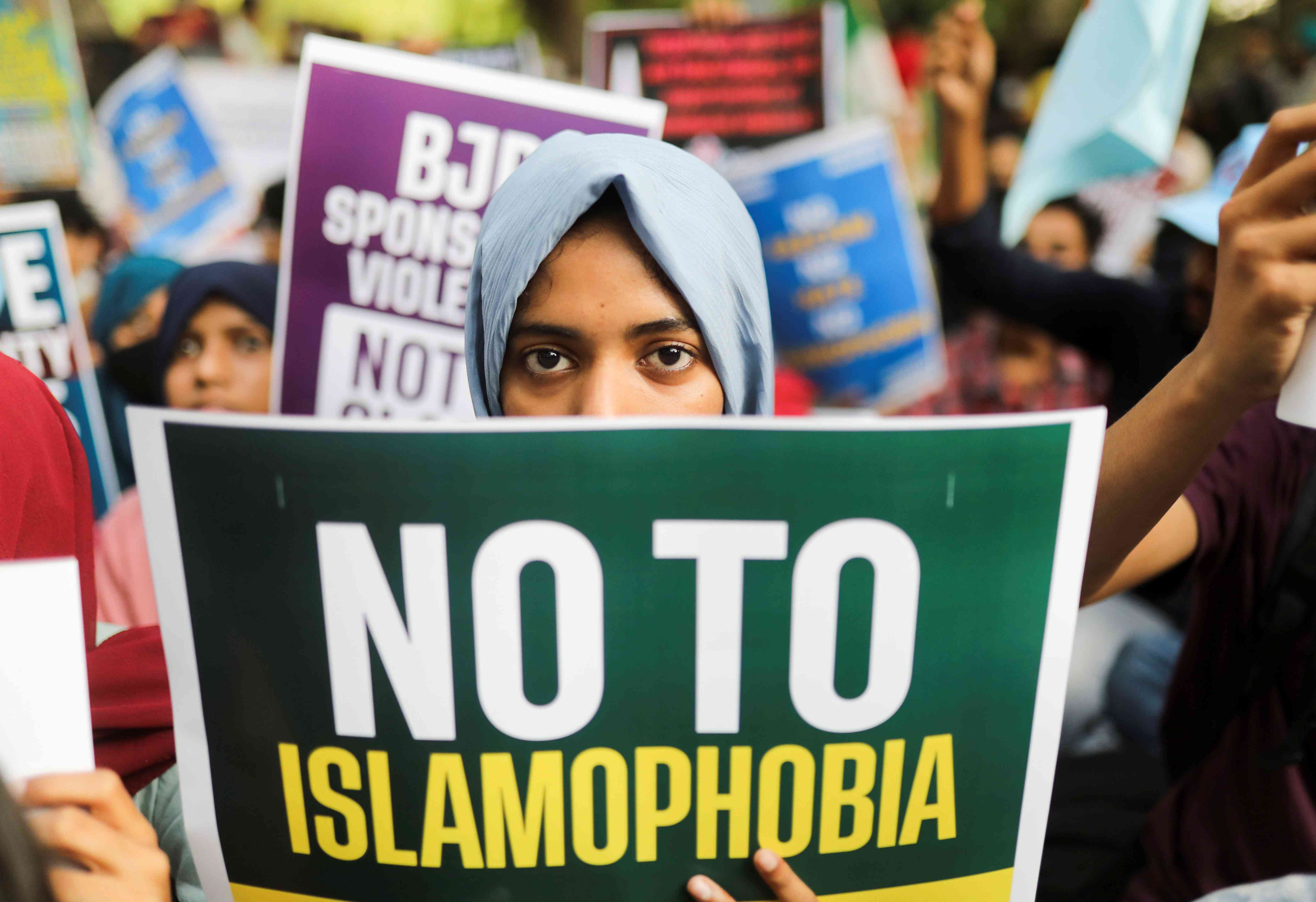
She adds that it is also true that “Often, the employers might simply have decided not to employ Muslims because of bigotry and Islamophobia. Even when they are selected, co-workers might subject them to subtle discrimination or microaggressions which makes the workplace hostile. Lack of dignity and low salaries keep much lower class and lower-middle class Muslim women from wage work because it is not considered worth their time,” said Jamil.
Three Indian Muslim women spoke to Article 14 of workplace “micro-aggressions”, which Jamil refers to, about their experiences of prejudice in Delhi-based private firms. They say they were chastised, humiliated, pressured to disown their religious identity, harassed over wearing the hijab, and subjected to taunts referring to Pakistan.
One said, “The CEO occasionally commented on how Muslims are intolerant and how he hoped I was different.” She was advised “not to wear her religion on her sleeve”. The CEO asked her in a meeting that if someone offered her a glass of wine, would she accept it – because it would be impolite to decline. When she was delayed in submitting an output, she was asked by her seniors in jest if she had gone to Pakistan.
Another young woman described her experience when she was called by a global company for a final interview for her selection. The question centred around the hijab she wore, and they offered her the job if she agreed to take it off. She refused.
A Muslim intern in a Delhi-based global ed-tech company talked about how casual Islamophobia was a normal part of office conversation. She explained once to her colleagues that in the Muslim nikah, or marriage, the woman is required to affirm qubool hai (I accept) three times before the marriage is solemnised. One of them laughingly remarked how Muslims also say talaq three times to end their marriages.
Another female colleague asked her how to get a gharara made; she would know because it is popular in Pakistan. “I asked her how I would know what people in Pakistan wear.” When the film The Kerala Files was released, another colleague kept speaking to her how traumatised she was by the experience of the women in the film.
Not just Muslim women. BBC reports that when Mumbai-based Zeeshan Khan applied after completing a business management course for a job at the jewellery firm, Hari Krishna Exports, the company did not call him for an interview. Instead, an email popped into his mailbox from them, saying, “We regret to inform you that we only hire non-Muslim candidates”. The company later formally retracted with a less than convincing denial after some social media outrage. Khan ruefully said he would take a break before he applies for a job again.
I am grateful for the research support from Syed Rubeel Haider Zaidi.
Harsh Mander is a peace and justice worker, writer, teacher who leads the Karwan e Mohabbat, a people’s campaign to fight hate with radical love and solidarity. He teaches part-time at the South Asia Institute, Heidelberg University, and has authored many books, including Partitions of the Heart, Fatal Accidents of Birth and Looking Away.
[ad_2]
Source link