
[ad_1]
Steven Spielberg’s monster hit Jaws (1975), about a man-eating shark plaguing a seaside town, was a turning point in the American director’s career. In 2025, the film’s fiftieth anniversary was marked by a re-release in the United States.
The Jaws experience is now available in India. After screenings at the recently concluded Red Lorry Festival, the restored director’s cut version of Jaws will be shown on April 2 in Mumbai. The one-off screening at Regal Cinema by Film Heritage Foundation is a rare opportunity to watch Jaws the way Spielberg intended – on a big screen, and with hundreds of shrieking viewers.
Jaws is usually classified as a monster movie or a horror movie. In an essay, writer-director Atul Sabharwal argues that Jaws actually belongs to another genre altogether. The only way to find out which one is to read on.
A Meeting of Minds and Men
There was a moment in Steven Spielberg’s life that was known only to cinephiles, his fans and film historians. That moment, thanks to Spielberg’s The Fabelmans (2022), is now known to the whole world and a whole new generation.
The moment was the meeting between young Steven Spielberg/Sammy Fabelman and the director John Ford. Spielberg’s reverence for Ford made him seek an unscheduled meeting with the master. Such was its impact on the yet-to-be-director that Spielberg chose to immortalise it on celluloid. (This is not that cliched phrase of film writing. Spielberg actually shot The Fablemans on celluloid).
Much like the Spielberg-Ford meeting, the timing of Spielberg’s Jaws (1975) is fortuitous and could serve as a pre-climax act in the Spielberg-Ford spiritual affair. Jaws, which would turn out to be Spielberg’s first box office blockbuster and concretise his career for perpetuity, went into production in the wake of Ford’s demise in 1973. Perhaps this is the raison d’etre for Jaws, the only Spielberg film that comes spiritually closest to Ford’s ethos and imagery.
Jaws has always been filed in the genre category of creature films, monster movies, horror films. But the genre that Jaws truly belongs to is so rare that it is the only film existing as its exhibit. There is no other such film that has existed prior or since Jaws in the genre that I’ll give a moniker to in a bit.
John Ford and the Westerns
In 1973, following Ford’s demise, Satyajit Ray wrote in A Tribute to John Ford:
“[Ford’s] hallmark remained virtually unchanged over the last forty years. A hallmark is never easy to describe, but the nearest description of Ford’s would be a combination of strength and simplicity. The nearest equivalent I can think of is a musical one: middle-period Beethoven. The same boldness of contour, the simplicity and memorability of line, the sense of architecture, even the same outbursts of boisterousness, and the same heroic, action-packed finales. All this is undoubtedly best expressed in the Westerns.”
Ford directed Westerns, and his departures from the genre were far and few. The birthplace of the Western is America. Though its mass appeal would compel directors the world over to imitate its form, the genre truly belonged to Hollywood.
Clint Eastwood had once remarked, “I feel very close to the Western. There are not too many American art forms that are original. Most are derived from European art forms. Other than the Western and jazz or blues, that’s all that’s really original.”
In its original form, the Western exists in a certain time and space – the western frontier of North America roughly between the end of the Civil War in 1865 to the closing of the frontier just before the twentieth century.
The genre’s artists include painters, authors, filmmakers, poets and musicians. In all their art forms, the Western’s ingredients are men, beast and the landscape.
This hallmark of the genre exists, irrespective of its artist or art form. The relationship in a Western between a man and the landscape is that of a gaze – the man is always looking at the landscape or is juxtaposed against it, displaying a sense of bewilderment, afraid as to what peril the landscape might throw his way. And yet, he cannot turn back because it is the land that he wishes to conquer as a territory or forge through it to ply his trade.
“The man on the black horse halted … and sat, rolling a cigarette, taking in the view. It was Nature in the raw,” writes Oliver Strange in his novel Sudden Rides Again. But the landscape in a Western is not a mere view or a scenery to behold. In the next moment, Strange writes, “as if in direct contradiction, the report of a rifle rang out and the bullet whined through the air above his head”.
Louis L’amour, the bestselling author of Western novels, worked largely in the genre, like John Ford. In his fiction How The West Was Won, L’amour writes, “But there was a time or two when he’d been on the land, when he’d smelled the earth freshly plowed, or hay freely cut…It made a man want a place of his own.”
The juxtaposition of man and landscape becomes more evident in the visual mediums. The National Geographic issue of January 1986 (which I had bought from a junk store) dedicated a cover story to the cowboy artist Charles Marios Russell, famously known as CM Russell.
His 1915 oil painting When Shadows Hint Death shows two horsemen, frozen midstep in shock and fear while pulling cargo on their horses up a hill, guns in hand they gaze at the adjacent hill that is lined edge to edge with the shadows of armed Native Americans from a war party and their horses.
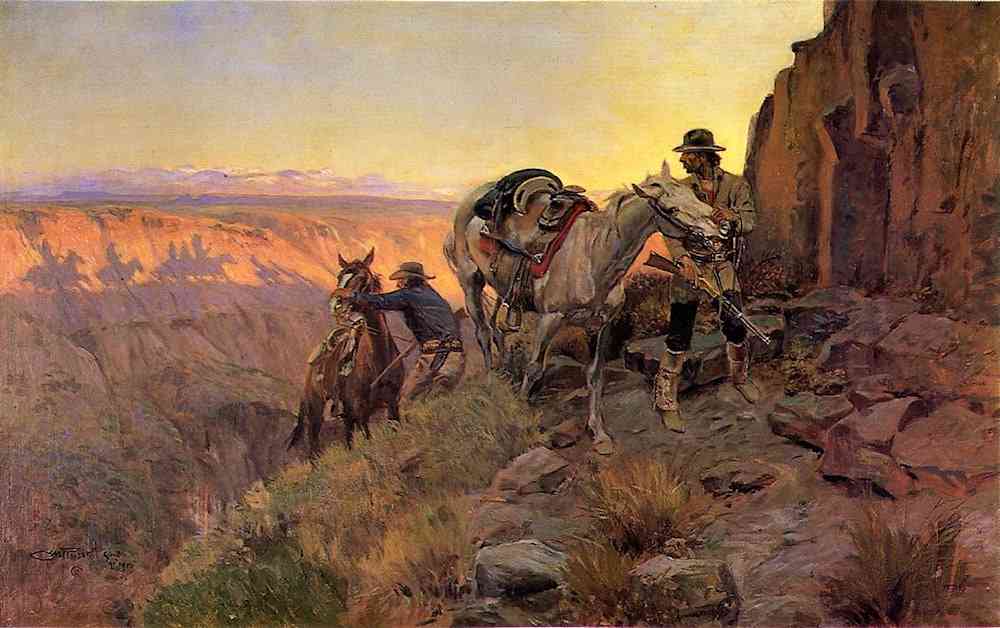
The painting is a precursor to a scene in John Ford’s silent Western The Iron Horse (1924).
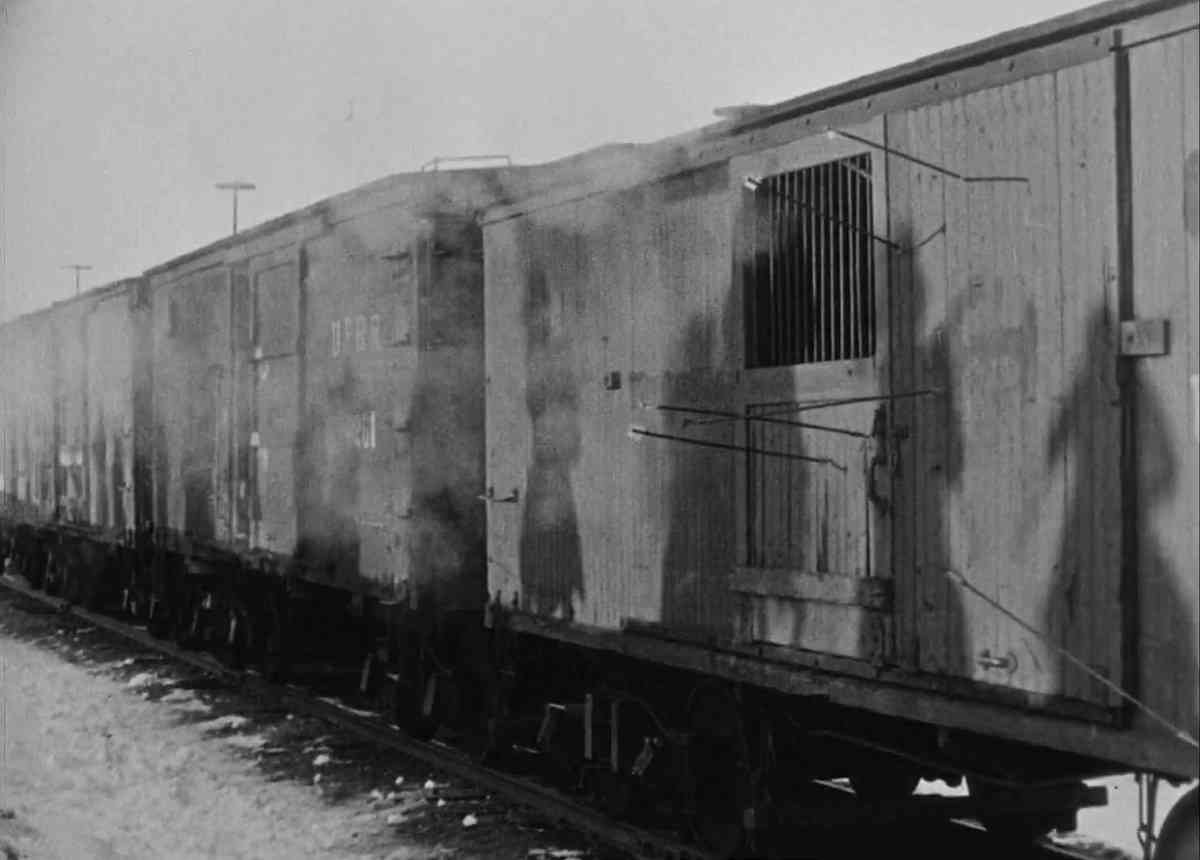
A train rushes down on iron rails. The path ahead is blocked by wooden logs. The engine driver slows down and halts. Out of nowhere, an arrow kills one of the men on the train. The other armed men on the train aim their guns in the direction where the arrow came from.
At this point, Ford does not cut to what the men on the train see. Instead, we get a panoramic shot of the train, isolated in the landscape. The train’s entire length, edge to edge, is lined with the shadows of men and beast from a Native American war party.
Ford was among the few filmmakers who was revered for telling stories through imagery. Francois Truffaut, in his introduction to Hitchcock by Truffaut, notes, “If the cinema, by some twist of fate, were to be deprived overnight of sound track and to become once again the art of silent cinematography, I truly believe most of the directors in the field would be compelled to take up some new line of work.” Truffaut then makes three notable exceptions to this statement: Howard Hawks, Alfred Hitchcock and John Ford.
Satyajit Ray dives deeper, observing Ford as “a master of static shot, of the ‘telling’ composition.”
The Indian Frontier
I was not brought up on Westerns. I was brought up on the stories of the frontier, though.
My grandfather grew up in the rugged and arid landscape of Jhelum. For his business, he travelled along the western flanks of British India, towards Peshawar and Landi Kotal. The imagery in his stories always had him riding home on horseback from the bus stop, from where his father fetched him.
The stories also featured violent tribes of Khyber, who would rob caravans and kill passengers. When I came to the Westerns through books and movies in the early 2000s, what initially seemed to me as better photographed versions of Hindi dacoit movies eventually grew in stature as I came to the masters: William A Wellman, Howard Hawks, Sam Peckinpah and Fred Zinnemann.
But I came to the visual manifestation of my grandfather’s stories only when I discovered John Ford. One of Ford’s signatures was an unsuspecting family on the hostile frontier. The pinnacle of that is The Searchers.
On the contrast between families and frontier imagery by Ford, Ray remarks, “Western is the least literary of film genres,” and then reverentially added, “A Ford film has the mysterious, indefinable quality of poetry. [His] films are full of such poetic details, which, taken in conjunction with the sweep and vigour of the action sequences, give [Ford’s] films their satisfying richness.”
In Hitchcock by Truffaut, Francois Truffaut ruefully adds, “One wonders, not without melancholy, whether the legacy [of visual storytelling] will survive when they [Hawks, Hitchcock, and Ford] retire from the screen.”
Truffaut’s book was published in 1968. Steven Spielberg had not yet emerged. And Truffaut, within a decade, would end up acting in a Spielberg film.
The True Genre of Jaws
Jurassic Park (1993) was the first Spielberg film that I ever saw, and he remains the only filmmaker on whose title card I have seen people in Agra standing up and clapping. It was not at a film festival. It was at Heera, a single screen theatre, where the Hindi dub of Jurassic Park was playing. The first name after the final fadeout was its director’s.
There were whistles and cheers too as the helicopter lands slowly against a waterfall, the kind of whistles that you get in a Hindi film only when they put a heroine under the waterfall or the hero flies upwards. This was not a crowd of cineastes. This was a mesmerised mass, awed and moved by Spielberg’s imagery, something that they had never experienced before in their local staple.
By the time I came to Mumbai, Saving Private Ryan and Schindler’s List had become Oscar winners. Therefore, in that era of DVDs, it would not have been difficult to get hold of a copy of Jaws, Spielberg’s first blockbuster. Every library had multiple lending copies. But I purposely avoided watching Jaws. I wanted my first ever viewing to be on the big screen.
I had gotten lucky with Martin Scorsese’s Taxi Driver, which I watched at the 2008 edition of the Osian’s Film Festival in Delhi, that too a 35mm print brought in by the film’s screenwriter Paul Schrader himself. I believed that Jaws too would fall in my lap in the same manner.
That vow was broken sometime in 2016 for commercial reasons. I was making a self-funded documentary and needed money. Shimit Amin needed a writer for a monster film that he wished to direct and Yash Raj Films was keen on producing. I found within its narrative a scope for myself to tell a Partition-like exodus story and conjure up refugee imagery. The film never got made. I wrote that pathos and imagery into the web series Jubilee (2023).
Shimit’s references were Pacific Rim (2013), Jurassic Park and Jaws. For the yet-unproduced film, christened Zero Point Station, I first watched Jaws on Shimit’s Blu-ray player, connected to a big TV screen in his house.
My epiphanous moment arrived towards the end of the beach-reopening scene where a boatman’s chewed-off leg hits the ocean bed and the protagonist, police chief Martin Brody (Roy Scheider), rushes to save his son who is in the pond. Just after reviving his son, who has fainted because of swallowing a lot of water, a very scared and heartbroken Brody stares ahead.
The next shot reveals his point of view. There is nothing out there. It’s just the ocean, seen through the pillars of a pier and the fading notes of John Williams’s melancholic music. Brody is not even studying the direction in which the shark vanished. He is just staring at the landscape that has turned hostile.
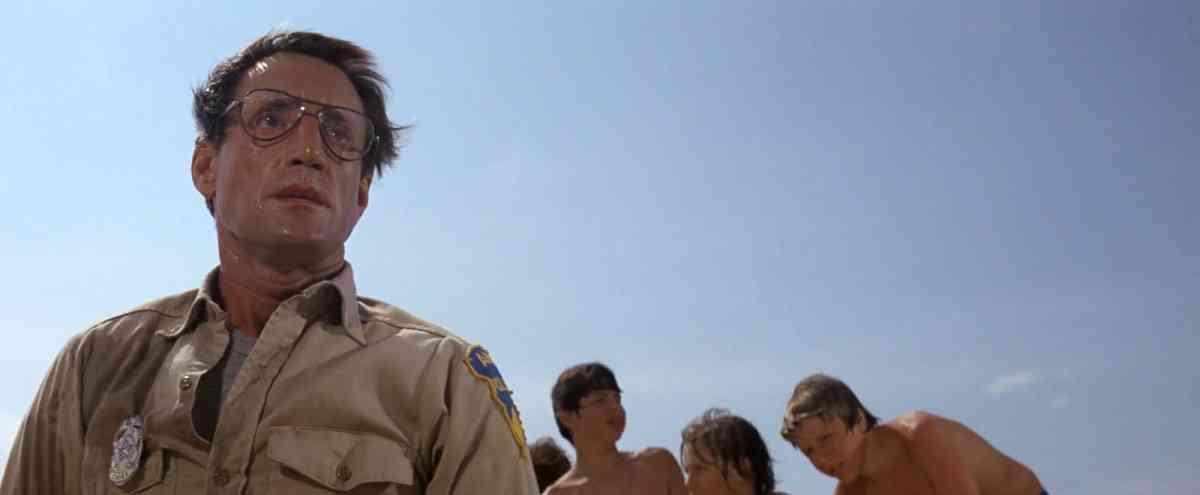
That shot does not belong in a monster/creature/horror movie. That shot belongs to a Western. And in Jaws, the way that shot is composed, the landscape framed between the two columns of a pier, is similar to how John Ford famously framed his landscapes – through doorframes. In that moment, my heart sang to me, “This is not a monster movie. This is an Ocean-Western.”
I would not reduce this pious moment in Jaws to a homage or a hat tip. The etymology of shots in a good movie is a richer and spiritually deeper study than several interviews of Quentin Tarantino will have the world believe.
A hat tip is a conscious move. This once-in-a-lifetime cosmic dance between filmmakers separated by time and space, like Spielberg and Ford here, is a subconscious one.
I have seen Jaws multiple times since then, and my monikered genre for it, the Ocean-Western, has been affirmed on each such viewing.
Consider Brody’s introduction shot. It begins with a telephoto shot of the horizon, separating the sky and the sea. Brody wakes up in the frame, juxtaposed against this landscape. He will soon have to go out in that ocean to fight the beast, a shark.
Brody’s job itself, the town Amity’s police chief, is the vocation dearest to the Western. Most Westerns had a frontier sheriff protecting the town, carrying the weight of its people’s safety on his shoulders. They rarely had kids and families with the exception of Ford’s films, George Stevens’s Shane (1953) and Tom Griess’s Will Penny (1968), the mothership to Nicholas Winding Refn’s Drive (2011). They created movie histories. Jaws too has kids and it wrote an unprecedented movie history.
Jaws also has men, and like the Westerns, it is replete with their constant bicker, banter and camaraderie. Apart from police chief Brody, there’s Matt Hooper (Richard Dreyfuss) and Quint (Robert Shaw), the shark (read bounty) hunter. Ever since Hawks’s classic western Rio Bravo (1959), there hadn’t been a better trio on the screen.
The scene that roots Jaws the most in the Western genre is the calm-before-the-storm scene in the boat Orca, between these three men. The scene, now famously known as Quint’s Indianapolis monologue, begins with Quint and Hooper showing each other their scars and ends with Quint describing, with a compelling emotional punch, how he and others survived the Japanese assault on the USS Indianapolis and attacks by sharks in the water afterwards.
The scene was not in Peter Benchley’s novel Jaws, on which the film is based. Although another book, Richard Newcomb’s Abandon Ship, with in-depth survivor accounts, had been published in 1958, Spielberg confessed that he had never heard of the sinking of the USS Indianapolis by a Japanese submarine in 1945 during World War II. The ship was returning to America after delivering the atomic bomb, and sharks had surrounded the helpless sailors.
“The speech was conceived by Howard Sackler, who was an uncredited writer, didn’t want a credit and didn’t arbitrate for one,” Spielberg has said. Sackler told Spielberg that Quint needed motivation to show us what made him the way he was. Sackler thought of the USS Indianapolis.
When Spielberg shared the script with his filmmaker friend John Milius, Milius asked Spielberg “Can I take a crack at this speech?” Spielberg added, “John wrote a 10-page monologue, that was absolutely brilliant … and then Robert Shaw took the speech. Robert himself was a fine writer, who had written the play The Man in the Glass Booth. Robert took a crack at the speech and he brought it down to five pages. So, that was sort of the evolution just of that speech.” The camaraderie among the men here can also be seen in another CM Russell painting, Laugh Kills Lonesome.
What the USS Indianapolis monologue has in its eventual screen version is humour, tragedy and one ingredient above all, which has almost gone extinct in films today. That ingredient is silence. In the scene, you can hear the boat’s creaks, just like in a Western you could hear the wind and the dust.
The irony here is that Spielberg has been quoted saying, during the promotions of his latest film, Disclosure Day, that he will be directing a Western next. The internet thinks this will be “for the first time”.
The soul of Jaws is a Western. The shark is the monster that terrorises the shores, but John Ford is the ghost that haunts Jaws.
Atul Sabharwal is the writer-director of the television series Powder, the films Aurangzeb, Class of ’83 and Berlin, as well as the writer of the web series Jubilee.
Also by Atul Sabharwal:
The original story ‘The Decipherer’, on which ‘Berlin’ is based
[ad_2]
Source link