
[ad_1]
In October 2025, Devlal Watti found himself in trouble because of his Whatsapp status.
That month, the young sarpanch of Dompadar village, in Chhattisgarh’s Kanker district, changed his status on the app to a quote from Article 25 of the Indian Constitution, which guarantees all Indians the freedom to practice and propagate any religion.
Watti is a believer of Koya Punem, the indigenous religion of the Gond, or Koitur, Adivasis in Chhattisgarh. But he had chosen his Whatsapp status in response to increasing hostility against converted Christians in his locality.
“I had been observing for a while that Christians were being criticised for conversions,” he said. “But the fact is all religions and sects that have entered Bastar have left an impact on our indigenous faith.”
Kanker falls within south Chhattisgarh’s Bastar division, widely seen as ancestral homeland for Central India’s Adivasis. While Adivasi communities in the region have historically practiced their ancestral religions, over the centuries, Hindu sects have also made inroads among them.
Christianity arrived in central India in the 19th century. Its spread in north Chhattisgarh provoked Hindu anxieties. In 1952, as a counter to Christian missions, the Sangh Parivar established the Vanvasi Kalyan Ashram in Jashpur, helped by its erstwhile royal family. A member of the family, Dilip Singh Judeo, elected to parliament on a Bharatiya Janata Party ticket, devised the ghar wapsi ceremony in the 1990s to bring converted Adivasi Christians into the Hindu fold.
Bastar, in South Chhattisgarh, was slower to witness similar mobilisations. It was only in the past decade that reports of ghar wapsi ceremonies began to surface with increasing regularity – often, they were supported by BJP leaders.
As the region saw a rise in evangelical forms of Christianity, with many pastors setting up house churches in villages, other forms of hostility also came to the fore – in recent years, news frequently appeared of Christians being physically attacked by non-Christian villagers, forced to leave their homes and prevented from burying their dead relatives in their villages.
A few days after he changed his WhatsApp status, Watti said he was summoned to a community meeting and “made to publicly apologise for sharing the Constitution!”
He explained that he did, in fact, believe that larger organised religions presented a threat to Adivasi faiths, but that he nevertheless opposed the targeting of specific communities. “Yes, the entry of Christianity in Bastar is erasing our traditional religion, but so is the spread of Hinduism and Sikhism,” he said. “Why is Christianity the only religion being targeted?”
Last year, a few months before Watti changed his Whatsapp status, anti-Christian hostilities took a new turn.
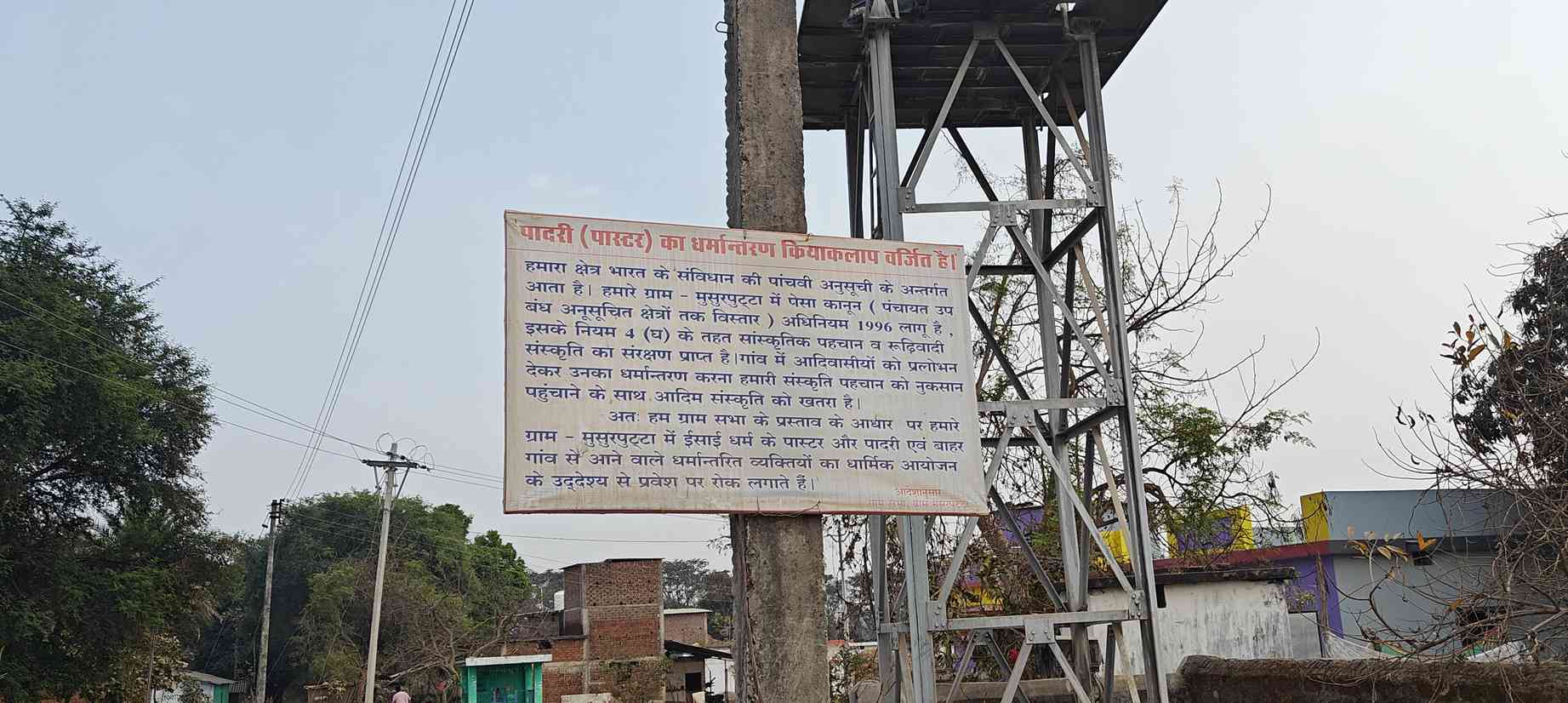
In June, several villages in Kanker district erected hoardings banning the entry of Christian pastors and priests, and even ordinary Christians, from outside. Local authorities claimed that the ban had been put in place to safeguard Adivasi culture and heritage. They argued that the move had a legal basis under the Panchayat’s Extension to Scheduled Area’s Act.
The act, a landmark piece of legislation passed in 1996, aimed to restore a measure of self-governance to Adivasi-majority areas listed under the Fifth Schedule of the Constitution. It granted gram sabhas powers over a range of matters, including those pertaining to local development and resource management. It also recognised them as a consultative authority in matters pertaining to land transfers and the extraction of minor minerals.
Most of the boards that came up in villages cite clause 4 (d) of the law. This clause states that “every Gram Sabha shall be competent to safeguard and preserve the traditions and customs of the people, their cultural identity, community resources and the customary mode of dispute resolution”.
The bans by villages were challenged by two different petitions in the Chhattisgarh High Court, one by a pastor named Digbal Tandi, and the other by an individual named Narendra Bhawani. The key argument that the former made against the ban was that it “suspended the fundamental right of conscience and free movement” of Christians in the region, and thus violated articles 25 and 19 (1) (d) of the Indian constitution, which guarantee the right to freedom of religion and the right to move freely throughout the territory of India, respectively.
The court ruled against the petitioners. In its order, passed on October 28, it observed that the “hoardings cannot be termed as unconstitutional” and that they were installed as “a precautionary measure to protect the interest of indigenous tribals and local cultural heritage”. It further noted that it was disinclined to hear the petitions because the law provided for avenues through which the petitioners could raise their grievances – specifically, under rule 14 of the Chhattisgarh PESA Rules, 2022 they could approach the sub-divisional officer (revenue) and the concerned gram sabha.
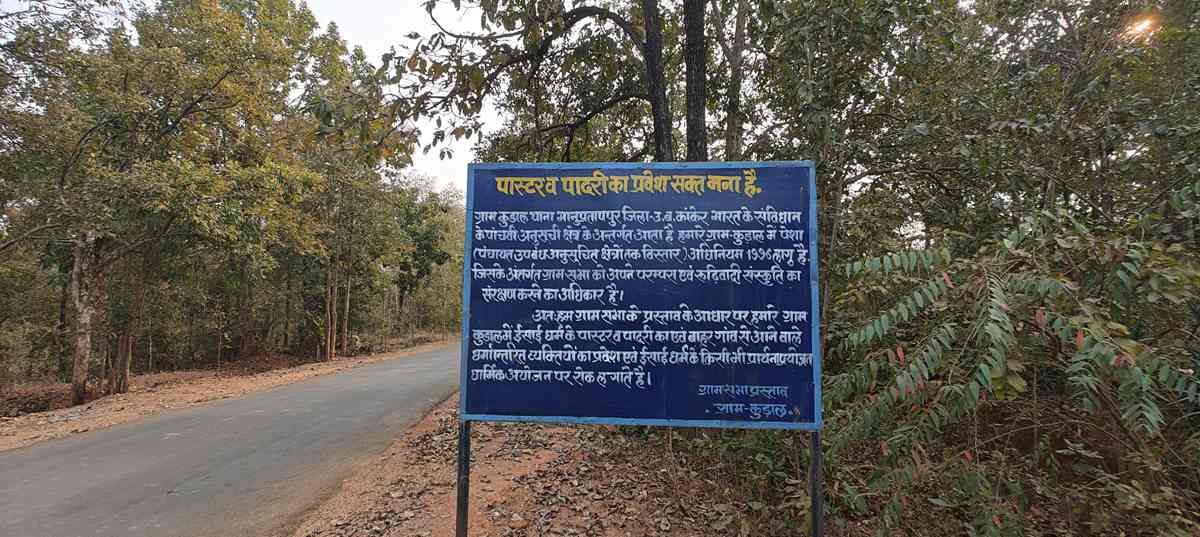
In mid-December, the petitioners appealed against the order in the Supreme Court. However, on February 16 the apex court dismissed the petitions, reiterating the high court’s directions to the petitioners to approach the gram sabha and the sub-divisional officer.
When I travelled to Bastar in February, including to villages that had implemented the ban, some locals explained that Hindutva bodies had, in effect, exploited a long-running rift in Adivasi society, between those who followed the traditional faiths, and those who adopted Christianity. In doing this, they argued, these bodies were seeking to consolidate Adivasi communities under the broader Hindu fold.
But there was something of a contradiction in the use of PESA to this end, they observed.
Even as the law was being invoked in a divisive manner now, in the 30 years since it was enacted, little progress had been made on most other fronts in its implementation in the state. In Chhattisgarh, rules for the act’s implementation were framed only as recently as 2022. In fact, my conversations with villagers, including chiefs, confirmed an observation that some activists had made – that many Adivasis were, in fact, unaware of the powers that the law granted to communities.
Activists have for years flagged instances where PESA provisions have been blatantly ignored by the state. “Across Chhattisgarh, there are mining and other deforestation projects happening, where the consent of the gram sabhas has been fabricated,” said Adivasi activist Yogesh Nareti. “The system doesn’t abide by the law in such cases, which has led to the steady loss of land. But somehow in the case of Christian conversion, the PESA is suddenly being recognised and executed very well.”
The village of Kudal is around 70 km from Dompadar, in the neighbouring block of Bhanupratappur. In June last year, it was the first village to erect a hoarding that banned the entry of outsider Christians.
Kudal’s sarpanch Binesh Goti, whom I met on February 21, was firm in his stand against Christianity. “Christianity is a threat to our Gond culture,” he said. “After conversion, people stop worshipping our ancestral deities and let go of our ways.” He explained that Kudal had a total of around 30 families, and that a little less than ten years ago, 12 of these families had converted to Christianity.
He recounted that he had participated in measures against the spread of Christianity even earlier. “All these years, I was a ward council member, so I did what I could,” he said. “Like taking pastors to the police when they would come to my village to preach. Last year, when I became sarpanch, I decided to erect that board.”
Goti spoke with great pride of the decision, and the effects he believed it had had. “Since I erected the board last year, some 650 people in Kanker district have done ghar wapsi, including two from my own village,” he said. He noted that community leaders in the region tracked such statistics and regularly shared them with each other in Whatsapp groups.
Goti conceded that the ban had in some ways deepened divides in the villages – many of the Christian families had stopped interacting with others, he noted. “Such rules are working, but not everybody is convinced by them, no matter how many times we tell them,” he said. “We hope that eventually they see what’s right and come back to us.”
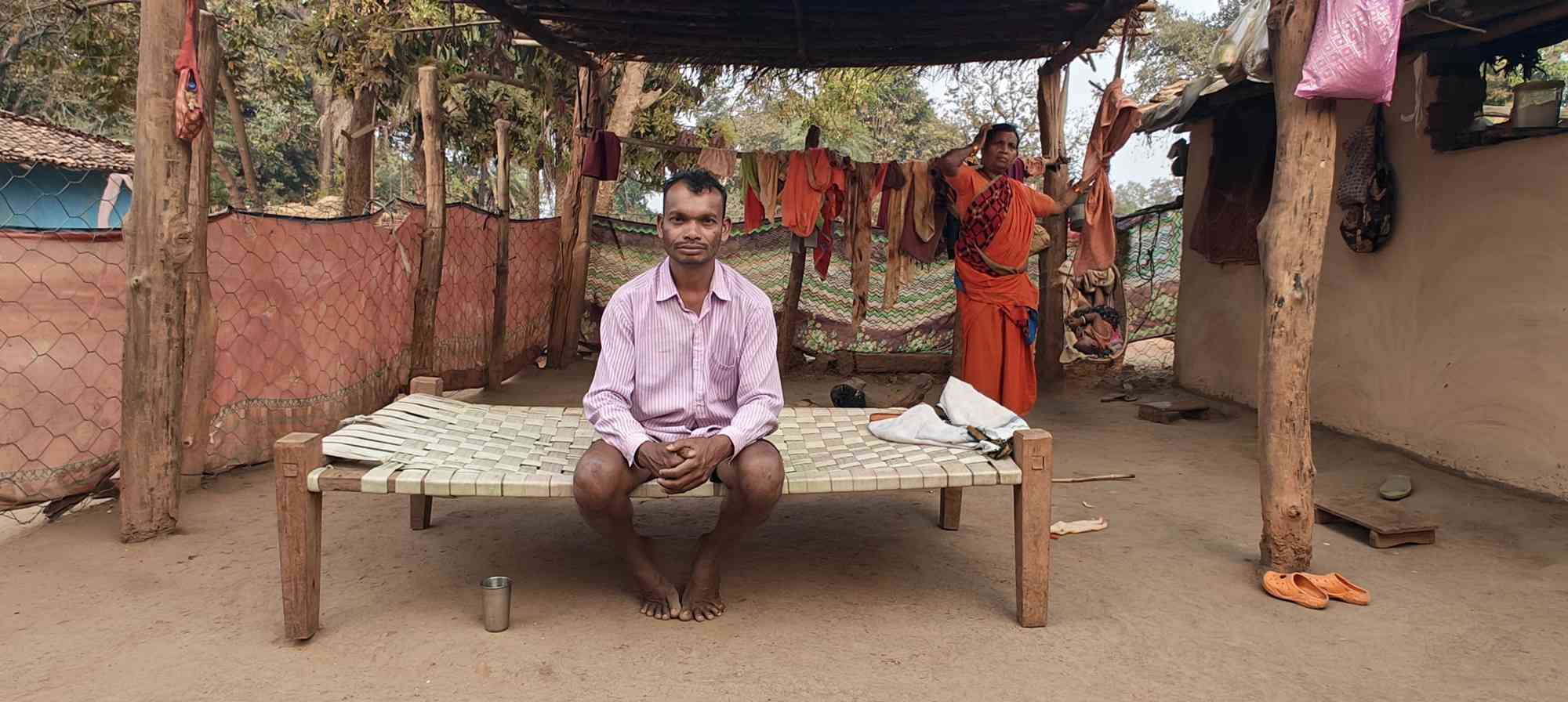
In my conversations with others in the village, I did not come across anyone who opposed the ban. In fact, many expressed discontent with those who had converted to Christianity. They noted that Adivasi culture was deeply tied to Adivasi faith, and that those who adopted Christianity usually went on to totally renounce Adivasi deities.
“My maternal uncle converted a few years ago,” said Khileshwar Gawde, one villager. “He threw out the idols and other markers of our gods, and was about to burn them, when my other relatives intervened.” He also noted that villagers who converted typically ceased visiting sites in the village that are believed to be inhabited by traditional deities. Citing the example of the deity Sheetlamani, he said, “She is the prime deity of the village. Everyone in the village is supposed to visit her periodically. Even the non-Adivasis visit her, but the Christians have stopped going to her completely.”
Bansilal Salam, the owner of a small grocery store, argued that “People converting to Christianity causes a divide in the Adivasi community. Our culture and identity start to fade away.” He added, “Once they convert, they stop participating in Adivasi rituals and festivals and paying obeisance to our deities.”
Those who converted had also withdrawn from social events, Gawde observed. “Conventionally, the entire village participates collectively in festivals, weddings and other events seasonally,” he said. “In a few months, we will harvest mangoes and then paddy, so we will collect money to perform the worshipping rituals. But Christians have stopped partaking in these events or even contributing money for them.”
Many saw this move away from local practices as a threat to the spiritual order that the community believed in. “This is why we tell them – either return to our traditional belief system or leave and go live elsewhere,” Gawde said.
However, some Christians had a different account of the situation. “It is them and not us who stopped interacting with us and socially boycotted us,” Anit Gota, a Christian villager from Kudal, told Scroll over the phone. Other Christians recounted similar experiences. Gota alleged that non-Christian villagers often threatened Christians in public, and had also banned them from local shops and the weekly bazaar. To access a bazaar, he said, they now traveled to Bhanubeda, which is about 7 km from the village.
Gota explained that his key motivation to become a Christian was to guard against caste-based social ostracism. “I belong to the Lohar community. In Chhattisgarh, we are categorised as OBCs, but society practices untouchability against us,” he said. “Living through that, one looks for love and acceptance, and I found that in Jesus and the church. The ostracism still continues, but now I at least have god’s love.”
The effort to draw Adivasis in the region into the Hindu fold are playing out even as Adivasi communities – here and elsewhere in the country – have been fighting for the recognition of their distinct religions.
While members of the Koitur or Gond tribes in central India have been demanding the recognition of Koya Punem, the Munda, Santal, Ho, Kharia and Kurukh, or Oraon, tribes in the Chotanagpur Plateau have been demanding the recognition of the Sarna religion. Similarly, members of the Tani group of tribes in Arunachal Pradesh have been demanding the recognition of the Donyi Polo faith.
Academics note that in the colonial era, Adivasis were often assigned a distinct religious identity in censuses, such as “aboriginals”, “animists” and adherents of “tribal religion”. In post-Independence India, however, these categories were excluded – thus, in their official documents, Adivasis were often forced to identify as Hindus, or as followers of “other religions”.
The Sangh Parivar has emphatically rejected Adivasis’ assertion of their distinct religions. Chhattisgarh’s chief minister Vishnu Deo Sai, who is from the BJP, has publicly asserted that “Adivasis are the biggest Hindus”, not just currently, but since “ancient times”.
In fact, Watti, the sarpanch of Dompadar village, described the spread of Hinduism as more insidious than other religions. “It begins slowly, say with the entry of a small Ganesha statue placed amongst the other village deities,” he said. “But in the following years, the Ganesha statue will grow larger in size, and the celebrations of Ganesha festival will become bigger and louder as it draws money and support from outside the village. Finally, it starts to dwarf traditional Adivasi celebrations.”
He argued, “This is precisely why we need our very own religious code. Our elders have taken the trouble to remind us. But in many villages, they accept Hinduism as a norm.”
In fact, on the ground in Kanker, conversations with villagers revealed confusion among some about the distinctions between Adivasi faiths and Hinduism, even among those who asserted that Adivasis needed a separate religious code.
For instance, when Kuda’s sarpanch Goti remarked that Christian Adivasis should return to their “own traditional religion”, I asked whether he meant Hinduism or Koya Punem. He replied, “See, Adivasis don’t have a separate religious code yet. It will definitely become official someday, but until then Adivasis are Hindu.”
In Bhainswada village of Risewada panchayat, an anganwadi centre was closed in December last year, after villagers alleged that one of the anganwadi workers, a Christian convert, was teaching their children Christian prayers. “If the worker returns to her traditional religion tomorrow, we are willing to reopen the school immediately,” said Lakhan Singh Komre, an elderly villager sitting on a public bench with his peers, who nodded and murmured in collective agreement. When I asked them which religion they were referring to, they stated that Hinduism and Koya Punem were the same.
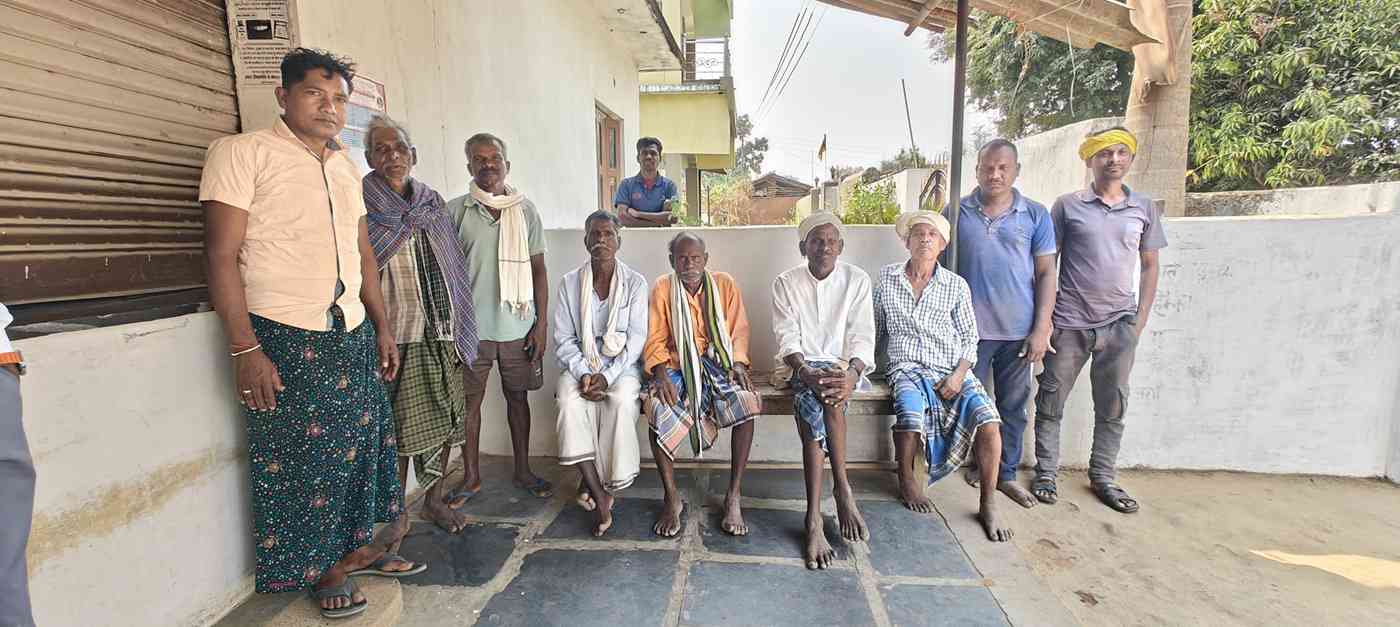
Elsewhere, however, locals had a sharper sense of Adivasis’ distinct faith. In Musurputta, another village with a prominent board barring the entry of outsider Christians, villagers I met in the community hall asserted that converted Christians should return to their traditional faith.
I asked what faith they were referring to. They replied, without hesitation, that they were referring to Koya Punem.
Apart from the bans on entering villages, Shalini Gera, a lawyer and member of the People’s Union for Civil Liberties, noted that Christian tribals in Bastar were also subjected to several other forms of social ostracism. For instance, they could be expelled from villages, subjected to economic boycotts, and prevented from tilling their lands or burying their dead.
This was echoed in interviews with lawyers working at the Chhattisgarh High Court involved in the case challenging the ban on outsider Christians, who had filed right-to-information requests pertaining to the gram sabha resolutions on the bans.
They found that some villages had sought to pass other, similarly harsh resolutions. For instance, a gram sabha in Pairvi village decided in June 2025 that no assistance of any kind would be provided to Christians in the village, that goods from grocery stores would be denied to them, as would benefits under government schemes. Further, if they had received government employment, their caste certificate would be cancelled. In Dompadar, the sarpanch noted that he, too, had heard of gram sabhas being encouraged to deny rations to Christians.
Gera noted that a group called the Janjati Suraksha Manch, associated with the Sangh Parivar, which was active up to 2022, had played a key role in the past in these processes.
Among the key demands that the group had made were that Adivasis who converted to Christianity should be stripped of their Scheduled Tribe status, and denied benefits that flowed from it, such as access to reserved government jobs. But, in fact, current Indian law contains no provision under which a member of a Scheduled Tribe would lose that status as a result of professing a particular faith. In contrast, under the law, an individual can only be a member of a Scheduled Caste if they profess Hinduism, Buddhism or Sikhism.
Among the most prominent recent incidents of extreme ostracisation occurred in December 2025 in Bade Tevda village in Kanker, and involved its sarpanch Rajman Salam.
Salam and one of his brothers had begun attending a local church, though his father continued to follow Adivasi traditions. When his father died, another brother made plans to hold the funeral according to Adivasi customs. Salam sought permission to attend the funeral, but villagers denied him entry. In response, Salam buried his father on his own land.
According to Gera, members of a newly created platform called Sarv Samaj then mobilised hundreds of people from nearby villages to exhume the grave. Members of the Dalit rights organisation Bhim Army arrived to support Salam, leading to a violent standoff. The next morning, Sarv Samaj members attacked Salam’s house and burned it down, along with a nearby church.
The administration later exhumed the father’s body and buried it in a location unknown to the family. According to local news reports, Salam and his family are now untraceable.
Such ostracisation has led to many leaving their homes and leading displaced lives.
On February 23, I met with Christian families, both Adivasi and non-Adivasi, of Dhantulsi and Salebhaat villages, who had been forced to leave their homes between December and January and were now living in ramshackle houses on the outskirts of Kanker town.
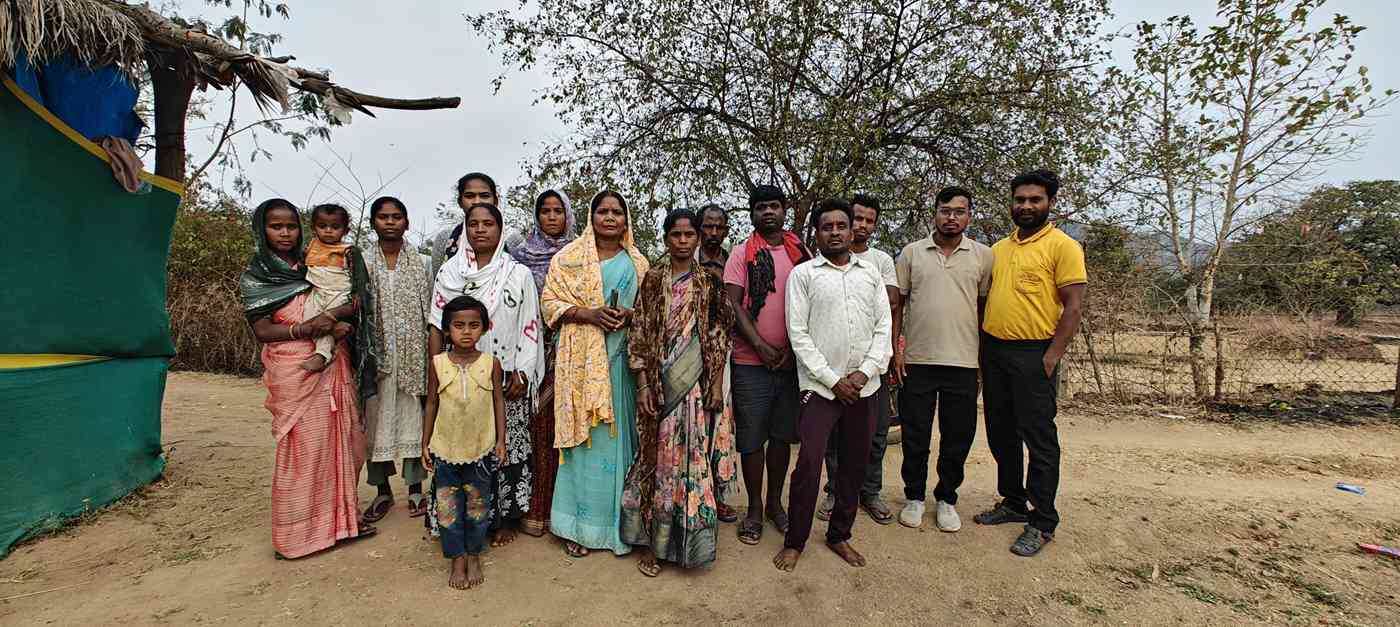
Chainu Ram, a quiet labourer from Salebhaat, who is in his fifties and who belongs to the Pardhi community, was also present in the room. The Pardhi community were historically nomadic and rarely own ancestral land. About five years ago, Ram applied for and received an individual forest rights title for about two acres of land, some of which he used for subsistence farming. In 2019, Ram, who is a widower, and his son, converted to Christianity.
Last year, Ram and his son, as well as other Christians in the village, were run out of their homes by fellow villagers. “The gram sabha took over my land, saying I don’t have rights over it due to my conversion,” he said. “When they first threw us out of our home, I lived under a tree for some days. My son went to live with his in-laws, but I have been left homeless.”
Ram now lives with other excommunicated Christians near Kanker, and earns a living by working as a daily-wage labourer.
Radhika Darro, a resident of Salebhaat, who once oversaw ASHA workers in the village, and four neighbouring villages, also in Kanker after being displaced from her home. She recounted that she and her niece converted to Christianity in 2019, and believed they obtained relief from health troubles after this. When they resisted undergoing ghar wapsi ceremonies, she said, other villagers beat them up and dragged them out of their home.
The extreme ostracisation that followed left them with no choice but to leave Salebhaat. “The gram sabha leaders told people, including my ASHA workers, that they would have to pay a fine of Rs 25,000 just for speaking with me,” Darro said. “And the person who reported these interactions to them would receive Rs 5000.”
The December incident at Bade Tevda appears to have been followed by a spike in hostility against Adivasis who converted to Christianity. “We converted some six-eight years ago. While people did oppose us, we still maintained cordial relations with them,” said Sanjay Kachlam, a resident of Mandri talking about his family and friends. “But the religious intolerance has risen sharply in recent months in Bastar, ever since the incident at Bade Tevda.”
Kachlam recounted that in late January he and other Christians were called by the gram sabha individually and told to return to their traditional faith. When they refused, he recounted, they were told, “You have to pick between Jesus or your land, you can’t have both.”
Kachlam and others refused to comply with this demand. Since then, he said, the other villagers had stopped interacting with them. Alongside, they were also denied rights over common land, forests, and public water supply. “We believe in Jesus Christ but we are also attached to our land and community,” Kachlam said. “Where will we even go if we leave?”
Kachlam, his wife Urmila Kange, and other friends are social workers who, among other activities, conduct workshops on matters of importance to Adivasis, such as the Panchayats Extension to the Scheduled Areas Act and the Forest Rights Act. “The recent setting up of boards prohibiting Christian pastors and outsiders are not what the PESA act was intended for,” said Kange. “The act was meant to empower tribal communities to govern themselves. Besides the protection of culture, there are various other provisions that are not being implemented.”
Research supports these accounts a paper published in 2025 states that “the promise of PESA remains under realized due to systemic constraint.”
Indeed, in Dompadar, Watti the sarpanch noted that Adivasis’ efforts to assert rights over nearby forest land had thus far been thwarted by the forest department. “We know about our rights, but whenever we make any decisions about the forest or even the village land, the administration prohibits us from doing do so,” he said.
Goti, the sarpanch from Kudal, was unapologetic about how the law was being deployed. “There is some work being done under the forest rights,” he said. “But our main focus under the PESA is to stop conversions.”
Meanwhile, activists noted that the current focus on religious conflict in Bastar had sidelined questions of tribal land alienation in the region. “There was a time when jal, jangal, jameen was on every Adivasi villager’s tongue,” said Yogesh Nareti. “People would constantly organise some or the other protest over local land or forest issues but now the protests have lessened.”
Gera agreed. “Before this violence, the local Adivasi communities were united in their mission to safeguard jal, jangal, jameen,” she said. “But the Right has managed to shift the discourse to religion.”
Villagers, too, echoed this fear. “The Bajrang Dal always talks about religion but never about jal, jangal, jameen,” Watti said. “I tell them that if you don’t protect jal, jangal jameen then nothing will survive, not even your religion.”
[ad_2]
Source link