
[ad_1]
In April, a video of Indian factory workers went viral. It showed the workers sewing garments while wearing white bands around their heads fitted with a camera.
The video garnered hundreds of thousands of views and was picked up by several news outlets that speculated about what use the footage of the hand movements of the workers could be put to. “Are factory workers training AI to replace themselves?” CNN asked.
The reports did not specify where the cameras had been deployed and by whom.
Scroll was able to identify the factory where workers were wearing the head-mounted devices. It is the Gurugram unit of Pearl Global Industries Limited, an apparel manufacturer with a presence across 10 countries.
“We were supposed to wear the device from 10 am to 4 pm,” one of the workers at the factory told us. “They [the executives] said that they wanted to find out what we were doing during our shifts and for how much time.”
Similar devices were used in the factories of Ken India, a textile manufacturer based in Ichalkaranji, Maharashtra, in March 2026, where they seem to have been used for a different purpose.
In a post on Linkedin, Ken India said that the hardware belonged to a start-up called Egolab.AI.
Founded in January 2026 by two teenagers in Maharashtra, Egolab.AI calls itself “India’s largest first-person POV Data Aggregator”.
In its company documents, it states that it collects “high-quality, labour-sourced egocentric video footage” from factory workers using “lightweight cameras”.
Egocentric is the term used for data captured from a first-person perspective.
This data is then “aggregated, processed, and packaged into datasets” for “global AI companies building robotics, computer vision, and autonomous systems”. These companies include Tesla, Boston Dynamics and Figure AI, Egolab claims in a document.
In March, Egolab was acquired by Build Artificial Intelligence Inc., or Build AI, a firm registered in Delaware, United States. Its India arm is based in Bengaluru but its founders, most of them in their late teens or early 20s, live in San Francisco. It describes itself as the “largest egocentric data collection effort in history”.
These firms are positioning themselves to profit from the growing demand for data to train robots. According to one estimate, over the next two to three years, robotics labs will spend $1.5 billion to $50 billion (Rs 12,000 crore to Rs 4.2 lakh crore) to gather 100 million to 1 billion hours of egocentric data.
Much of the data is being collected without any safeguards, experts say.
However, Egolab claims in its company documents that it recruits between 100 and 1,000 “volunteers” in every factory it works with.
Workers who participated in the exercise at Pearl Global, however, said their consent was not obtained, either verbally or in writing.
We spoke to the head of business operations at Egolab, Arnav Kabra, and asked him specifically whether the company had obtained consent from workers at the Pearl Global factory. “We took consent to use the device and we did it in our own way,” he said.
Kabra did not elaborate on his “way” and did not respond to subsequent phone calls.
Questions emailed to Egolab and Pearl Global were unanswered at the time of publication.
The guinea pigs
Workers say that in the first week of April, two executives arrived at the Gurugram factory of Pearl Global Industries Limited. They brought white devices that had cameras and could be worn around the head.
“They distributed it to workers one by one,” said a factory worker who spoke to Scroll on the condition of anonymity. “They said that we had to wear it for one week.”
The executives were from another firm and the workers had not met them before. They told them that the device would monitor them during their working hours, when they would be sewing apparel. “We did not trust these reasons,” said a worker. “There are cameras in the factory. Why not use those?”
Most workers at Pearl Global that Scroll met came from the villages of Bihar or West Bengal. They were either Muslim, Dalit or from other backward classes. They work 12-hour shifts, from 9 am to 9 pm, between Monday and Saturday, earning between Rs 20,000 and Rs 30,000 every month.
At the end of their shifts every day, the executives collected the cameras, which were fitted with a memory card of 32 gigabytes. Every device had a unique serial number, which was jotted down next to the workers’ unique ID supplied by the factory.
Frooti was served to everyone, which made the workers wonder: why are we being fed mango juice?
On the third day, several workers grew wary of the device. “It had batteries near our temples and as they would heat up, we would feel uncomfortable,” said the first worker. “It felt like it was sucking our blood.”
A third worker was uncomfortable with how much the device could surveil. “We had to take it out before going to the toilet,” the worker said. “Moreover, we couldn’t speak to our spouse while wearing it. It could listen to our conversation. Nor could we wander around or enjoy gutkha. Sometimes I would switch off the device myself.”
The tech bros
“100 million factory workers. 100 million hours of egocentric footage.” This is what Egolab said it wanted to achieve in a company document available online, which featured a photo of the device.
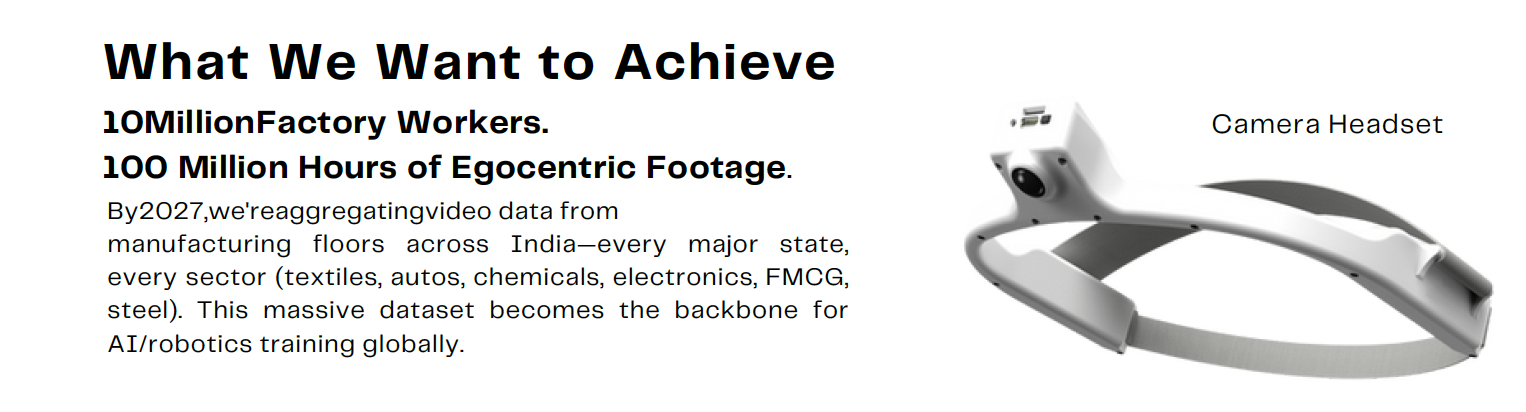
It claims it will aggregate egocentric data from every major state and every sector in India by 2027, including textile, automobile, chemical, electronics, steel and fast moving consumer goods, or FMCG.
“This massive dataset becomes the backbone for AI/robotics training globally,” it added.
Egolab offered manufacturing firms a “labour efficiency report based on proprietary AI models” in return for allowing it to record their workers’ egocentric data.
Workers, it added, would feel valued for “contributing to AI advancement”, opting-in voluntarily for their data to be collected. It added that the exercise was compliant with the Digital Personal Data Protection Act, 2023.
A sample report seen by Scroll offered a “productivity analysis” of factory workers based on the footage captured by the camera devices. It claimed that this was generated using artificial intelligence.
The report mentioned the productivity of the “best worker” and the “worst worker” based on the amount of time they spent working in the eight hours that they wore the camera. It then rounded them up for an “average productivity” score.
“Your workers are not working for 2.2 hours per day on average,” said the analysis in a sample report. “This costs you approximately Rs 33,000 per day in lost output.”
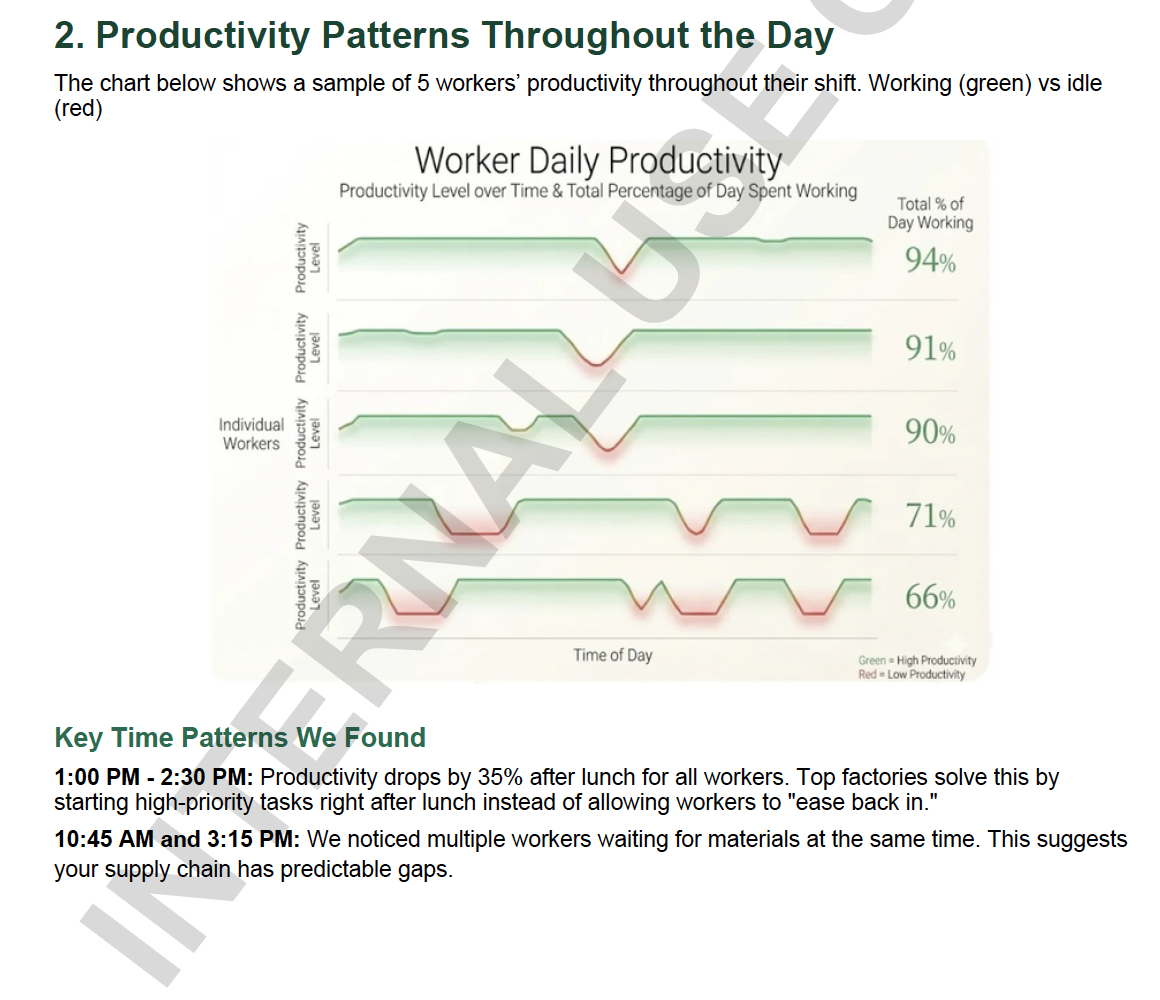
Moreover, the report gave a quantified breakdown of what workers did while not working, such as 32% of their “% of Idle” was spent in talking with coworkers. It even singled out workers: “51% of idle time is socializing…we noticed workers from different stations gathering near the wearer of CAM 02 between 2:00-3:30 PM.”
The report then compared these scores to other factories that Egolab had worked with to give a percentile score to the productivity of workers.
How the science works
Spandan Roy, an assistant professor at the Robotics Research Centre at the Indian Institute of Information Technology, Hyderabad, told Scroll that for firms that are trying to make robots imitate human actions, egocentric data might be a cost-effective way to make it happen.
The traditional way to train robots was to recruit people and make robots replicate their actions in a computer-generated three-dimensional environment. “Another way is to record a video of humans doing a task and note down the actions – the movements of objects, the angles of joints in the human hand, the language being spoken – and use this data to train robots,” Roy explained.
In an enterprise like this, the more the data, the better the robots. “The more data you can feed, more versatility, more variety of processes, scenes, variations that you can embed into the system, the better the robot will function,” Roy added.
He said it was not surprising that firms were moving visual data from Indian factories to tech firms in the West – that is where the capital and capability for this research lies. “Earlier, industry used to rely on academia for research directions on a technology and then commercialise it,” he said. “Now the academic research papers, and most breakthroughs, are coming from Nvidia, Google, Microsoft.”
“That is because AI infrastructure – GPU, data centers – all those things are concentrated in the industry,” he added.
Enter Americans
Egolab was founded in January 2026 by Raghav Samani, 19, from Sangli and Varun Pareek, 18, from Ichalkaranji. According to their Linkedin profiles, Samani is studying business in the UK while Pareek dropped out from a US university where he studied engineering.
In March, the firm was acquired by Build Artificial Intelligence Inc., an American firm that operates the brand Build AI. It was registered in Delaware in September 2025 and is headed by Edward Xu, 19, and Jonathan Jia, 21, according to the business registry of the California secretary of state.
“This is a brutal game and we’re going to win,” Xu tweeted on the acquisition.
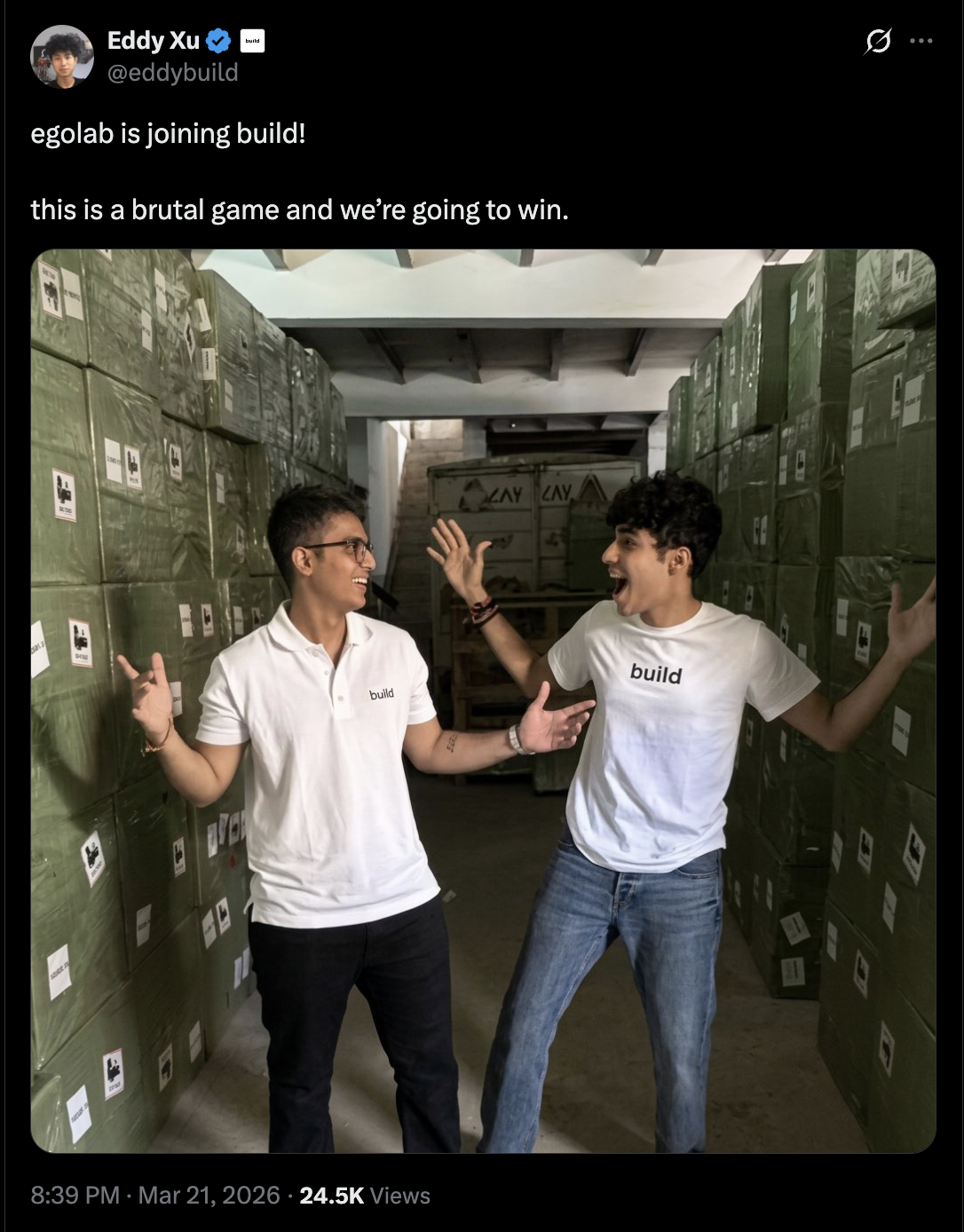
Samani pegged the takeover at “seven figures”, which could be between one million dollars and $9.9 million (Rs 9.5 crore to Rs 95 crore).
In a December 2025 filing, Build Artificial Intelligence described its purpose as collecting egocentric data “to accelerate the development of general purpose robots”. That month, it made one lakh hours of this data publicly accessible on Hugging Face, an open-source AI platform.
A month earlier, Xu, the chief executive officer, had tweeted that the firm “manufactures hardware” to collect egocentric data from around the world.
The CEO claims that the Build AI has $22 million (Rs 210 crore) in investments from three venture capital firms based in California, US – Abstract, Pear VC and HF0. HF0 tweeted to confirm its investment but Pear VC and Abstract are yet to list Build AI as an investee on their websites.
On April 4, 2026, Samani and Pareek registered Build AI Private Limited’s Indian arm in Bengaluru, each with a 50% stake.
Bigger picture
India’s textile industry is one of its largest employers, with nearly 4.5 crore people employed directly, many of them in rural India. At 3.9% global market share, it is the world’s sixth-largest exporter of textiles and apparel, according to the Ministry of Textiles.
It is not the only sector where efforts to collect egocentric data to build robots are underway. An Indian firm called Awign Enterprises Private Limited, a part of Japan’s Mynavi Corporation, is collecting similar data to automate household tasks, like cutting a cucumber or sorting toys. Another San Francisco-based startup, Humyn AI, is trying to build a similar business.
Astha Kapoor, a co-founder and director at Aapti Institute, a Bengaluru-based non-profit that studies the intersection between technology and society, told Scroll that egocentric data is a new category that moves away from the traditional notions of personal data.
“It doesn’t matter whose hand is making a cloth because there is no immediate one-to-one mapping of whose data is [that is being used to train a model] and whom it harms,” Kapoor explained. “So it is outside the remit of personal data and quite ungoverned at the moment, even by India’s data protection law.”
Instead of thinking about the data collection through the prism of individual consent, Kapoor said, “It is necessary to think about this from the notion of collective data rights because it impacts workers as a collective”.
“There needs to be collective community muscle. Otherwise we are doing the work that is supposed to make us redundant,” she said.
The journey between collecting egocentric data and automating factory jobs is not straight nor simple. Tech firms need billions of hours of good quality data from multiple geographies. Firms like Build AI only claim to have collected a tiny portion of this.
For now, Kapoor is sceptical about a scenario where robots take over India’s textile manufacturing sector. “The scale of this business is unknown at this point,” she said. “We know that there is a bubble among AI investors in the US and we should be careful about the hype cycle.”
In Gurugram, workers at Pearl Global had sensed that there was more to the camera device than just surveillance. But it was only after the videos went viral and users left comments about automation and robotics that they realised that by participating in the exercise, they could be making themselves redundant.
Most of them, however, are sceptical about robots replacing them in the future because they believe in human skill. “It might be easy to stitch a shirt,” said one of them. “But working on a coat takes real skill. Will a robot ever be able to stitch a coat properly?”
[ad_2]
Source link