
[ad_1]
In 1940s’ Bengal, famine and war displaced Rabindrasangeet (the corpus of songs composed by Rabindranath Tagore that synthesises lyrical poetry and music and occupies a central place within Bengali cultural life) from its performative location within the bhadralok domain, the English-educated, upper-caste, middle-class elite of colonial Bengal, whose authority was grounded in notions of respectability, cultural capital, and intellectual refinement. Within this conjuncture, the genre moved into sites of collective performance and political mobilisation, entering an uneasy encounter with the progressive networks of the cultural Left, namely, the Marxist cultural movement of the 1940s, through organisations such as the Youth Cultural Institute (1940) and the Indian People’s Theatre Association (1943), where it acquired new political meanings.
Sonic registers of protest
Each year, on Tagore’s birth anniversary, his songs are re-inscribed into institutional and commemorative spaces, such as concert halls, classrooms, and carefully curated public performances, that stabilise their canonical authority within a rabindrik (Tagoresque) aesthetic order. Rabindrasangeet is performed with a reverential continuity that frames it as timeless, stable, and largely removed from the urgencies of politics. It is in the Bengal famine of 1943 and the movement that grew out of it that these songs sounded markedly different, carrying their earlier Swadeshi (1905–1911) resonances into new political contexts and continuing to be reactivated across later movements, including the Language Movement (1948–1952) and beyond, in Bangladesh (then East Pakistan).
Recent interventions, most notably the work of public historians of South Asia, including Three Million on BBC Radio 4, and memorial initiatives in Manchester, have unsettled the famine’s status as a distant historical statistic. These efforts foreground its lived immediacy while drawing attention to its continued absence from formal commemoration. The famine, as is well documented now, was not merely a natural disaster but a crisis shaped by the glaring failures of colonial policies, wartime scarcity, and systemic neglect. Its images, the breakdown of rural economies, emaciated bodies, mass migration into Calcutta, the sonic registers of deprivation, as famine victims’ repeated appeals for rice-water sounded through the city streets, entered the cultural imagination with devastating immediacy.
It also destabilised the social worlds that had sustained elite musical forms like Rabindrasangeet, inserting them into new and unfamiliar political lives. The pervasive influence of Tagore, revered by the broadest swathe of the Bengali community as a cultural and literary icon, and recognised as one of the foremost advocates against imperialism, served as a fundamental and inspiring force for a diverse range of organisations and leaders across the political spectrum during this era, such as served as an important point of reference for organisations such as the YCI and the IPTA. The members of YCI in Calcutta were largely young intellectuals from the bhadralok social class, known for their liberal and progressive inclinations, occasionally displaying fervent opposition to fascist ideologies. Understandably, their musical interests were primarily attuned to bhadralok cultural aesthetics.
It was within this context that they embarked upon their initial forays into the community singing of Rabindrasangeet as an expression of leftist solidarity. Although Rabindrasangeet had already demonstrated its choric potential during the Swadeshi Movement, where songs composed for political mobilisation were performed collectively in public marches and gatherings, and within the everyday musical practices of Santiniketan, including the Baitalik (community gatherings for prayers and welcoming seasons through the singing of Rabindrasangeet), this moment marks a shift from composition with an immediate political context to recontextualisation: here, songs, not originally written for a particular political movement were mobilised as such, with the YCI refunctioning their choral dimension within new contexts of political performance.
Among the foremost members of the YCI were Rabindrasangeet artistes Debabrata Biswas, Jyotirindra Moitra, and Dwijen Mukhopadhyay, and the group started singing patriotic songs by Tagore and Nazrul Islam, alongside revolutionary songs and their own compositions, which later came to be known as Ganasangeet (people’s music). During the later years of YCI’s operation, community singing became established within its premises, namely, 46 Dharmatala Street in Calcutta, and assumed a pattern of political performativity under the directorship of Rabindrasangeet performer Debabrata Biswas. Patriotic songs by Tagore, Dwijendralal Roy, Atulprasad Sen, and Kazi Nazrul Islam were rendered with explicit anti-fascist sentiments.
The YCI’s use of community singing became a successful recruiting tactic, as audiences were encouraged to join in, thus rendering interactions at meetings more personal and emotional, especially in student gatherings where they usually performed. It seems likely that the YCI inaugurated the modern practice of community singing of songs drawn from traditional repertoires as well as new compositions on current issues at large political gatherings. Their idea was to project through songs, dances and theatre contemporary events, the significance of which was to be understood both by the audience and the performers. As community singing grew in popularity, these performances expanded in scale: in public meetings by “star performers” and on the streets, on trams and buses, and in marketplaces across the countryside.
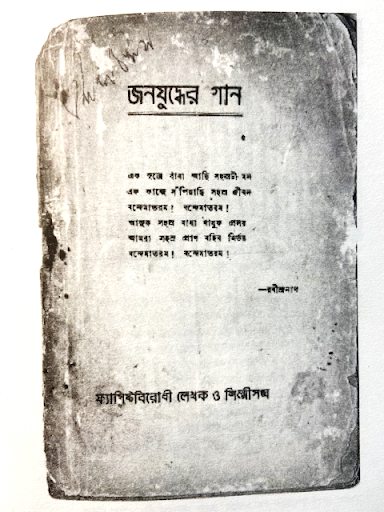
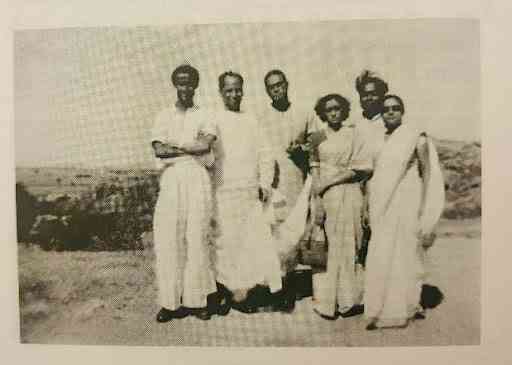
The mass evacuation forced by the Japanese bombings in Calcutta in 1942 led to the dispersion of the YCI, yet the flames of its cultural activities continued to burn brightly, as some of its former members came together to establish several literary and cultural bodies, amongst which the most crucial was the IPTA. In their pursuit of forging new traditions of songwriting, music, theatre, and dance dramas aimed at cultivating new audiences, these organisations built upon the initiatives and resources laid out by the YCI.
New political urgencies
Upon its inception, the IPTA assumed responsibility for overseeing cultural initiatives. It was during the famine of 1943, a crisis exacerbated by colonial biopolitics, that the IPTA’s artistic projects gained momentum. Artists from diverse backgrounds came together to compose songs and craft plays. Despite limited resources, they travelled to rural communities and other regions across India, their unwavering dedication was exemplified not only in their creative endeavours but also in their relentless efforts to generate financial support combining artistic production with efforts to raise funds for famine-stricken regions.
Bengali musicians, composers, and singer-songwriters, including Hemanga Biswas, Satyen Sen, Sachin Dev Burman, and later Salil Chowdhury, alongside Rabindrasangeet practitioners such as Debabrata Biswas, Jyotirindra Moitra, Kalim Sharafi, Dwijen Mukhopadhyay, Suchitra Mitra, Hemanta Mukhopadhyay, Priti Bandyopadhyay, and Santosh Sengupta, became associated with the IPTA, forming what came to be known as the “Bengal Squad.” The IPTA sought to consolidate culture as a strategic instrument of mass political mobilisation. For many of these artists, already trained in, and practitioners of, Rabindrasangeet, this meant that they brought the genre with them into these spaces, reshaping it through performance as it encountered new political urgencies shifting from a closed canonical repertoire to a more porous musical language capable of generating new political expression.
The choice of repertoire is telling. Songs such as, “Ek Shutre Bandhiyachi Sahasrati Mon” (We have bound together a thousand in a single thread, 1879), “Sharthok Jawnom Amar Jonmechi Ei Deshe” (Fulfilled is my life, for I was born in this land, 1905), “Oder Bandhon Jotoi Shokto Hobey Totoi Bnadhon Tutbe Moder” (The tighter their bonds become, the more surely ours will break free, 1905), “Ekhon Ar Deri Noy” (There is no time to delay, 1905), “Amar Sonar Bangla Ami Tomaye Bhalobashi” (My golden Bengal, I adore you, 1905), “Byartho Praaner Aaborjona Puriye Phele Aagun Jwalo” (Burn away the debris of a futile life and ignite the fire, 1933), and “Bhango! Bandh Bhenge Dao” (Break! Break down the barriers, 1939) were foregrounded, but their meanings were recalibrated. No longer simply evocations of national unity, they became articulations of resistance against fascism, imperialism, and economic injustice. Most of the songs mobilised in this moment were drawn from Tagore’s earlier Swadeshi corpus. What emerges is not simply continuity but refunctioning: Rabindrasangeet moving across political contexts, from anti-colonial nationalism to Marxist cultural activism, and later into post-Partition struggles. Rather than a static, reverential tradition, the genre reveals a history of political engagement, its meanings reshaped through performance, institutionalisation, and shifting claims over who could perform, adapt, and authorise it.
However, the cultural activists of the movement did not simply perform the genre; they reworked Rabindrasangeet towards explicitly political ends, revealing its elasticity even as it provoked discomfort, and at times anger, among its custodians. This is most clearly realised in the work of Suchitra Mitra and Salil Chowdhury, whose collaboration around “Sei Meye” marks one of the most direct points of contact between Rabindrasangeet and the famine. Tagore’s “Krishnakoli,” a lyrical and romantic evocation of a rural woman, is here reconstituted as a famine narrative. The imagined pastoral figure, dark, gazelle-eyed, and sensuous, is transformed into a starving, displaced girl: “her tattered sari barely covering her emaciated body, her thin arms raised in burning hunger, begging for food… perhaps the same girl from the poet’s dream…” Upon attentive listening, one can discern that the song’s musical arrangement, incorporating the esraj and the khhol, echoes the traditional auditory nuances of Rabindrasangeet, while its lyrical content references Tagore’s work.
Performed sequentially, the juxtaposition collapses the distance between aesthetic ideal and historical catastrophe. The audience is compelled to recognise both continuity and rupture – to see how the same cultural vocabulary can articulate radically different realities. Rabindrasangeet here becomes a source text for new political songwriting, demonstrating how IPTA composers reworked Tagore’s imagery to address contemporary crises such as the Bengal famine.
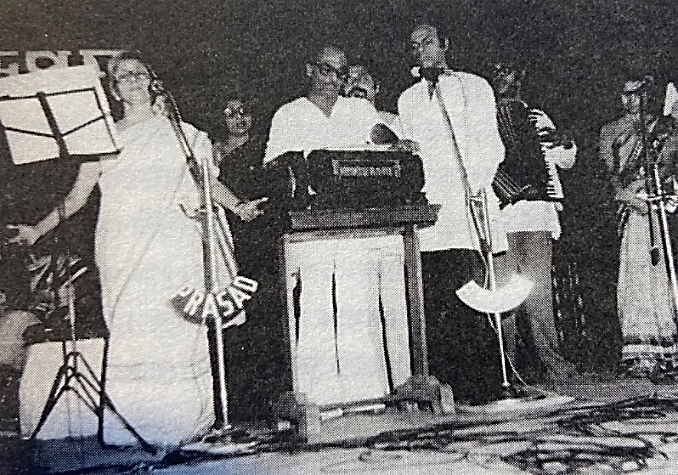
Yet such reworkings unsettled the rabindrik establishment and upon its release, it sparked significant controversy. Suchitra’s rendition was denounced vehemently as a distortion, and Salil’s lyrics were condemned as a “branded communist’s parody”. They were accused of being performers, essentially violating the aesthetic integrity of Tagore’s compositions. Hemanga Biswas also offered his own reworking of Tagore’s “Krishnakoli” in “Surer Guru” (The Guru of Melodies), inflecting it with Bengali folk idioms and situating the figure of Krishnakoli, displaced and alone, in the wake of Partition. While this version extends the song’s political afterlife in a different direction, it remains unclear whether it generated any comparable controversy. However, it is within this tension – between preservation and transformation – that the political afterlife of Rabindrasangeet becomes most visible.
The turbulent conjuncture of the 1940s, marked by war, famine, riots, and the impending rupture of Partition, reconfigured the broader ecology of musical production. Within this context, Ganasangeet, as discussed above, emerged as a new musical language of the movement: songs designed for collective singing and mass mobilisation. If Ganasangeet provided the explicit idiom of mobilisation, Rabindrasangeet occupied a more ambiguous position: an elite form that could be repurposed, yet never fully disentangled from its origins. This coexistence matters. The movement did not simply replace elite forms with popular ones; it held them together, although not without tension. The IPTA’s reliance on bhadralok artists both expanded and limited its reach. For a brief but intense moment, these contradictions held. The urgency of famine and war allowed aesthetic hierarchies to be set aside in favour of political need.
This tension did not remain abstract; it entered performance, reshaping the gayaki (distinctive vocal style) of Rabindrasangeet itself. The socio-politically oriented practitioners of Rabindrasangeet and their conviction of its applicability as a people’s genre shaped its gayaki. Debabrata Biswas’s unrestrained gayaki in the genre was moulded by his political alignment and his engagement in the performance of Ganasangeet alongside Rabindrasangeet. Once he entered the folds of the IPTA, he noticed that Rabindranath’s spirited patriotic songs were being rendered in a spiritual gayaki. Feisty compositions such as “Bandh Bhenge Dao” were being performed in a graceful and supple manner and he began performing these songs in a self-proclaimed “militant style”, despite objections. As a self-taught artist, he embraced a degree of artistic liberty, moving between Rabindrasangeet, folk songs, and Ganasangeet. Kalim Sharafi’s gayaki similarly departed from the prevalent softened, elongated, and deliberately leisurely style that later came to define the genre; his renditions were marked by a comparable directness and force. Suchitra Mitra’s full-throated, resolute, and tellurian gayaki, infused with the “sweat and grief of daily routine,” extended this transformation further, expanding the repertoire beyond exclusivist spaces. Across these practitioners, Rabindrasangeet’s gayaki was reconfigured, becoming more direct, forceful, and politically charged within the movement.
However, Rabindrasangeet was not dislodged from its standardised performative norms through these moments; it remained within the bhadralok sphere. And yet, in moments of crisis across Bengal, in East Pakistan and Bangladesh, it was repeatedly drawn out of these settings and refunctioned, returning as a language of resistance. As Bangladeshi linguist, Rabindrasangeet artist, activist and scholar Sanjida Khatun recalled, Rabindrasangeet became “our haatiyar (weapon).”
Placed against this longer trajectory of recurrence and reactivation, Three Million and the broader questions of what, who, and how things are remembered, Rabindrasangeet becomes difficult to apprehend in its conventional terms. Its history is one of continuity and reverence, entangled with histories of rupture, political urgency and creative reworkings. In the absence of formal memorialisation, these songs and performances functioned, however briefly, as sites of remembrance. They did not monumentalise the dead but resisted the ease with which such lives receded into abstraction.
To revisit this history on Tagore’s birth anniversary perhaps allows for a different kind of listening – one that moves beyond the canonising reverence through which his songs are often performed, and attends instead to the instability of these forms – recognising how they have been mobilised, contested, and re-signified across moments of crisis. The 1940s reveal that Rabindrasangeet did more than respond to catastrophe; it acquired a political afterlife, shaped by its uneasy, generative encounter with the cultural Left.
And perhaps, in listening again, to allow that unease to remain – as a way of holding open the tension between aesthetic form and political life that Rabindrasangeet continues to inhabit, at times resurfacing within contemporary protest spaces.
Sahana Bajpaie is a practice-led researcher specialising in Rabindrasangeet and Bengali folk music. She is a Senior Teaching Fellow at SOAS University of London and a Leverhulme Post-Doctoral Fellow at the School of Music, University of Leeds. She is also a singer.
[ad_2]
Source link