
[ad_1]
Earlier in May, the 2026 Pulitzer Prize for Illustrated Reporting and Commentary was awarded to trAPPed, a story about a neurologist from Lucknow who finds herself ensnared by a “digital arrest” cyberscam.
Sharing the byline with two investigative journalists is a comics artist who has depicted the invisible walls of that prison. Anand Radhakrishnan, known as Anand RK, was already a name to reckon with before this honour: conjurer of jazz-haunted nightmares, and a draftsman who can switch from the rain-slicked gullies of Mumbai to the outer reaches of a post-apocalyptic radio station without ever losing his grip on the emotional weather inside a panel, he was first Indian, in 2021, to win an Eisner.
The Pulitzer Prize for Illustrated Reporting and Commentary was instituted only in 2022 to accommodate long-form visual reportage. But it has already built a distinctive record: it has honoured graphic investigations into state oppression, data visualisation that maps billionaire wealth, visual essays on incarceration, and editorial cartoons so fearless they cost a veteran her job.
That Anand, working from a home studio in Mumbai, sits comfortably in such company says much about the breadth of the career he has built. It also speaks to the steady, under-documented arrival of a generation of Indian artists in the bloodstream of American comics.
The art of Anand
After abandoning his medical ambitions and a BSc at St Xavier’s College, Anand graduated in 2011 from the Sir JJ Institute of Applied Art in Mumbai, one of the country’s oldest art institutions. The degree gave him an agnostic relationship to style: “A chameleon, essentially,” he said. The story would always dictate the drawing, not the other way around.
He fed himself on international artists through the online gallery Cgunit, proceeding to absorb the fundamentals of image-making for two years at The Art Department, an online school that closed before his final year.
The letterer Aditya Bidikar, who has worked on almost every comic Anand has drawn, remembers his first impression: “I expected a much older gentleman,” Bidikar said, “like a stately painter kind of person.”
The artist he eventually met was an unassuming man his own age, kickstarting a collaboration that has continued to this day. “He is very versatile,” Bidikar said. “He does different styles for everything. I get to try new things again and again with the same artist.”
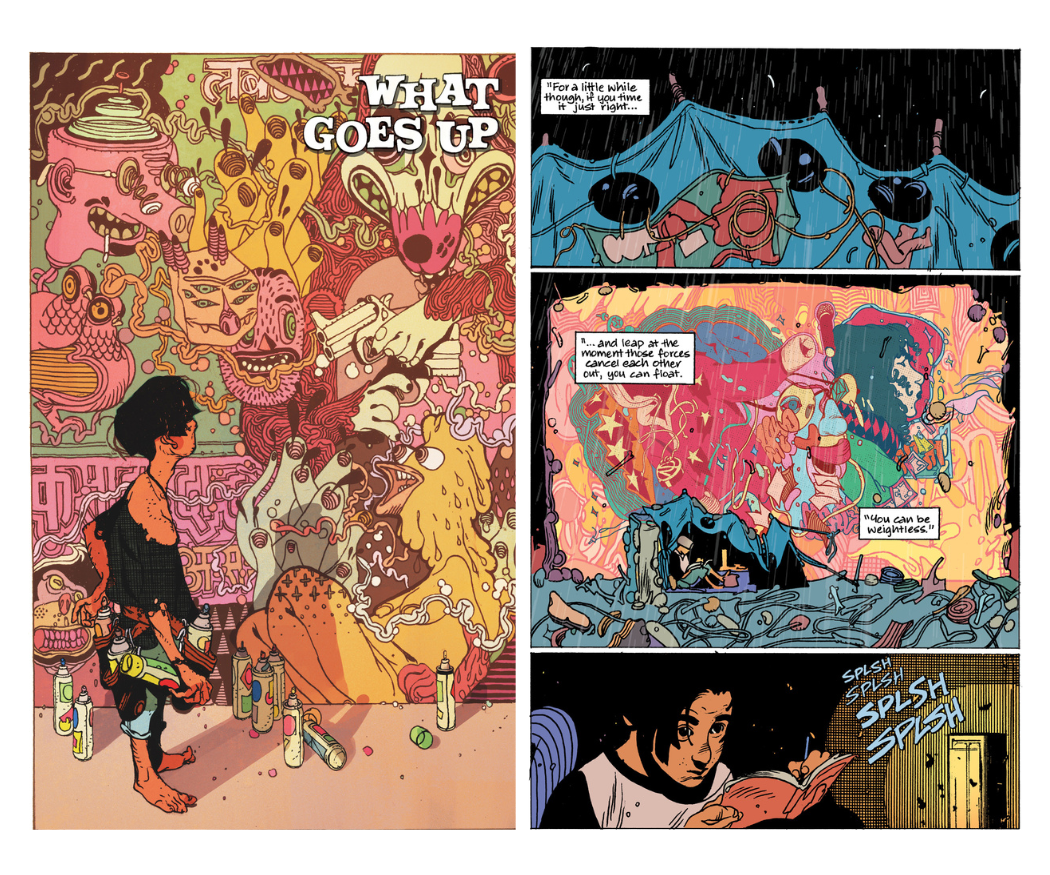
The comics writer Ram V saw Anand’s early work online in 2015 and reached out. The partnership that followed has been compared by Anand to musical improv. “Having been one of Anand’s earliest collaborators, what was apparent even then was the honesty and authenticity of voice that is ever present in his work,” said Ram. “In an age of pop culture-driven ubiquity, Anand’s narrative art continues to have an earnestness in its way of looking at and representing the world, its people and their truths.”
There is a larger history here of a wave of Indian creatives who, over the last decade, have quietly entered the American industry at every level – mainstream and independent, writing and drawing, colouring and lettering – carrying with them sensibilities that neither India’s graphic-novel boom nor Western criticism has fully acknowledged.
The late 1980s brought the likes of Alan Moore, Neil Gaiman, and Grant Morrison into the American mainstream, reshaping superhero grammar with a darker, literary sensibility. Several formal experimenters followed, well into the turn of the century.
The current “invasion” is Indian. It is wider in distribution and not centred on writers alone. Ram V and Sumit Kumar went from self-publishing to producing a prolific body of mainstream work; Bidikar is an institution in himself (and is now writing his own comics). Bhanu Pratap’s Cutting Season was published by indie publisher Fantagraphics in 2024, placing him in the lineage of experimental cartoonists redefining what the medium can do.
Lavanya Naidu has built a prolific reputation in children’s comics. And Anand Shenoy’s self-published Zoo anthologies ridicule the quotidian realities of post-millennial Indian life, among others.
The sensibilities they bring are all nodes in a network that have emerged without a manifesto or market campaign. If there is a shared quality, it is a relationship to texture: an attentiveness to the way bodies occupy space on the comics page, to the historical grain of a city, and its weight on the individual.
This is also visible in trAPPed, where a house in Uttar Pradesh becomes a prison through the simple repetition of a phone screen’s dark eye.
The anatomy of trAPPed
The scam the Bloomberg team set out to investigate is a sordid by-product of India’s headlong digital transformation. Criminals pose as police officers, place victims under “digital custody” over a video call, and drain their life savings while performing elaborate bureaucratic pantomimes. Ruchika Tandon, the neurologist at the centre of trAPPed, was kept under surveillance for eight days in August 2024, ordered to shun her family and never be off camera. She ultimately signed away three generations of family wealth.
Suparma Sharma spent nearly a year on the ground investigating such cases. The team travelled over 16,000 km, interviewed more than 65 people and examined thousands of pages of police diaries, bank transactions, and WhatsApp logs.
They tracked a network of mule accounts, crypto exchangers, and hollow companies from Dehradun to Cambodia. Sharma and Pearson understood early that conventional photography and video would fail; the crime unfolded inside a mind, on a screen.
The editorial team at Bloomberg – Ken Armstrong, Nadja Popovich, Amanda Cox, Flynn McRoberts, and Jui Chakravorty – translated that mountain of raw reporting into a script.
For the visuals, they turned to Anand.
The collaboration began in April 2025. The investigation was already in progress, but Bloomberg wanted to produce an illustrated version of one victim’s ordeal. Anand also had a personal connection to the material: a relative had been scammed as well, and he had seen how it eroded their self-confidence years after the event.
He jumped into a series of Zoom calls with Pearson, Sharma, and the editorial team. “Through these calls and reading about what Natalie and Suparna had already uncovered,” he related, “I started to understand more about the intricate network that is the digital arrest scam in India.”
With much of the heavy lifting already done, Anand needed his own encounter with the real. He met Sharma, and together, they attended a court hearing in Lucknow related to Tandon’s case. He sketched inside the crowded courtroom, but the chaos was too much; he couldn’t produce anything usable.
He was not allowed to speak to Tandon either; she was already drowning in press attention. Instead, he visited her neighbourhood, workplace, and the bank, while relying on previously taken photographs of her home for reference.
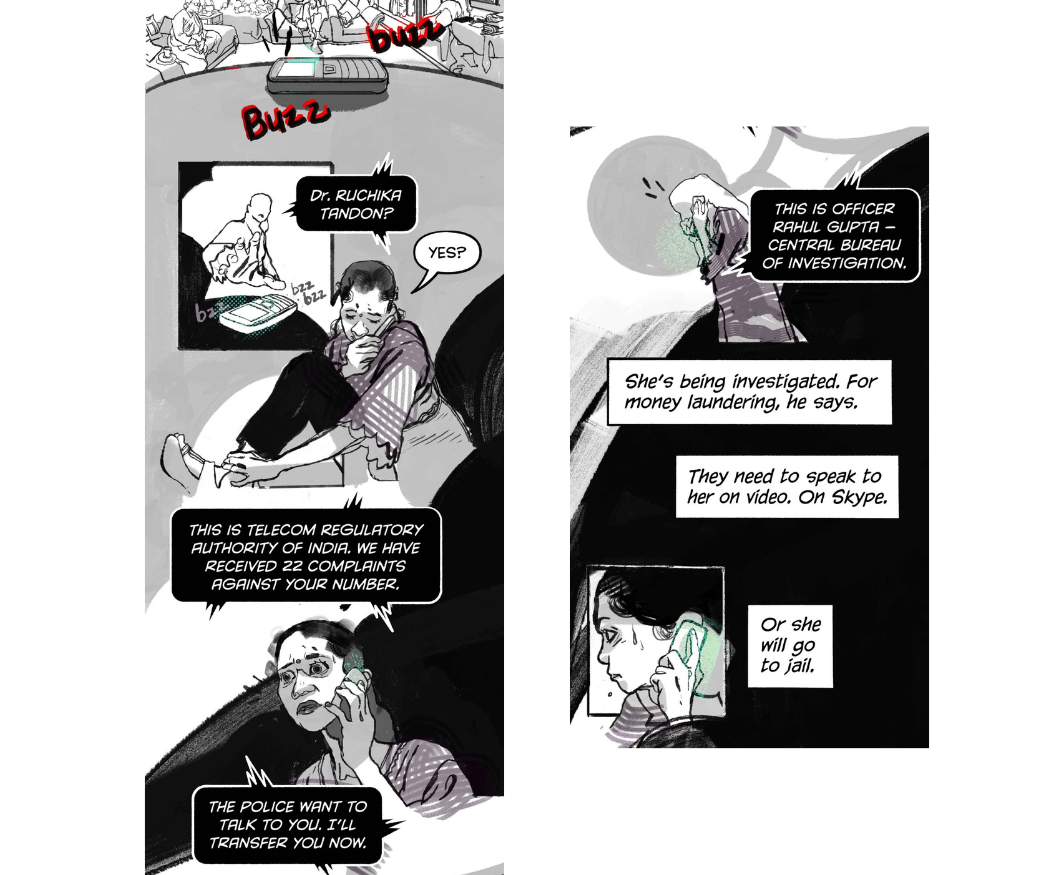
As scripting progressed, Anand tested visual treatments, looking for something crisp but fast enough to sustain such an intensive, collaborative project. After trying a handful of techniques, they landed on a mostly black-and-white, bold line-heavy drawing style. Week after week, the team pushed the story from script to style checks to thumbnails to final inks.
“Process-wise, this was vastly different,” he said in relation to his other comics work. Here, a roomful of editors with little experience in vertical webcomics were figuring it all out in real time, even though they all ended up being exceptionally good at it.
In thrall of the scroll
The biggest challenge was the format. Anand was used to print, with fixed page dimensions. A vertically scrollable comic, optimised for a smartphone, was alien territory: the kind of infinite canvas popularised by webtoons, repurposed here for narrative journalism. “This was a big mental hurdle to get over … it was really hard to visualise,” he said.
The breakthrough came when Cox and Popovich reminded him that there was no vertical limit; he only had to think of boundaries horizontally. Even so, the team broke the story into conceptual “pages” – small units that mapped onto days or scenes – so that Anand could work without drowning in its endless expanse.
“All the editors, especially Popovich and Cox, were instrumental in getting the pacing right and thinking of the story in terms of scrolling,” he said. “Each story beat was so-and-so number of scrolls and [calibrated to] that much amount of time spent by the audience within that scene.”
Popovich also made mock scrolling compositions with rough layouts and letters before meetings, giving Anand a crucial sense of how the piece would be read. The challenge was also technical: lettering for a webcomic had to be larger and chunkier than for print, so Bidikar had to recalibrate everything.
He found the perfect “phone voice” – a tone that was “both extremely sinister and also smooth/mellow when it was required,” Anand recounted. Nisha Singh handled colours and Zeeshan Akhtar translated the piece into Hindi (also lettered by Bidikar).
The final comic is not paywalled and was published alongside an additional text version for the visually impaired.
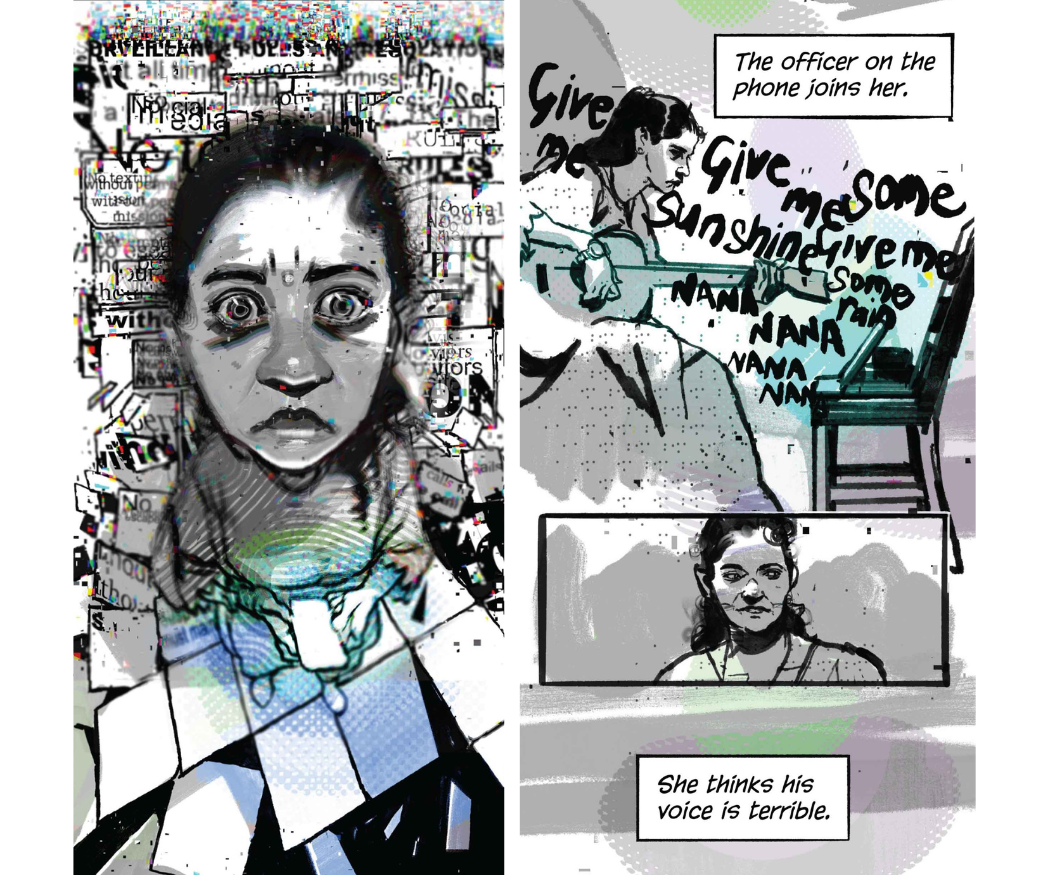
What emerged is sequential storytelling that weaponises its own format. The logic of the scroll – the endless downward pull on a smartphone screen, the way time passes and attention is held in thrall – mirrors the total capture that the scam itself threatens. Tandon cannot turn off her camera; the reader cannot stop swiping. The phone becomes both the instrument of the crime and the architecture of its telling.
There are no splash pages, no operatic double-page spreads. Perspective is mostly held on domestic interiors: a checkered floor, a cupboard, a glowing phone on a shelf, Tandon’s face as it moves from confusion to terror to numb compliance. The palette leans into the fluorescence of Indian middle-class homes: pale blues, institutional greys, the ochre of a bank form.
“A scrolling comic is essentially one really long image,” Anand pointed out. “That means you can use very interesting transitions between scenes and images and can control how long the reader spends within the world of the character.”
Nowhere in the Pulitzer citation does it ask whether the artist’s primary medium is fiction or fact. What it honours is “a distinguished portfolio of editorial cartoons or other illustrated work […] characterised by political insight, editorial effectiveness, or public service value.”
For a story that ends with a neurologist staring at Google, wondering if she is still being watched, the phrase “public service value” lands with uncommon force. The fake crests of the Central Bureau of Investigation, the WhatsApp messages from handlers ending in smiley emojis, the Amitabh Bachchan-inspired name of the inspector (Vijay) and his Big Brother-like authority: each of these details accumulates without melodrama, until the procedural weight of it all itself becomes the horror.
A career without seams
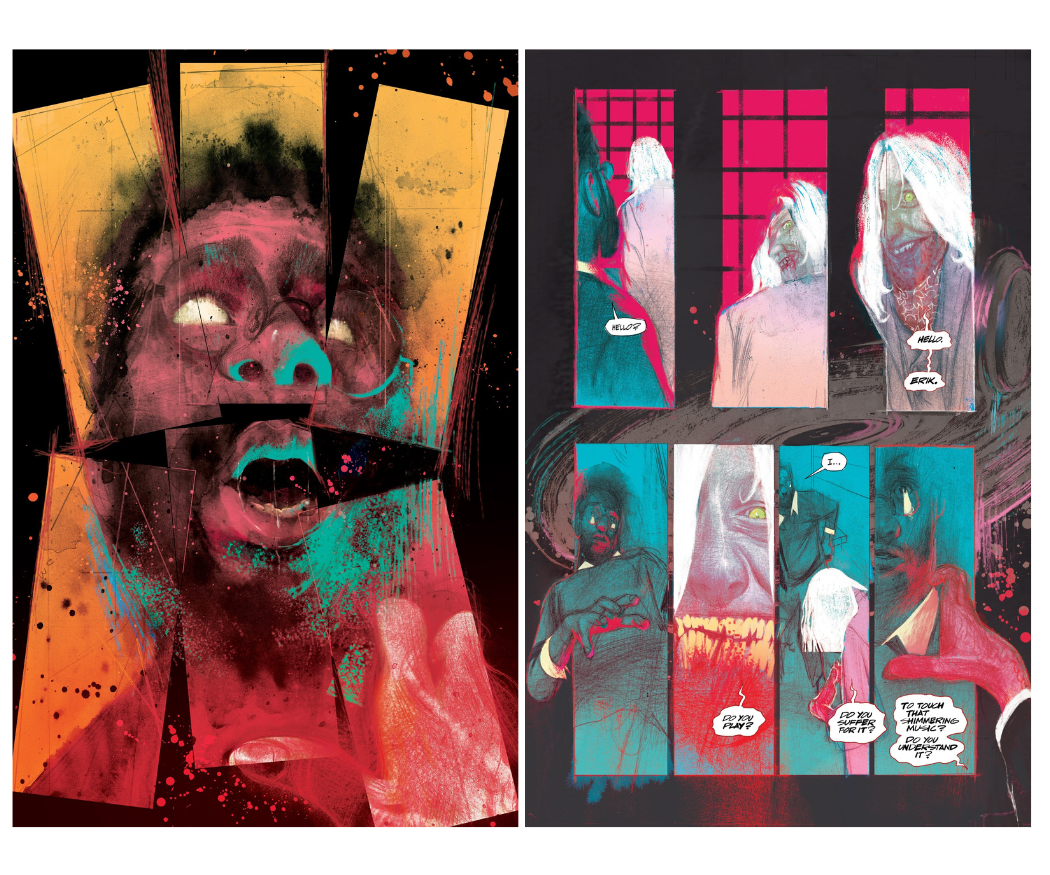
Anand’s work so far has involved bringing together the personal, commercial, and civic. Grafity’s Wall (2020) arrived as an underdog coming-of-age story set against Mumbai and the sensory overload of the city’s many illusions. The same year, Image Comics released Blue in Green, a psychological horror comic that reaches for the crescendo of being human and the Faustian compact lurking beneath. The book’s six to eight panel grid mirrors the octaves, jointly winning him and colourist John Pearson the 2021 Eisner Award for Best Painter/Multimedia Artist.
The incomplete Radio Apocalypse is another tribute to music, playing alongside a sense of abandonment and the shifting bodies that follow after the unthinkable has happened. More recently, Resurrection Man: Quantum Karma (2025) for DC Black Label dramatised the cosmic scope of what it takes to tackle the recurring evils of our world, the superhero macro to trAPPed’s micro.
Under the working title Kuntham, he has also been building a private bestiary of eroticism and mutation, at the border between art and science. His influences are legible: the sci-fi vistas of Moebius, the dystopian agility of Katsuhiro Otomo, and the painterly grit of Metal Hurlant, among a host of others.
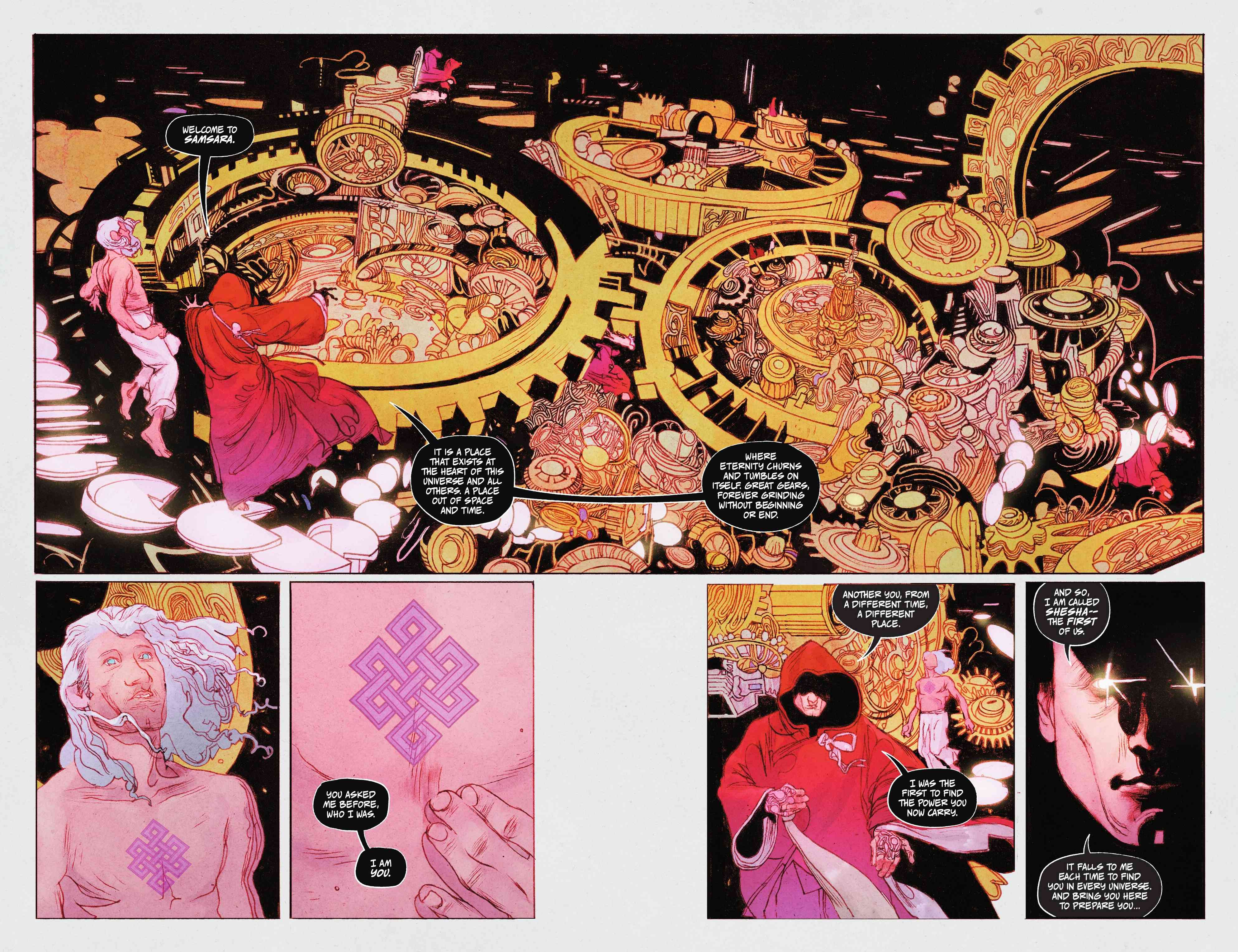
The Pulitzer has also landed on a man uneasy with the recognition. “The shock is wearing off, and imposter syndrome is kicking in full force. I feel mostly undeserving of it,” he confessed. “There are many [who are] better who have been working in nonfiction for decades who probably deserve it way more.” He is also not sure if it will pull him deeper into reportage, but he would “love to find a way to collaborate again with the Bloomberg team of editors.”
Anand has also signed on for a creator-owned science-fiction graphic novel with the French publisher Morgen, written by Ram V, with art by himself and Evan Cagle, letters by Bidikar, and design by Tom Muller. Work begins in August and will run until 2028, while personal projects continue to progress alongside.
For the small, still-emerging ecosystem of writing on Indian comics – caught somewhere between academic symposia and bookstagram carousels – trAPPed is an event. The work of Anand and his colleagues insists that we learn to speak with precision about the labour behind their piece. The cartoonist’s work is laid bare here as a form of public intelligence, as is the utility of comics as an effective means of mass communication.
The recognition of the Pulitzer made it official, and in doing so, it handed the Indian comics community a mirror. What we do with the reflection is our own work.
Arunava Banerjee is a comics critic and scholar of media art.
[ad_2]
Source link