
[ad_1]
Sharing its name with the coast of its origin, the language of Konkani is spoken in multiple dialects and written in scripts as diverse as Perso-Arabic, Roman, Devanagari, Kannada, and Malayalam. Enmeshed within the politics of language, so closely tied to regional identity in South Asia, official status, standardisation, and patronage pertaining to the scripts and languages in which Goan literary production occurs have been matters of long-standing concern in the enclave.
Located on the Konkan coast, Goa’s linguistic and literary heritage outsizes the region’s diminutive geography. Konkani is one of the languages in which Goan writers have expressed their craft in Romi and Nagri scripts, but Goan literature also appears in Marathi, English, and Portuguese. In fact, among the first novels of South Asian nascence is Os Brahmanes (1866) by Goan writer Francisco Luís Gomes (1829-1869); its Portuguese title really requires no translation, although The Brahmans (1971) – an edition in English – does exist.
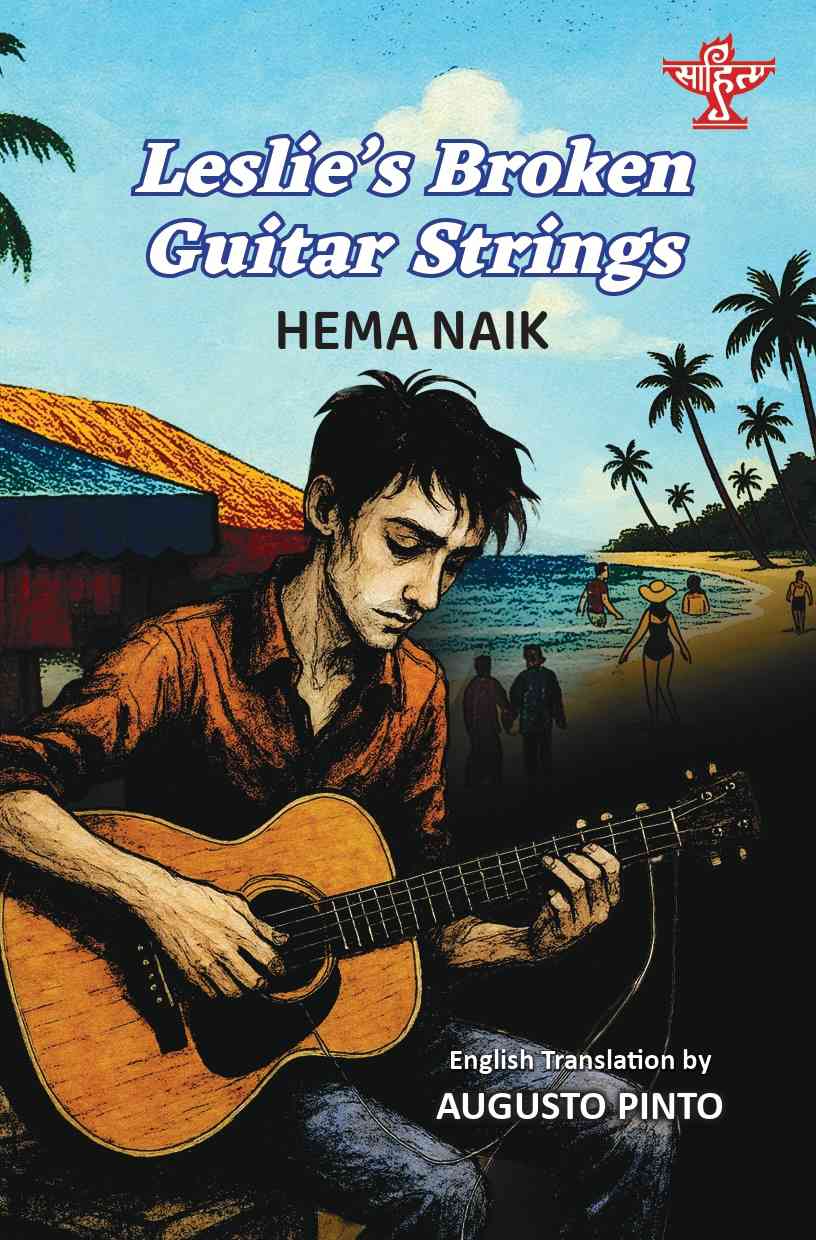
Despite this varied literary heritage, in addition to the controversies surrounding it, intra- and inter-language translation in Goa has been limited. While translation efforts alone cannot diminish internecine linguistic tensions, they may support dialogue across the borders between scripts and languages. It is against this backdrop that one can place the work Augusto Pinto has been doing as a translator. His retirement as an Associate Professor of English at Goa’s SS Dempo College of Commerce and Economics notwithstanding, Pinto has continued to work in the field of literary studies as a translator. Published by the Sahitya Akademi, Hema Naik’s Leslie’s Broken Guitar Strings (2025) is Pinto’s latest translation of a novel that was originally published in Nagri Konkani.
With a focus on Naik’s book, in this conversation with Scroll, Pinto reflects on the task of translation, Goan literature, and the life of translated texts beyond their original form.
Before it was Leslie’s Broken Guitar Strings, this novel by Hema Naik began its life in Nagri Konkani as Bhogdand (1997). Do you recall how you first encountered Naik’s novel and what about it piqued your interest in wanting to translate the book?
The title you have chosen for the translated version works really well, evoking the fragility of the musical instrument the eponymous Leslie is so fond of, as well as its metaphorical relaying of the precarity surrounding the character, his household, and his community. Yet, the English title is rather different from that of its Konkani counterpart, so why the dramatic alteration?
I’d been translating the major plays of Hema Naik’s husband, Pundalik Naik, before Bhogdand and I had the occasion to meet both at their home in Savoi Verem. However, before Bhogdand I had encountered Durgavatar, a collection of Hema Naik’s short stories and I had translated the title story “Durgavatar” (The Avatar of Durga), a chilling story of two women with abusive, alcoholic husbands, for an anthology that unfortunately didn’t get published.
How did Bhogdand get translated? Well, I had brought the novel to the attention of an online book club which was seen by the editors of the Interdisciplinary Journal of Portuguese Diaspora Studies who requested me to publish a translated excerpt from the novel. When I approached Hema Naik for permission to publish the excerpt, she requested me to translate the entire novel into English using a Sahitya Akademi scheme, which supports translations of its award-winning titles.
With regard to the title of the book Leslie’s Broken Heart Strings, let me preface my explanation like this: a translator is, willy-nilly, also an editor of the book. It’s not wise to translate everything literally and one has to judge when to omit matter irrelevant to the English reader and when to elaborate on words and ideas that may have no corresponding term in English. For example, the word khazan is a commonplace one in Goa and among those who know Konkani. But, in English, the translator can’t leave it unexplained and may have to explain that it is an elaborate system of dykes and bundhs on the rivers of Goa and, further, has to decide how much to explain about the importance of khazans for agriculture and fishing and life in general.
Now, the title of the book is one part which I think needs special attention. It needs to be memorable and capable of prodding the reader to pick up the book, while at the same time, it should give an idea about the kind of book it is. The problem with Bhogdand is that it is a compound word which has no single-word equivalent in English: while danda means punishment, bhog is ambiguous and can mean, among other things, satisfaction or lust, or libido, or even suffering. If I used a title which had lust or libido in it, it risked misleading readers into thinking that the genre of the book was erotica – which might have been disappointing to say the least.
Among the options I had was using the original title, as in Tagore’s Gitanjali, Premchand’s Godan, and Vivek Shanbhag’s Ghachar Ghochar. I thought that wouldn’t work with Bhogdand. Another option is using something entirely different from the original, like Stieg Larsson’s thriller, which, in the original Swedish, was entitled Men Who Hate Women, but which became in English the memorable The Girl with the Dragon Tattoo. That’s the way I went when I chose Leslie’s Broken Guitar Strings, which I believe encapsulated the story – and I’m glad you think well of it.
Having said that, changing the title like this can sometimes be a dicey thing. For instance, Jerry Pinto translated Jnanpith Award recipient Damodar Mauzo’s Konkani novel Jeev Diunk kai Chya Marunk (literally Commit Suicide or Drink Tea?) as Boy, Unloved. The problem is that the shock value that emanates from the sense of wistfulness towards suicide in the original title, and which is a theme that runs through the novel, vanishes with the translated title. Personally, I’d have gone for something equally weird like Hara-kiri or Cuppa Tea?
Universal themes abound in Leslie’s Broken Guitar Strings: migration, familial conflicts, gender roles, and economic hardship. Nevertheless, set in the recent Goan past (the 1980s and 1990s), the novel’s regional and sociocultural milieu is evident. The village of Jua is like an ever-present character in the novel, the community’s intimate nature expressing itself as much in being close-knit as it is in inducing claustrophobia.
As you rendered your translation of Jua’s idiosyncrasies, did you find yourself drawing from your own understanding of Goan village life? Simultaneously, how did you negotiate the time difference, as it were, between the moment in which you were translating the novel and the historical period of its unfolding?
I agree with your observation that Jua emerges as a character in the novel. All the actions of the characters of the novel are performed with the island being the backdrop. It is constantly observing them, sometimes in unnerving ways. It is for this reason that Gemma, the female protagonist of the novel, is quite determined not to build her new house within the village but instead wants a plot of land across the river surrounding the island, where she will be out of sight of its nosy, intrusive inhabitants. However, this Jua isn’t a single individual but is more like the chorus of a Greek play, which takes on different forms at different times. The island expresses itself through a variety of means, including patriarchy and tradition and conservative values.
The novel can, at a larger level, also be seen as a commentary on migration, a phenomenon which is too often seen only in material terms. No doubt, for Goans, migration was a means of improving their economic life, but if one examines it from a cultural viewpoint, it may be seen as a means of escaping from the hierarchical and patriarchal norms that stifled the lives of the people of Goa, something which historian Teotónio de Souza, quoting Karl Marx, called “the idiocy of rural life.”
Although caste, which is one of those determining factors of traditional Goan life, is one that Naik keeps on the sidelines, she does dwell on how women, who had hitherto been tied up by the bonds of patriarchy, are now finding freedom through education and entrepreneurship.
As for drawing on my own experiences, it’s true that living in Goa makes it easier to catch the nuances of life here as it is lived. A Goan is aware of the differences of caste, class, and tribe, for instance, and the kinds of differences that exist in Old Conquest areas, where the Portuguese were controlling the administration from the sixteenth century, and New Conquest areas, which came into their possession a couple of centuries later. Life in the Sattari taluka, which Prakash Parienkar deals with in The Bitter-Fruit Tree and Other Stories, can be a culture shock even for someone who has lived most of their life here.
However, Leslie’s Broken Guitar Strings largely takes place in a Catholic Goan ethnic setting, which I’m very familiar with and so it made translation all the more easy for me. With regard to the period when the novel was written (roughly around 1990, when the Iraq invasion of Kuwait took place), it was one that affected me closely, as I had many friends and even family who were living in the Gulf at the time. Like many a Catholic Goan family, I had been following the conflict very closely at the time. So, negotiating the time difference in this novel wasn’t much of an issue.
Naik often goes into quite a bit of ethnographic detail. A passage that set this writerly trait in relief for me is this exquisite moment:
“One day Antonette [, Leslie’s mother,] sat on the sopo idly thinking about things … She recalled how the old people used to describe the different phases of the monsoons. The scattered drizzles that would occasionally fall nowadays were the sontaran rains–meaning the rains of the great-great-grandchildren. The very first rains that would fall, the pre-monsoon showers, were called the mhataream rains – rains of the old people which was because the old needed rain more than others.”
This is just the beginning of such a catalogue of kinds of rainfall, all personified in terms of familial and generational relationships. I can see an eco-critical literary scholar having a field day with this climatic chronicle, given that the environment is likened to kin in Antonette’s reminisces of “how the elders would describe” monsoonal precipitation.
Antonette’s reverie signals changing times. Such knowledge of the elements, refined but also likened to the members of one’s family, is something even she imagines as being the purview of “the elders” – a knowledge system that she cannot claim a ready facility with. The reader is to imagine a time when this information will no longer be commonplace and even less so a memory.
Now, what I find even more intriguing here is not that you have retained the original Konkani words but that they appear in Romi Konkani in an English text. Said differently, the Nagri words readers would have encountered in Bhogdand (as well as the cultural knowledge they codify) are preserved and propagated in Romi Konkani through this English version of the novel.
What might this tell us about the role literary works play in the multilingual/multiscript context of Goa in serving as cultural texts and also as holders of verbal knowledge beyond their own linguistic remit?
A language embodies the culture of a people and the Konkani that we use is intimately related to the soil and soul of Goa. Till quite recently, Goa was an agrarian society and Konkani reflected that. The example that you cite of Antonette describing the rains is only one of them. Much else depended upon the monsoons and how they would affect the crops. For instance, there’s the aspect of making purument or provisions for the rains that now has become much diminished.
However, I know it’s a commonplace one but I don’t agree with the distinction that you make between Romi and Nagari Konkani (you presumably mean Devanagari, as Nagari can refer to an older script which is not in current usage). The words I use are Konkani words and not Romi Konkani or Devanagari Konkani words (just as they would not be Kannada Konkani words or Malayalam Konkani words had I used those scripts). The Romi-Devanagari script war that is waged in Goa is linguistically senseless. Romi and Devanagari are scripts, not languages, and Romi Konkani and Devanagari Konkani are not dialects.
If the terms Romi Konkani and Devanagari Konkani are of any significance, it is because they refer to the positions of two politically opposing elite Konkani groups whose major difference is essentially religion and who are fighting to have their own favoured dialects as the standard dialect of the language. The conflict between them is also indicative of how writing has become more privileged as compared to speech among these elites. It’s worth recalling that if Konkani survived over the ages, even during periods when the Portuguese banned its literature, it did so because it lived on the lips of the people. Writing and printing are, in civilisational terms, a very recent phenomenon and the belief that written language is of greater importance than spoken language is not just mistaken but is doing great harm to the Konkani movement. It delegitimises all the regional and social dialects that Konkani comprises, including the dialects of the Velips and the Gawdas and the Padyes; the Saxtti and Perni variety and those of Sattari and so on. (I dealt with other aspects of this issue in a review of the volume The Languages of Goa, which is part of the People’s Linguistic Survey of India edited by GN Devy.)
Hopefully, the audio-visual culture of modern times that has been spawned by the mobile phone and the internet, and which has been accelerated manyfold by the developments of AI, will reduce the obsession with scripts. In fact, AI, which allows for almost simultaneous transliteration among scripts, can not only make the Devanagari-Romi battle a redundant one but can also make Konkani a leader in using language across multiple scripts simultaneously. It could also make redundant the need for a standard dialect and allow the different dialects of Konkani to coexist without being looked down upon by users of a preferred standard dialect, which currently is Antruzi, or the one preferred by the Romi Konkani protagonists – Bardezi.
Did you have the opportunity to consult with Naik as you translated her book? As you assayed the translation, what was most challenging? How did this translation project differ from others you have undertaken?
I did very occasionally do that when I didn’t understand a word or phrase in a passage. However, when translating Bhogdand, this happened very rarely because the novel is set in a largely Goan Catholic milieu, which I am obviously very familiar with. In fact, there were a few occasions when I was able to correct some minor errors related to some Christian prayers and rituals in the Konkani version.
The case was very different when I translated the brilliant plays of Pundalik Naik – her husband – which, as of now, are sadly unpublished. Plays like Shebai Shebai Bahujan Samaj or Shri Vichitrachi Zatra, for instance, need an intimate knowledge of life in Goan villages and an intimate knowledge of the significance of different rites and rituals and cultural practices, which, for me, required a lot of consultation with the author and others familiar with the culture.
It’s good to have an original author by one’s side; however, for a different reason. When alive, they are more often than not extremely keen on getting their work translated competently. However, I’ve had the occasion of translating some authors who have passed on and when this happens, it can be a real pain in the neck because the heirs to the copyright aren’t familiar with literature and sometimes they harbour the suspicion that the translator is out to steal the author’s legacy and they create needless hassles for him.
What would you like readers to take from your translation of Naik’s novel? Do you foresee this book appearing in educational curricula in Goa and elsewhere?
Frankly speaking, I hope that readers just find it an interesting read, as most people read fiction for entertainment and not to get educated. That, of course, does happen, but it’s a subconscious process.
As for it being used in the educational curriculum in Goa, I certainly see that happening at some point in future as it is a novel that has multiple themes, among which are migration, unemployment, and interpersonal relationships, which will enable readers to examine their own lives in a meaningful way.
Finally, what can you tell readers about other translation work they might see from you in the time to come?
The work of Pundalik Naik, who is one of the greatest Konkani writers of modern times, is looking for a publisher. Naik’s forte is drama and, in my opinion, he’s one of the finest Indian dramatists, but the problem is that his plays haven’t been translated into English and other languages. I’ve translated seven of his best plays. Unfortunately, it appears as if publishing drama has fallen out of favour. A manuscript of the late Gajanan Jog, one of the most skilled Konkani short story writers, is awaiting publication with a local publisher. I’ve also done translations of poetry, which many others have found difficult but which I enjoy doing. The late Vishnu Wagh’s controversial book of poetry, Sudhirsukta, for instance, is on my computer waiting for a publisher. There are also a number of writers whose best pieces I have translated over the years: Chandrakant Keni and Soter Barreto come immediately to mind, whose works need to be anthologised. The problem with publishing translations is that they need publishers who have a national and, better still, international distribution network. Otherwise, their books don’t get the attention they deserve.
But unfortunately, the more prominent publishing houses that can do this are ruled by their bottom lines and don’t give much space for translations by writers from smaller states or of minor languages. In this connection, the Sahitya Akademi could have been a liferaft for smaller languages in the scheduled list, like Konkani. The problem is that the process in the Akademi tends to be exhaustingly slow and bureaucratic. Also of late, there are signs that the Akademi, which had, despite all its faults, been a relatively autonomous institution, is under pressure from the government to follow its diktats. If only the government had the wisdom to appoint people of the calibre of [publishers] Ravi Singh or David Davidar who could turn this institution around!
R Benedito Ferrão is an Associate Professor of English and Asian & Pacific Islander American Studies at William and Mary, Virginia, US. He is the author of The Girl Who Was the Color of Nothing (2026), illustrated by Maria Vanessa de Sa, as well as the forthcoming Across Continents: Writing Goans, Making Worlds.
[ad_2]
Source link