
[ad_1]
As August 1947 drew near, MK Vellodi was faced with a peculiar problem. The seasoned civil servant from Madras had taken over as the acting High Commissioner of British India to the UK only a few months before, in April. He had been tasked with overseeing the Independence Day celebrations at the historic India House, British India’s diplomatic mission in London, on August 15.
But, as he explained in a telegram to the Ministry of External Affairs and Commonwealth Relations in New Delhi on July 22, he had still not received proper instructions from the government of India about the event. He needed them sent well in time so that he could make the necessary arrangements.
Vellodi also complained that the mission had no national flag to hoist, so he would need details of the colours and dimensions of the tricolour.
The lack of such details isn’t surprising. Lord Mountbatten, the British viceroy, had announced only on June 3 that the colonial power would leave India on August 15, instead of the earlier scheduled date of June 30, 1948. He also declared that British India would be divided into India and Pakistan.
In July, he appointed a Partition Council to decide upon the division of financial assets, communication services, armed and civilian personnel, and institutions between the two dominions. In his personal reports to London during this time, Mountbatten expressed satisfaction in the progress that the Council was making in New Delhi and Karachi.
But there were many loose ends. For instance, Vellodi was concerned about the future of India House – which, until August 15, was to serve as the foreign mission for all of British India, both India and Pakistan. He wanted to confirm whether the building would remain the High Commission of India on August 15 and the Pakistani authorities would be accommodated elsewhere.
“Clear orders and press publicity should be given to this decision so that no embarrassment and disorder is caused here on August 15th by Pakistan supporters insisting on hoisting the Pakistani flag on India House,” he wrote. “Pakistan demonstration at India House would be most unfortunate and should obviously be avoided.”
Vellodi concluded on a pacificatory note, suggesting that both the Indian and the Pakistani flags should be hoisted together on August 15.
New Delhi’s response to these concerns was rather unhelpful. Vellodi was told that the matter of the future of the India House had still not been decided by the Partition Council, the administrative body headed by Britain’s viceroy Louis Mountbatten to coordinate the division of the subcontinent.
As it turns out, both India and Pakistan had staked their claim to consular buildings. The Partition Secretariat gave an indication that the matter could only be settled through arbitration.
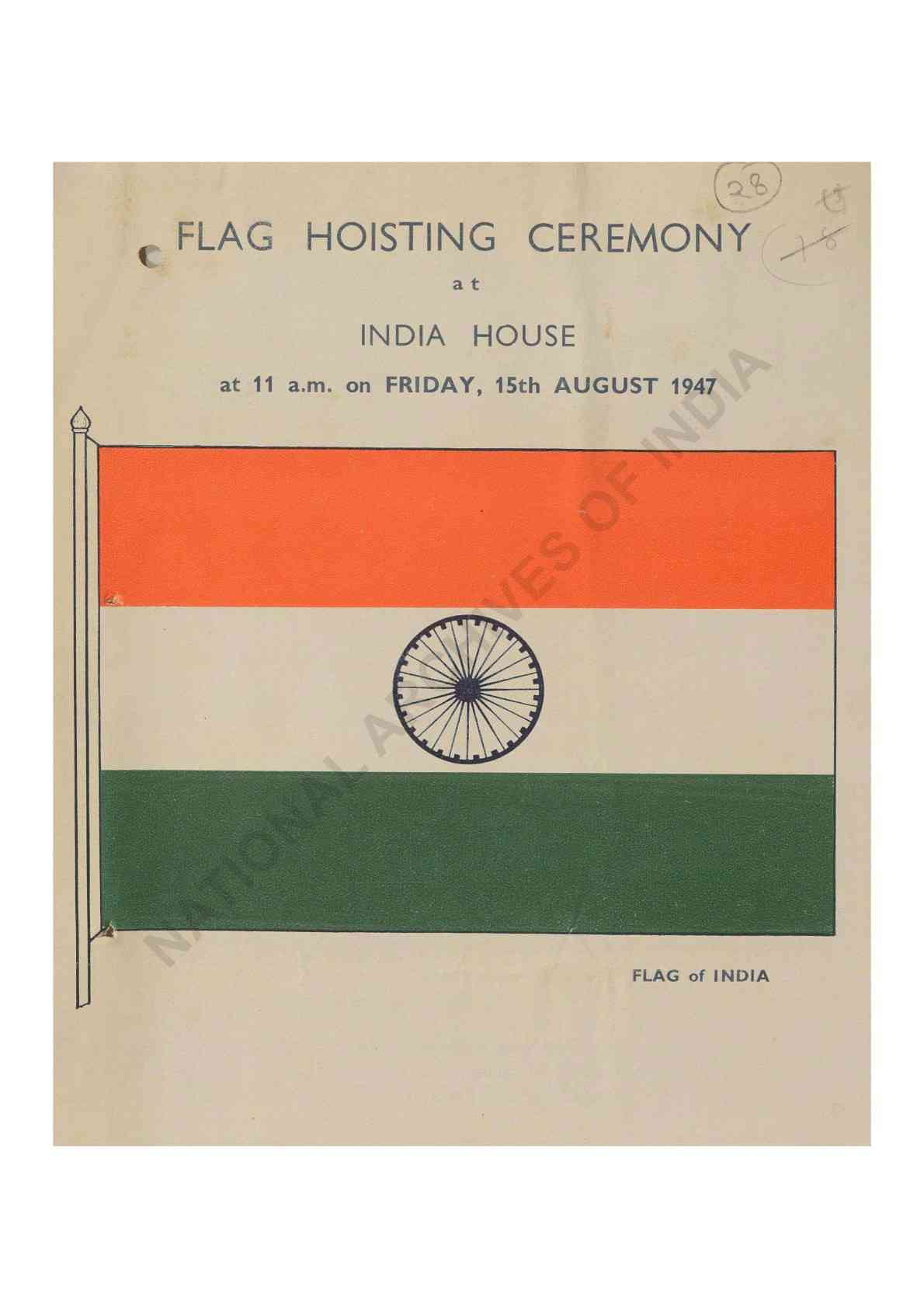
The matter of the flag was soon settled. On July 22, the day Vellodi sent his telegram, the Constituent Assembly, which had been assembled to draft India’s Constitution, approved the tricolour with a charkha as the national flag of India. But Vellodi was still worried. He told New Delhi on July 30 that invitations could not be sent to guests without resolving the debate about the ownership of India House.
Besides, the Constituent Assembly had not fixed on a national anthem. So Vellodi asked if a patriotic song such as Jhanda Uncha Rahe Humara could be played while hoisting the flag.
New Delhi responded only on August 6, saying that in India, the flag would be hoisted without accompanying music. But it gave Vellodi the liberty of choosing any popular song to perform alongside the ceremony, provided it was not confused as the national song.
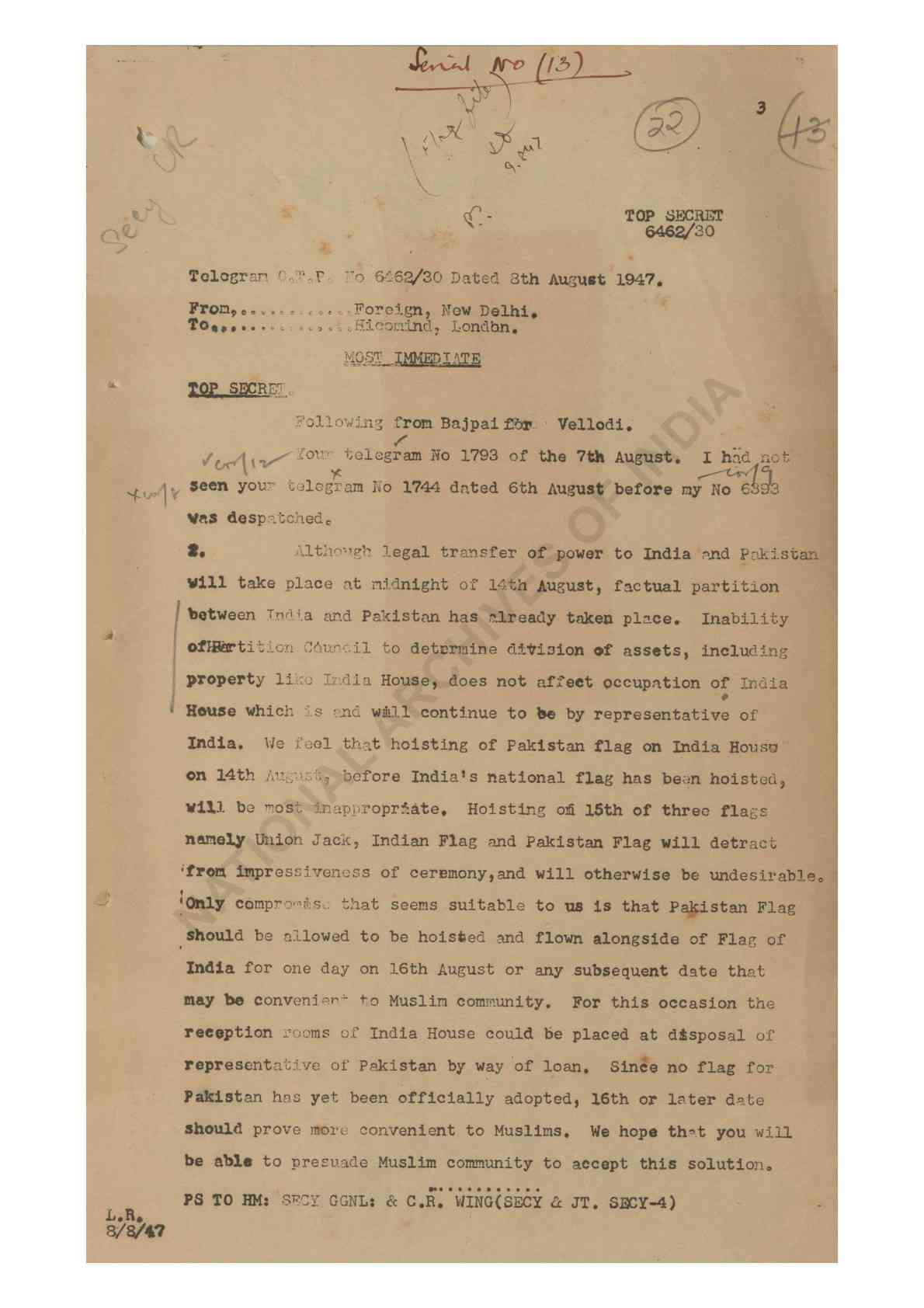
The same day, Girija Shankar Bajpai, the secretary general of the Ministry of External Affairs, also responded to Vellodi, confirming that since the Indian High Commissioner was already occupying the India House, the building would be retained as the mission of the Indian dominion after August 15. Hence, only the Indian flag along with the Union Jack could be flown from there.
Notwithstanding these assurances from New Delhi, Vellodi was not satisfied. Local representatives of the Muslim League had already approached him to demand the right to hoist the Pakistani flag at the India House on August 14, just as it was scheduled to be in Pakistan. Already irritated with the persistent lobbyists for the Indian princely states in London demanding independence for their own territories, the High Commissioner was losing his patience. To his relief, the Muslim League representatives did not mind the Indian flag being hoisted alongside the Pakistani one on August 15.
But Bajpai did not budge. He replied unambiguously on August 8, “Although legal transfer of power to India and Pakistan will take place at midnight of 14th August, factual partition between India and Pakistan has already taken place. Inability of the Partition Council to determine division of assets, including property like India House, does not affect occupation of India House which is and will continue to be representative of India.”
Flying the Pakistani flag alongside the Indian flag and the Union Jack, Bajpai maintained, would “detract from the impressiveness of the ceremony”. As a compromise, he suggested that the Pakistani flag could fly with the Indian flag on India House on August 16 or any other day deemed suitable by the Pakistani authorities. The Indian mission could loan them the building’s reception rooms for that purpose.
But the Pakistani authorities were already gearing up for their celebrations at India House on August 15. They had appointed a noted Muslim League politician, HI Rahimtoola, as the first High Commissioner of Pakistan to the UK, and were negotiating to acquire Clarence House as their future High Commission.
That was not to be. On August 15, the Indian flag was hoisted at India House, while the Pakistan flag was raised at the nearby Lancaster House, which was loaned to them by the UK government for a day. The records do not reveal what actually transpired in the week between August 8 and August 15 to untangle the complicated knot.
However, it could be speculated that since Rahimtoola was reported to be an old friend of Vellodi, amicable personal relations might have saved both the countries from an international embarrassment.
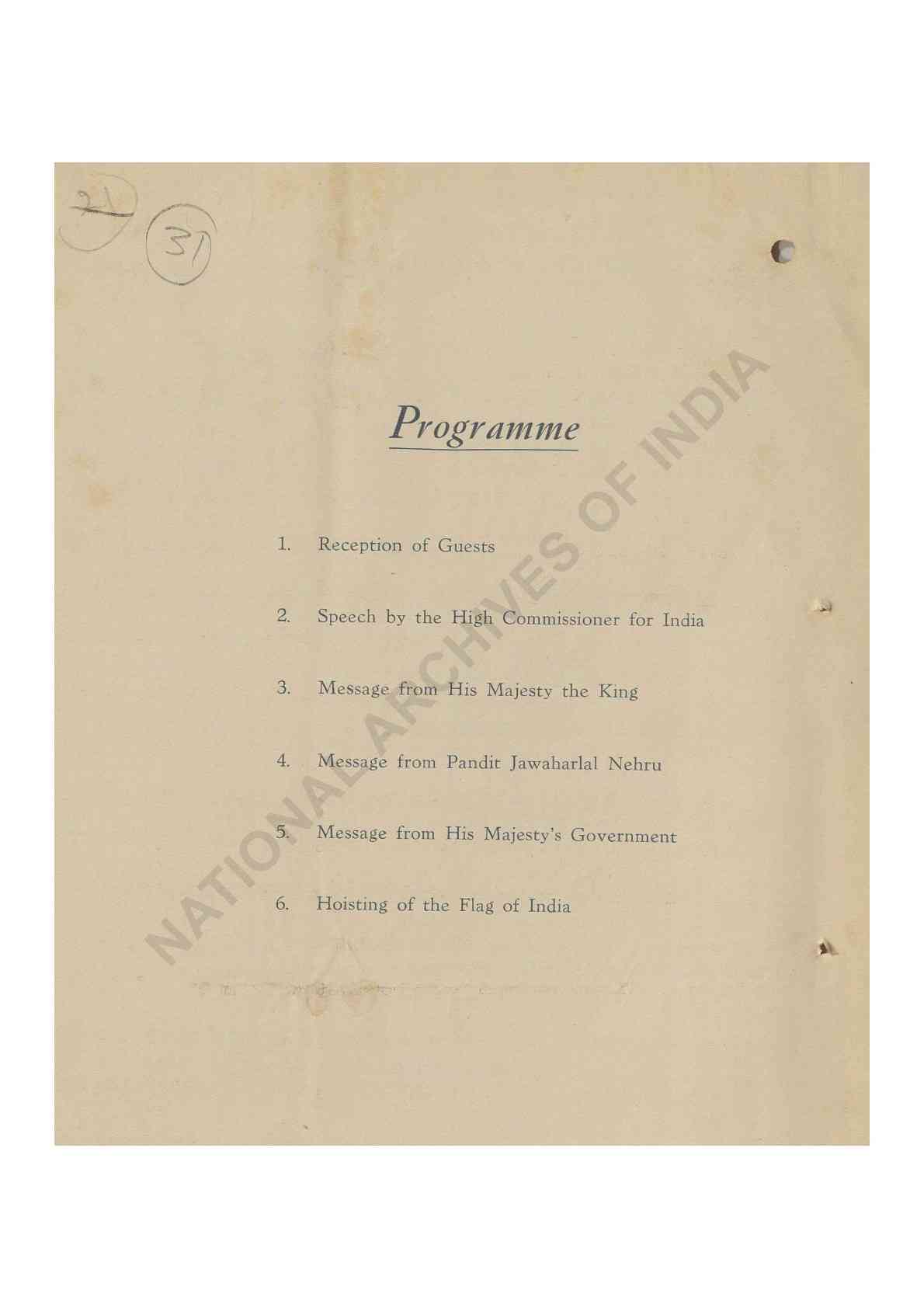
The Indian Independence Day celebrations at the India House on the morning of August 15, 1947, were joyous. Dignitaries filled the ceremonial hall, as a huge portrait of Mahatma Gandhi looked over them. They included the High Commissioner of Pakistan, and the Ambassadors for China, Brazil, and Turkey, along with the dean of the diplomatic corps of the UK and representatives of the British government.
Following an address by Vellodi, messages from the British king, Indian Prime Minister Jawaharlal Nehru and officials of the British government were read out. Due to the restricted entry, many Indians had to satisfy themselves by standing outside.
Held immediately after, the Pakistani celebrations were not as elaborately organised, possibly because they had a very short time to make the arrangements. But Rahimtoola was in a jubilant mood, as were the guests.
The celebrations by each country underscored the importance of friendship over political tussles. Rahimtoola attended India’s celebrations while Vellodi attended Pakistan’s. The show of unity between freshly-minted diasporic Indians and Pakistanis in the capital of the imperium was possibly due to their distance from the heated communal atmosphere in the subcontinent.
But the weeks leading up to August 15, 1947, in London highlight the strength of dialogue and negotiation, even through times of conflict and confusion.
Watch a video of the ceremony here.
Ananyo Chakraborty is a doctoral scholar of History at the Australian National University, working on an Environmental History of the Partition of India.
[ad_2]
Source link