
[ad_1]
Thirty lions and tigers that spent years in cramped concrete cages at a shuttered zoo in Argentina have begun a long journey to new homes at wildlife sanctuaries in South Africa and the United States.The big cats were moved into large transport crates on Friday as part of an international rescue operation led by Four Paws, an animal welfare organisation. According to news agency Assocaited Press, the operation is one of the largest relocations of captive big cats in the world.The animals are being rescued from the former Lujan Zoo, about 70 kilometres northwest of Buenos Aires. The zoo was shut down in 2020 after Argentine authorities raised concerns about safety and animal welfare. Since then, the future of the animals kept there had remained uncertain.“We are putting everything into making this go as smoothly as possible so we can celebrate that 30 lives have improved because of this effort,” said Luciana D’Abramo, programme director for Four Paws, as quoted by Associated Press.The transfer is the result of a longer effort to move the animals away from the conditions in which they had spent years. Four Paws first arrived at the site in 2023, when 112 big cats were still there. By the time the organisation was allowed to take over the site two years later, only 62 remained.
Big cats head to new sanctuaries
The 30 animals being moved will be divided between sanctuaries in South Africa and the US. Nine tigers and six lions will travel to Lionsrock, a Four Paws sanctuary in South Africa. The sanctuary is home to more than 80 big cats and has natural enclosures covering 60 hectares, or 148 acres.The remaining eight tigers and seven lions will travel to The Wild Animal Sanctuary in Colorado. The refuge is located on grasslands northeast of Denver and provides large habitats for rescued lions, tigers and other animals.The journeys will involve several stages. The cats travelling to Colorado will fly through Chile. Those heading to South Africa will travel to Johannesburg through either Frankfurt or Amsterdam. After reaching Johannesburg, they will have another four-hour journey by road to Lionsrock.
Nine tigers and six lions will travel to Lionsrock, a Four Paws sanctuary in South Africa.
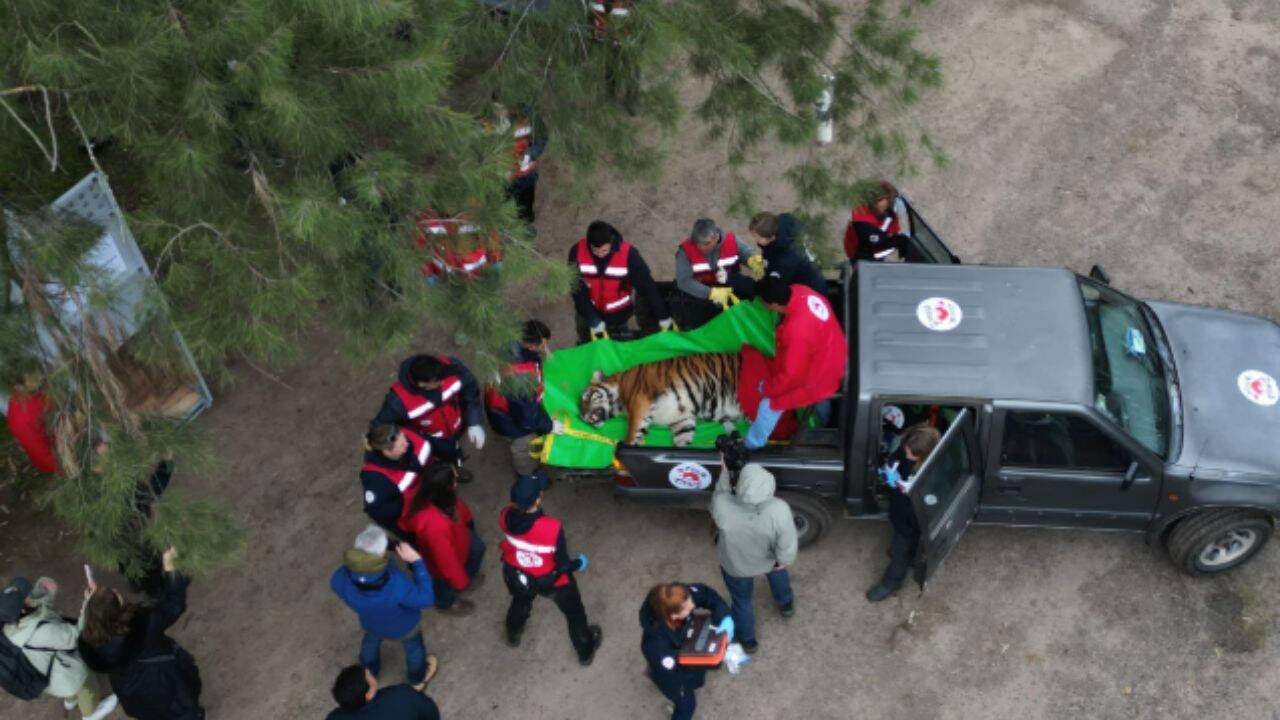
The transfer has required a lot of preparation. Four Paws handlers trained many of the lions and tigers to enter the transport crates voluntarily. This meant some animals could be moved without being forced into the crates.However, not every animal could be handled in the same way. Some of the big cats required sedation before they could be transferred safely. Two tigers were sedated on Friday and then carried by hand in canvas slings before being placed inside their transport crates.Photos from the operation showed the animals inside the large crates as Four Paws staff prepared them for the next stage of their journey. The cats were then loaded onto trucks before being taken for air transport.
Animal welfare concerns
The former Lujan Zoo had become known for allowing visitors to get unusually close to lions and tigers. Visitors were allowed to handle the animals and pose for photographs with them.Argentine authorities eventually shut the zoo in 2020 because of concerns over safety and animal welfare. At the time of its closure, about 200 big cats were living at the facility.When Four Paws arrived at the zoo in 2023 to look for a solution for the animals, the number had already dropped to 112. That number fell further before Four Paws was allowed to take over the site. By 2025, only 62 animals remained.The organisation found that some of the surviving animals had serious health problems. Some could barely walk because of obesity, muscle loss or poor nutrition. Others had dental and kidney disease. Some also had complications linked to declawing, while others had injuries that had not healed properly.D’Abramo said the number of animals that had been kept at the zoo was itself an indication of the conditions they had experienced. “That alone shows the level of overcrowding and the conditions in which these animals have endured.”After taking over the site, Four Paws also began working with the people who had been employed at the zoo. The organisation retrained longtime zoo employees in modern animal-welfare practices. It also started improving the diets and medical care provided to the remaining big cats. The changes were part of the wider effort to care for the animals while Four Paws looked for suitable long-term homes for them.More than 20 lions and tigers still remain at the former zoo. Four Paws is continuing to search for long-term homes for those animals.
[ad_2]
Source link