
[ad_1]
In January, Rushikesh Dhore visited a doctor in Maharashtra’s Akola district with a range of problems – insomnia, irritability, twitching and pain in his leg muscles.
But most striking for the 25-year-old was a feeling of “tremors” running through his legs.
The doctor was perplexed and advised Dhore, a resident of Goregaon village in Murtijapur, to visit a neurologist in Akola city, 50 km away.
Neurologist Dr Nitin Virwani immediately knew what the problem was. He had treated similar patients a few weeks before Dhore showed up.
As he had suspected, Dhore had recently started using a skin brightening cream he bought from a store in his village. “Within days of using the cream, I couldn’t sleep at night. Because I was awake all night, I became irritable. Then a burning sensation began in my legs,” he said.
Like him, a 30-year-old woman in Akola had started using a fairness cream on a friend’s recommendation in April. In the initial days, she felt her skin “considerably brighten and blemishes lighten”. “I even told a few other friends to use it. It is easily available in grocery stores,” she said, requesting anonymity.
In a few weeks, however, her face became dry and itchy. Then, a constant tingling sensation began in her feet.
When Virwani asked for a few blood tests, it turned out that her mercury serum level was 10 times the normal range.
Her blood also tested positive for CASPR 2 antibodies. Both tests are a sign that the body has been exposed to heavy metals, which leads to involuntary muscle twitching and leg pain, a symptom Virwani saw in both patients.
‘Over a 100 cases’
In Akola, Virwani has treated 40 such patients in the last year.
He is not the only doctor to do so. Indeed, neurologists across Maharashtra have been sharing stories of mercury poisoning in young people over the last year on a common WhatsApp group.
“In most cases, it is mercury poisoning caused by skin brightening creams,” said Dr Bhushan Joshi, a neurologist in Pune’s Manipal hospital. In some cases, he added, patients suffered nephrotoxicity, or kidney damage.
“I am a part of a group of neurologists from the state. Together, we have seen over 100 cases in the last few months,” he said.
The doctors also privately tested some samples of the creams and found high mercury levels in them.
In most cases, the fairness creams had no details about ingredients, manufacturer or the batch of production. The Maharashtra government has now begun a crackdown on stores and distributors stocking the creams, but there is very little information about how they were being sold in the first place.
Unlike drugs, selling cosmetic products needs no licence, although manufacturers need a licence to make them. This has posed the biggest challenge in this case, an official of the food and drug administration department told Scroll. “We can’t track the retailers, or the several rural grocery shops that stock these products and there are no licensed distributors. We are unable to pin down the distribution chain,” a Mumbai-based drug inspector said.
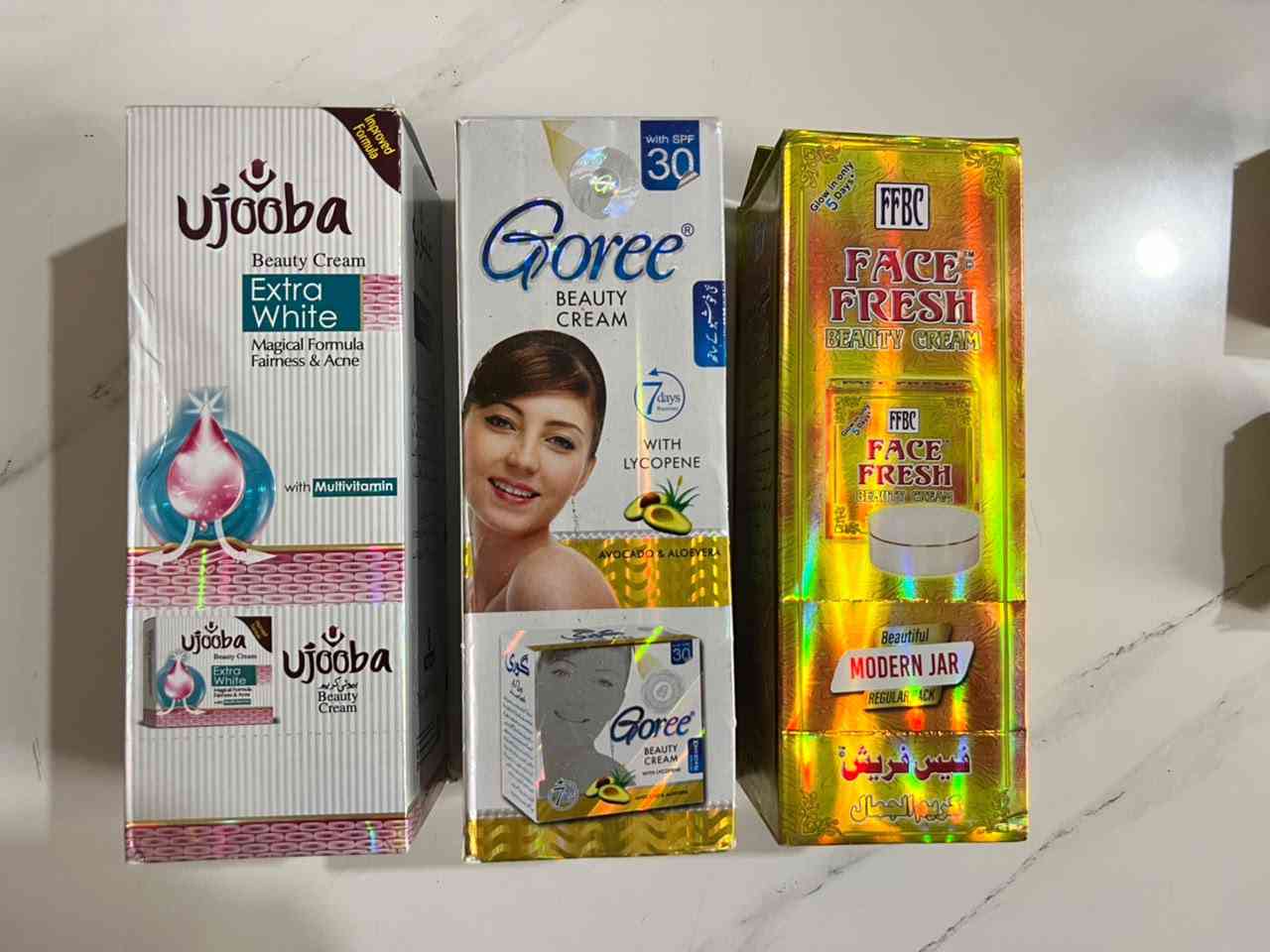
The cream that both Dhore and the 30-year-old used was purportedly made by Goree Cosmetics, a Pakistani brand. “But the packaging had no label or batch details which is why we suspect it could also be counterfeit,” said Ganesh Rokade, Maharashtra FDA’s joint commissioner for drugs.
Six first information reports have been filed under various provisions of the Drugs and Cosmetics Act, 1940, in Parbhani, Sambhajinagar, Nanded, Mumbai and Nashik against owners of grocery stores and cosmetic stores for selling such products and against unknown persons for manufacturing and distribution.
The primary charge is under Section 27 of the act, which provides three years of imprisonment for manufacture or sale of adulterated or unsafe cosmetics.
The Maharashtra FDA has issued an alert for three Pakistani brands – a cream, whitening body lotion and whitening soap manufactured by Goree Cosmetics, a beauty cream made by Golden Star Cosmetics, and a cream called Face Fresh Gold Plus made by Shaheen Cosmetics.
Scroll has emailed the three Pakistani manufacturers, asking for a response to the revelations. The story will be updated if they respond.
According to Viraj Paunikar, joint commissioner of drugs in Sambhajinagar, the products of Goree Cosmetics were tested and found to have high levels of mercury.
In one raid in Sambhajinagar, “the mercury level was found to be 18 to 40 times higher than the permissible level in the seized products”, said Rokade.
“We have requested the Maharashtra DGP to initiate an inquiry under the anti-terrorism squad,” said Rokade. “Some product labels mention ‘made in Pakistan’. We want to see if these not-of-standard-quality products are being forced into India or if they are domestically manufactured and distributed as part of some nexus.”
However, neurologists Scroll spoke to said they also came across domestic brands that had high levels of mercury. Drug officials told Scroll that the department has written to officials in Karnataka to investigate one manufacturer of cosmetics based on complaints about their skin brightening cream.
Surge in patients
Neurologist Dr Rahul Baviskar saw the first trickle of cases in his Nashik clinic about six months ago.
“Young patients between 20 and 40 years of age came in with similar symptoms – a burning sensation in their feet, pain in legs and thighs, and a rippling movement as if worms were crawling under their skin,” he said. Some patients complained of insomnia for a month.
“We could not correlate this with mercury initially,” he said. The breakthrough came when a patient told him that he observed these symptoms after he began to use a new skin brightening cream.
Mercury blocks the production of an enzyme called tyrosinase, which produces melanin that gives skin its dark colour. The metal is often illegally added to skin brightening cream for that reason. It is low-cost and gives rapid results compared to other skin brightening agents like niacinamide or kojic acid.
Under Drugs and Cosmetics Act, 1940, mercury is only permitted up to 1ppm in all cosmetics except for eye shadows where higher levels are permitted.
However, mercury can confuse the immune system and lead to higher production of antibodies. Baviskar said 17 patients he treated had signs that the presence of mercury had confused the immune system, and made it generate more anti-CASPR2 antibodies. This is called a CASPR2 antibody response in which healthy nerve cells are attacked causing twitching in muscles, memory loss and seizures.
“In other districts, my colleagues had sent samples of locally manufactured face cream for testing and found it had high levels of mercury,” Baviskar said.
In Sambhajinagar, neurologist Dr Anand Soni saw many patients with CASPR2 antibody response. Three of his patients developed kidney problems. In all cases, doctors said patients recovered after being administered steroids. “Since the exposure was short term, once the cream is stopped, the symptoms eventually reduce,” said Soni.
Satish Sinha, associate director at Toxic Link, a non profit that works on toxicity and waste related issues, said their organisation has been flagging the issue of high levels of mercury in beauty creams for several years. “In our two previous reports, we found high mercury content in cosmetics. The regulation needs to be stronger. In our tests, several products imported from Pakistan and Thailand had mercury beyond permissible limits,” Sinha said.
The supply chain
Since March, the Maharashtra food and drug administration has raided stores selling the creams and seized stock worth over Rs 70 lakh.
On March 29, police in Sambhajinagar and officials of the food and drug administration department raided three stores and seized products of Goree Cosmetics. “The owners of the store could only tell us that they purchased the cream from Crawford market in Mumbai. They had no bills or purchase order,” Paunikar said.
The problem in all the cases, Paunikar said, is in establishing the supply chain. “The shopkeepers have not been able to lead us to those who supply the products or the distributor,” he said. “We have asked the police to investigate further. We don’t know if an import license has been approved for this product.”
Paunikar said since cosmetics can be sold without a licence, it makes it easy for counterfeit products or illegal products to enter the market. Manufacturers of cosmetics are monitored through regular inspections. “But if there are illegal manufacturers, finding them is not easy,” Paunikar pointed.
[ad_2]
Source link