
[ad_1]
The yolk does not fall cleanly.
It has to be guided into the syrup.
Too slow, and it thickens before it reaches the surface.
Too fast, and it breaks.
For a moment, the threads hold. Then they begin to disappear into themselves.
This is how Thoufeek Zakriya remembers it.
Not as a historian of this kitchen but as someone who stood close enough to learn it.
Thoufeek grew up in Kochi’s Mattancherry, near Jew Town, in the orbit of the Paradesi synagogue and the last Jewish households still living there.
When he wrote to me, it was not as a historian, but from memory.
Thoufeek called it what was in his house. Muttamala, an egg garland.
It wasn’t familiar to me, but I was fascinated by both the man and the dish: a golden egg-yolk dessert.
He did not describe this dish as Portuguese. He did not describe it as Iberian.
And yet, the dish belongs to a wider family of egg-thread confections that can be traced across the early modern routes of the imperial Portuguese world.
In Portugal, the technique is still known as fios de ovos – egg yolks drawn into fine strands and set in hot sugar syrup.
Like its more famous cousin, pastel di nata, it emerged within Portuguese convent kitchens, where egg whites were used for starching laundry and textile finishing, leaving a surplus of yolks to be transformed into sweets.
The historical record of egg threads points instead to a distributed conventual system across Portugal, in which egg-based sweets were developed, guarded, and transmitted across multiple religious houses.
What emerges is not a single point of origin, but a network that follows the trade routes of empire:
A shared technical repertoire shaped by abundant eggs, access to sugar, and disciplined craft.
From the sixteenth century, this technique travelled wherever the Portuguese extended their reach.
The method is repeated, but never identically.
At first glance, this kind of repetition can look like the cycles of modern food culture, where dishes appear, disappear, and return under new names. But the resemblance is superficial.
In those cases, repetition is driven by visibility – by media, fashion, and rediscovery. Here, it is sustained by practice and belonging. The technique persists not because it is revisited, but because it continues to be made and adopted for use by a different community, for its own traditions and special uses.
I wrote here last January about the history of the pastel di nata and how its special braided architecture appears in Asia today, and is still part of the Jewish Malabari cuisine.
Egg threads follow a similar route.
In Spain they are known as huevo hilado. In Brazil as fios de ovos. In Japan as keiran sōmen.
In Thailand as foi thong. In Malaysia as jala mas.
Sugar did not need to travel to Asia. It was already there, its name rooted in the Sanskrit śarkarā.
What travelled instead was method – egg yolk and syrup brought together in a controlled form.
On the Malabar coast it is known as muttamala. In Kerala, a mala is a garland, a chain of verses strung together.
The word holds at the level of sensation as well as form. Once finished, the strands resemble a marigold garland – soft, bright, and loosely gathered. Thoufeek describes them as a “thread-like delight,” slightly eggy, best eaten as they cool, before they settle into themselves.
And in the Paradesi Jewish community of Cochin it is known as motta salada.
Thoufeek recalled: “My grandmother used to make it here… Cochin Jewish and Muslim communities made it specially for the groom, during wedding banquets.”
And so the thread returns to Kochi – more precisely, to Jew Town – and to Thoufeek, the author of the message that began it.
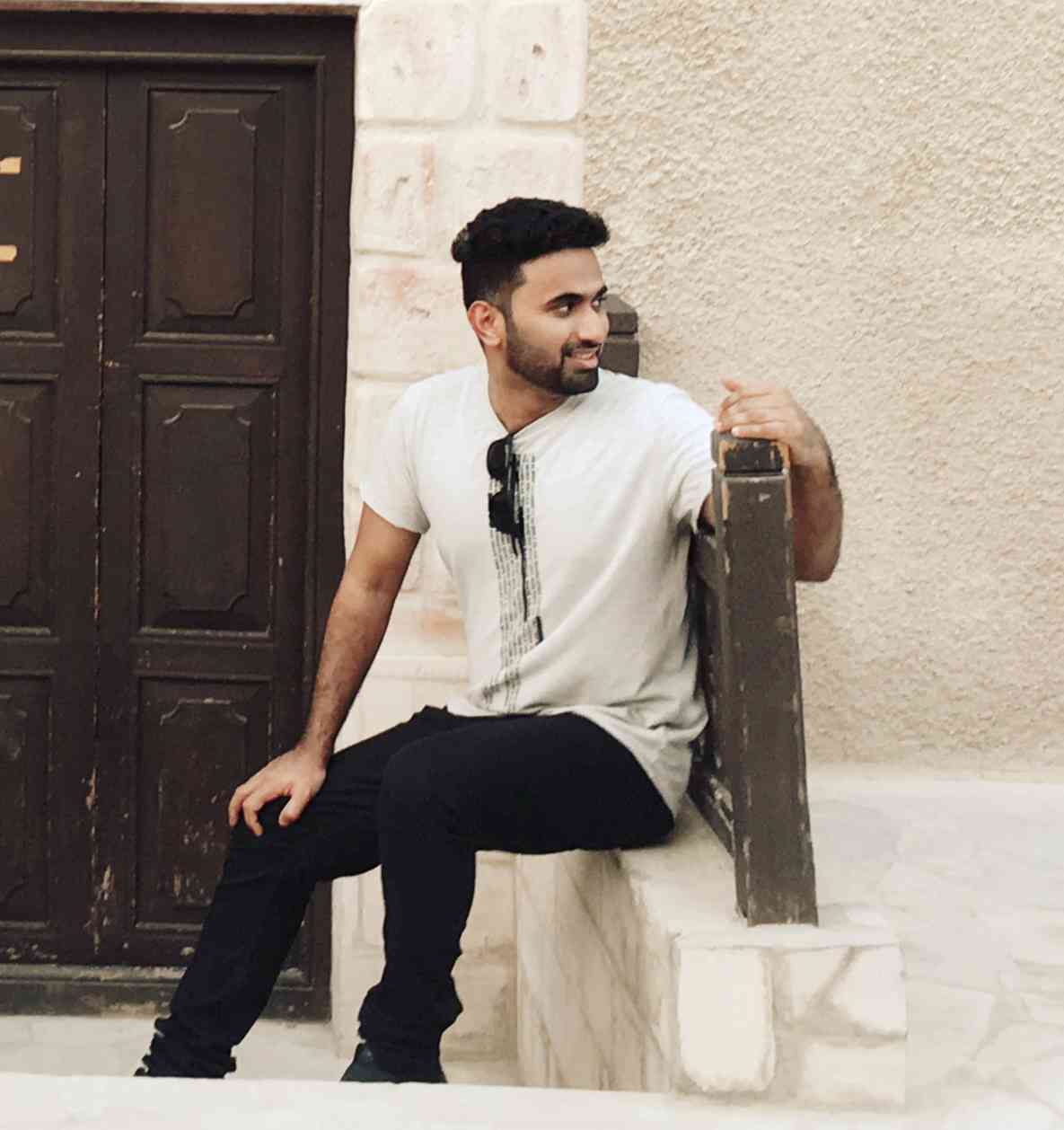
Thoufeek, now a sous chef with Taj Dubai, grew up in the orbit of the Paradesi synagogue and the last Paradesi Jewish households of Mattancherry.
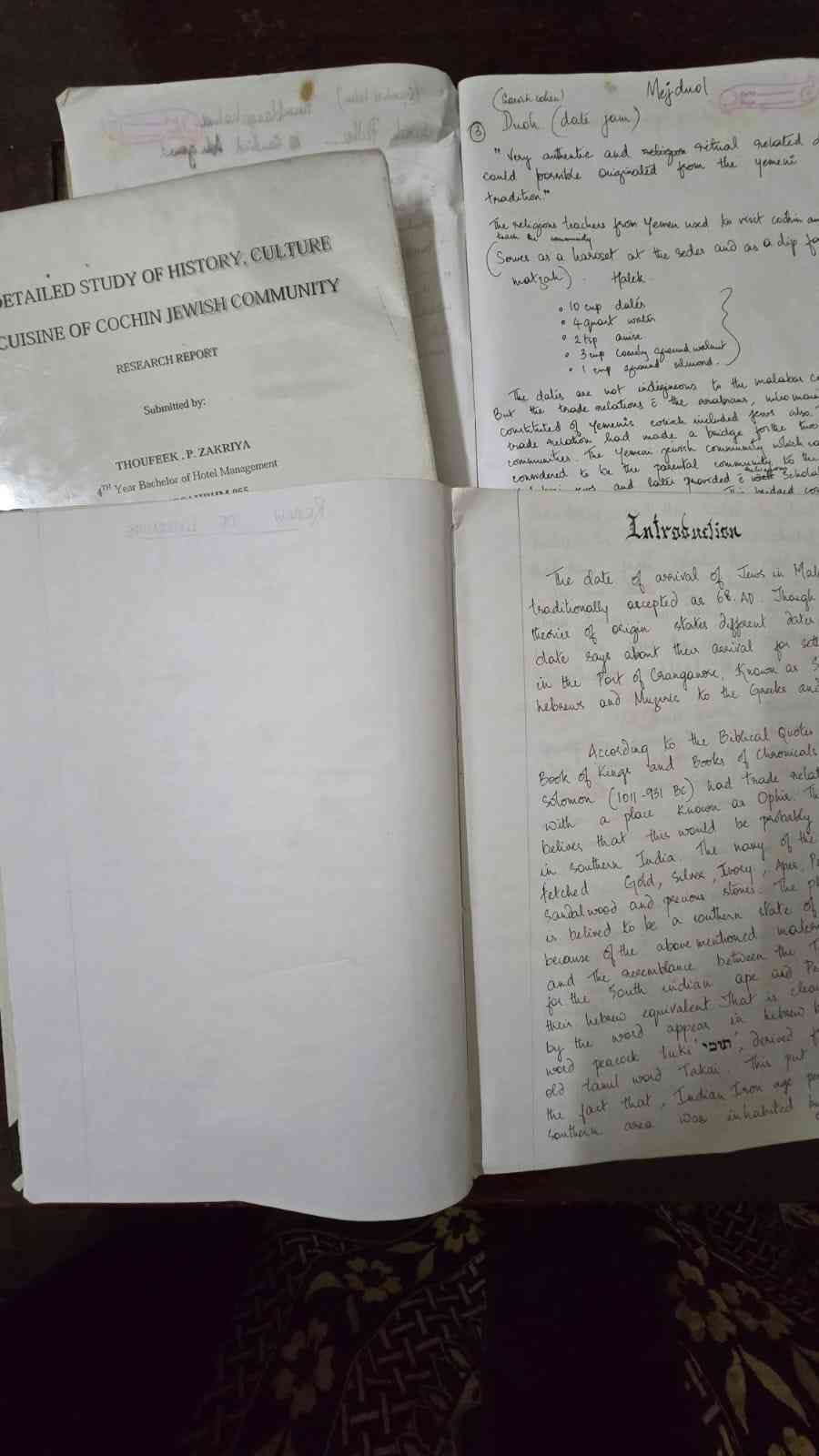
He has since collected many of the handwritten recipes that survive, even as the community itself has moved away – or passed on.
Thoufeek’s path to muttamala does not follow the usual lines of transmission in Jewish tradition, father to son, mother to daughter.
Thoufeek is Muslim. He taught himself Hebrew as a teenager – copying letters late into the night – first from a Gideon’s Bible, later from a prayer book bought on the street.
As a child, he asked his father to take him to the synagogue in Jew Town, before he could read what was written inside it.
He remembers the moment precisely: the yellow streetlights, the closed gate, and the man who opened it for him.
Years later, standing in that same synagogue, someone asked him: “Are you Jewish?”
“No. I am a Muslim.”
“Then how do you read Hebrew?”
“I learned it myself.”
What followed was not formal training, but practice. He worked with members of the Cochin Jewish community, reading Hebrew inscriptions, documenting fragments of memory, handwritten recipes, and helping preserve material that was already becoming difficult to access.
He grew up near Sarah Cohen of Mattancherry, one of the last visible members of Cochin’s Jewish community, whose home and small embroidery shop became, in her final years, a living trace of a world already disappearing.
He called her Sarah Auntie. The relationship is understood before it is defined. What he describes is not inheritance in the usual sense. It is proximity and trust.
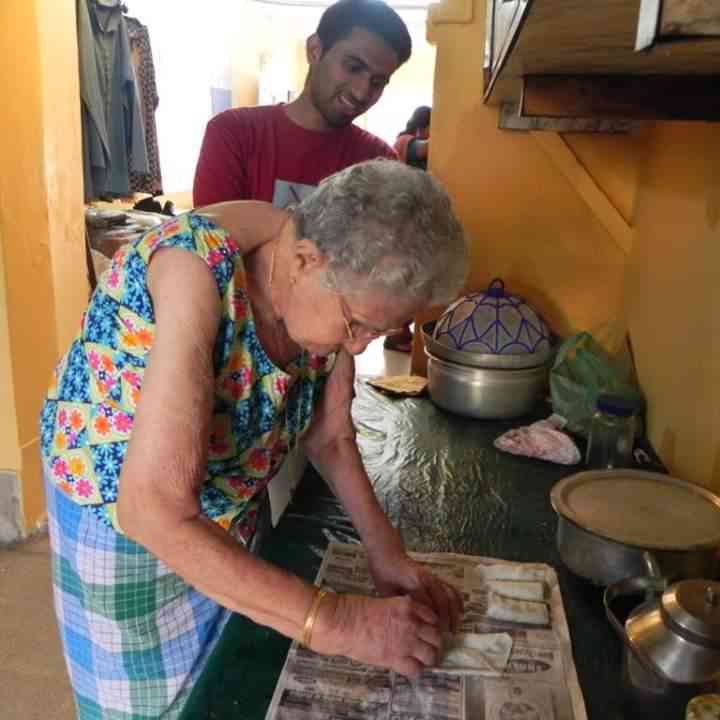
When Thoufeek speaks about this dish, he does not speak as a historian of empire. He speaks from within that proximity.
For him, the dish belongs to the shared world of Jew Town – Muslim and Jewish kitchens in contact, not separated by theory but connected through practice.
That perspective shifts the frame.
In Jew Town, the dish was not everyday food. It belonged to weddings and often to the groom. It was prepared by the most experienced women within the household or those known for their skill. Thoufeek recalls it as a craft led by the eldest women of the community.
It was admired as much for its appearance as for its taste, arranged at the center of the table. It was also remembered in scale: weddings were measured in eggs – hundreds, sometimes more – marking the status of the event.
The detail survives in memory with a kind of pride, and occasionally with humor. “I used three eggs when I was learning,” one woman told him, laughing.
My earlier accounts of Cochin’s Jewish life describe the Paradesi and Malabari communities as distinct. separated by origin, and at times by colour. From that vantage point, I would have expected their kitchens to remain separate.
To be sure, the distinctions that defined Cochin’s Jewish society – Paradesi, Malabari, meshuchrarim (freed slaves) – do not disappear.
They persist in language, in memory, in how communities described themselves and each other, each claiming dominance.
The kitchen crosses them without friction.
What still survives of that world is entrusted – not preserved within the community alone, but carried forward by someone outside it.
Egg-thread sweets are not Jewish in origin.
Like many dishes, this one entered a Jewish kitchen through centuries of coexistence in Cochin, acquired a special name, and was absorbed as if it had always belonged there.
On the Malabar coast, muttamala is still made in Muslim kitchens. Egg yolks are streamed into hot sugar syrup, forming fine strands that are gathered into coils. It is typically served alongside a second preparation made from egg whites, most commonly pinjanathappam, a steamed pudding.
Together, the two form a system that uses the entire egg.
Across communities, this pairing appears under different names.
In the accounts Thoufeek gathered, the egg-white preparation appears under different names: pinjanathappam in Muslim kitchens, kinnathappam in Cochini Jewish memory. The distinction is linguistic – kinnam in Malayalam refers to a bowl, pinjanam to a shallower dish – but the structure is the same: the egg is divided, then recomposed at the moment of serving.
What travels here is not a recipe, but a division of the egg: yolk and white, ornament and base, each assigned a role. This division reflects local conditions.
In Kerala, starch was already drawn from rice rather than wheat.
Within that environment, egg whites – less suited to the thread technique – could be absorbed into a different preparation, combined with existing methods of steaming and setting.
The result is not a replication of Iberian sweets, but a reorganisation of available materials into a coherent local system.
The Malayalam name – muttamala, “egg garland” or “egg necklace” – is descriptive rather than borrowed.
Within Cochin Jewish sources, a related preparation appears under another name: motta salada. It is described as a ceremonial dish of egg-yolk strands served at weddings and communal occasions, and explicitly noted as similar to muttamala.
The differences are small but precise. Muslim preparations favour cardamom in the syrup; Cochin Jewish memory recalls rosewater, and later, in Israel, vanilla. The structure does not change. Only the accent does.
At this point, the name itself becomes part of the story.
In colonial Kerala, foreign words rarely survived intact. They bent, shifted, and settled into local speech.
Other Portuguese terms were absorbed and reshaped with a local twang – baptismo becoming bouthees, comendador becoming gumentha. The term motta salada does not resemble the Portuguese fios de ovos.
But it sits closer, perhaps, to another Iberian form, huevo hilado, heard, adapted, and re-spoken across languages that did not share the same sounds.
This is not direct transmission.
It is what happens when a word travels with a dish – altered in the mouth, and settled in the ear.
Crucially, this memory is tied to Mattancherry. Not to all Cochin Jewish kitchens. Not to Chendamangalam, where the Portuguese pastel was served. But to the world of Jew Town. This was the same world Thoufeek knew and grew up with.
What survives of the dish in Jewish memory is not only form, but occasion. Motta salada appeared twice within the wedding cycle, each time marking a different moment of transition.
The first preparation belonged to the groom’s family, on the evening before he went to the synagogue.
This moment was known as manavalan erakkalu – the groom’s departure.
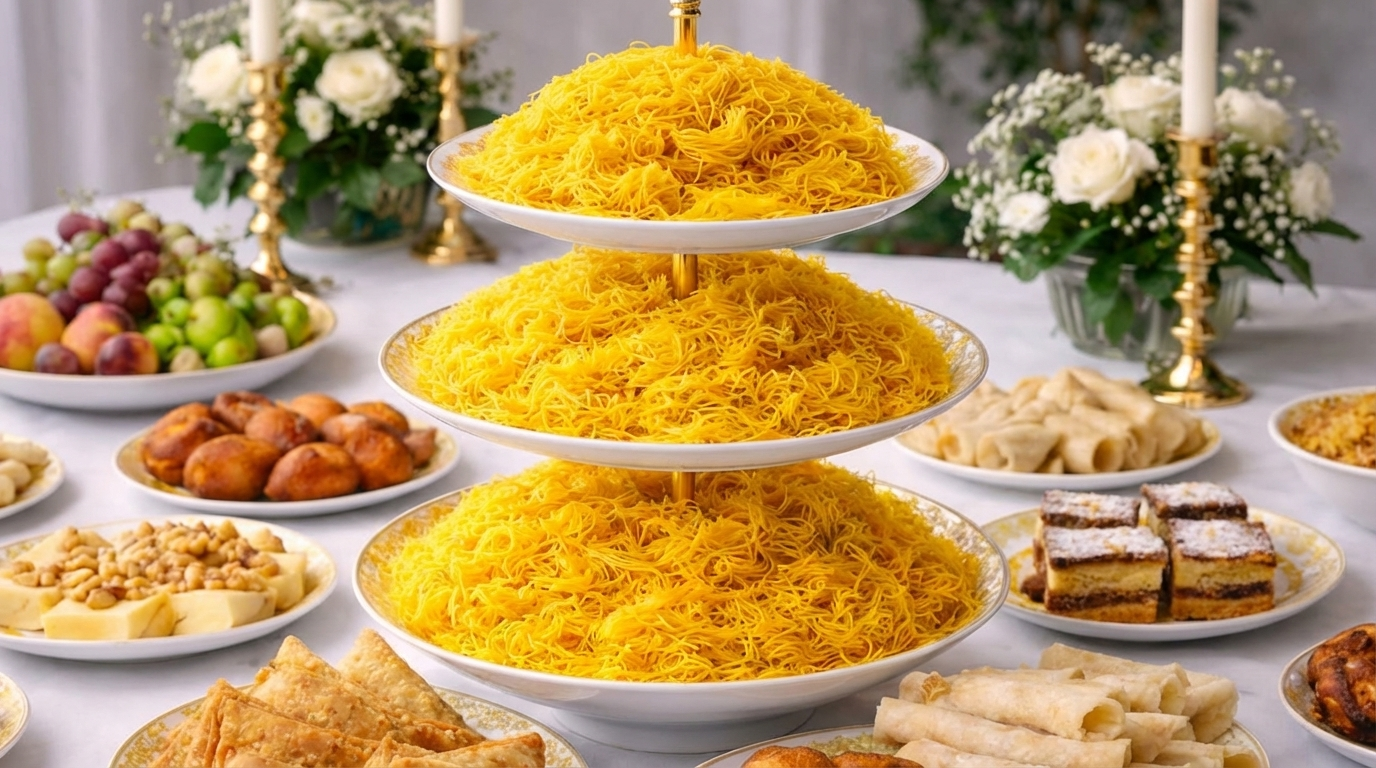
The dish stood at the center of the table, arranged on a three-tiered motta salada thattu, surrounded by bananas and small snacks.
The women gathered with handwritten notebooks – Malayalam transcriptions of Jewish songs – and sang blessings over the groom.
“Vazhvu vanna vazhvu ninakkayirikka.”
(May the blessed life be yours.)
The second preparation belonged to the bride’s side. It was made on the first Shabbat after the wedding, known as erakkana shabbath the shabbat of departure.
Here the dish appeared again, this time on the bride’s side.
Surviving in fragments
In Cochini Malabari Jewish cuisine derived from other localities, the dish does not appear. What was once made in Mattancherry did not travel evenly.
In Muslim kitchens, the dish continues in practice. In Jewish memory, it survives in fragments.
This difference points to something deeper: the presence – or absence – of a structure that allows repetition to continue.
In other contexts, Cochini Jewish life was sustained through networks that extended beyond Kerala: rabbinic authority in Baghdad and later London, printed books from Livorno, and shared systems of law, language, and ritual.
These were not abstract ties. They formed a framework within which practices could be maintained, adapted, and transmitted. Where such structures hold, continuity is possible. Where they weaken, transmission becomes uneven, and the thread breaks.
The egg garland appears to belong to that second category.
It survives – but not everywhere it once did.
The broader historical environment helps explain how this could happen.
The Malabar coast was never a single culinary system. It was shaped by centuries of trade, migration, and coexistence: Arab merchants, Persian influences, local Hindu and Christian traditions, and later European powers all contributed to a shared but differentiated food culture between the communities that formed in that ecosystem.
In such a setting, techniques moved easily. They passed through kitchens, through labour, through proximity. They did not require formal transmission. They required repetition and continuity.
This is where Thoufeek’s role becomes central again.
Thoufeek’s vast knowledge does not come from a single source. It was gathered –patiently – from the women who still remembered.
He has spoken with the elderly women he grew up among, many now living in Israel. They remember the weddings. They remember the dishes:
The late Sarah Cohen, Venus Lane, Matilda Davidson, Rachel Roby, Sandra Twig.
Not as a formal archive, but as fragments – recipes recalled, gestures repeated, corrections made in passing.
Sarah Cohen was among the last visible custodians of that world – keeping its practices in use, and its memory close at hand. She left no book behind. What she held remained in notebooks, and in the work of her hands.
Thoufeek is not preserving a single tradition, but working across the boundaries that once separated them.
Practice does not always follow identity. His work does not restore a lost past. It keeps fragments legible.
The egg garland shows how a technique can remain visible even after the community that once held it no longer fully does.
It was a dish meant to be seen first. Thoufeek recalls it arranged on a three-tiered motta salada thattu, placed at the centre of the table Thoufeek- a deliberately spectacular display. Sometimes served in small portions, even cups, it circulated among guests -but only after it had been admired.
In Muslim kitchens, the dish continues in practice. Among the Paradesi Jews, it survives mostly in memory Thoufeek held by those who still remember how it was made, and when.
The threads do not hold for long. They settle. They gather. They lose their shape.
What remains is not the strand, but the knowledge of how to make it.
This article first appeared on Beyond Babylon: Jewish Food Stories from Southeast Asia.
[ad_2]
Source link